
What to expect in a Hypnosis Session
You have an appointment, or you are hesitating about making one. And you probably have questions that nobody dares to ask out loud.
Will I have to lie down. Do I keep my shoes on. Am I going to cry in front of someone I don't know. Can I stop if I don't like it. And what if I actually fall asleep.
This page answers all of that, in the order it happens.


How long a session lasts
The first one lasts between an hour and an hour and a half. Most of that time is not hypnosis: it is the conversation beforehand.
The following ones last between 45 minutes and an hour. How many you will need is another question, covered on our page how many hypnosis sessions do you need.
The length varies with the subject. For sleep or your relationship with food, many things come into play — pace of life, stress, family habits — and the conversation naturally takes longer.
With a child, allow less: 30 to 45 minutes for the hypnosis part. See our page on hypnosis for children.
Before: what to plan
Nothing in particular. No fasting, no exercise the day before, no required preparation. Three things still help.
Think about what you are coming for. Not a perfect wording: simply knowing what bothers you and, if possible, what you would like in its place. Many people know very well what they no longer want and have no idea what they want instead. That is normal, and it is precisely part of the work of the first conversation.
Write down your questions and your fears. Including the ones that seem silly. They are not, and they are easier to ask written down than remembered on the spot.
Keep a quiet moment afterwards. Avoid squeezing the session between two meetings. Half an hour's margin is often enough.
On the practical side: dress comfortably, go to the toilet beforehand, and mention it if you feel the cold easily, since body temperature drops a little in a relaxed state. You take nothing off; you stay dressed from start to finish.
During: what actually happens
The conversation, which matters more than people think
It starts with talking. At some length in the first session.
The practitioner tries to understand your situation, but also to pick up your own words: the images that speak to you, your pace, the way you describe things. That is what later lets them guide you in a language that suits you rather than with a standard script. This moment also serves to define a concrete goal and to anticipate what might get in the way.
This is when you ask your questions. All of them. And you can say what you do not want to go into: nobody will make you tell anything.
The induction
The practitioner gradually guides you into the hypnotic state, through voice, breathing, images. You sit in an armchair or lie down, as you prefer, usually with your eyes closed.
Nothing like the finger-click of the stage show. The gradual descent is part of the experience, and it is often the part people like best. To find out what that state is, and what it is not, see our page what is therapeutic hypnosis.
The work itself
Once the state is established, the practitioner uses the tools suited to your goal: suggestions, guided imagery, metaphors, sometimes techniques drawn from NLP. You may also talk out loud during this phase, and you remember it afterwards. The approach varies by practitioner: our page which type of hypnosis to choose presents the main ones.
You stay aware. You hear the traffic outside, a noise in the corridor, the practitioner's voice. You are not asleep, you are not somewhere else. The fairest comparison is the moment just before falling asleep, or the film that absorbs you so much you lose track of time.
Coming back
The practitioner tells you the session is ending, sometimes with a countdown, and you open your eyes at your own pace.
A time follows to talk about what you experienced. Some practitioners deliberately keep it short, not out of lack of interest but because analysing everything straight away can undo what has just been put in place. If you need to talk about it more, say so: it is your session.
Video available in French

Video transcript
Bonjour, Comment se déroule une séance d’hypnose thérapeutique ? Une séance avec un hypnothérapeute de notre équipe dure environ une heure, parfois un peu plus longtemps pour la 1ère séance. Nous allons d’abord parler longuement pour faire connaissance, créer une relation de confiance, que nous comprenions votre situation et votre objectif, car il est important pour votre hypnothérapeute de bien vous connaître pour pouvoir choisir les bons mots.
Nous avons besoin de comprendre votre univers mental, et construire sur mesure votre « voyage hypnotique ». Par exemple nous allons peut-être vous amener vers un lieu où vous vous sentez particulièrement bien : la mer, la forêt, la campagne… Et vous avez aussi besoin de vous sentir en confiance avec votre hypnothérapeute afin de pouvoir lâcher-prise en vous sentant en toute sécurité. C’est le moment où vous pouvez poser toutes les questions que vous avez sur l’hypnose.
Puis nous passons à la phase hypnose de la séance avec 3 étapes : 1. D’abord ce qu’on appelle l’induction, où nous vous accompagnons vers l’état d’hypnose à votre rythme. Le plus agréable pour le client est en général une détente progressive, physique et mentale. Cela n’a rien à voir avec l’hypnose de spectacle où la personne est mise en état d’hypnose en un claquement de doigts. Nous pouvons le faire mais ne le faisons pas car cette détente progressive, ce lâcher-prise, font vraiment partie intégrante de l’expérience.
Et c’est tellement agréable ! 2. Puis c’est le travail thérapeutique. Une fois que vous êtes bien avancé en état d’hypnose, nous passons à la phase de travail thérapeutique. Et là c’est nous qui utilisons nos techniques, nos métaphores, nos suggestions. Parfois aussi nous discutons sous hypnose, et vous vous en souvenez ensuite. L’état de transe hypnotique ressemble à l’endormissement, sauf que vous ne dormez pas, vous pouvez même être attentif à ce qui se passe, ou non.
3. Enfin, nous vous prévenons que la séance est en train de s’achever, parfois nous faisons un décompte et à votre rythme, vous rouvrez les yeux… La fin de séance peut ensuite être assez rapide. Nous discutons de ce que vous avez vécu, vos sensations mais à partir du moment où tout va bien pour vous, nous préférons en général ne pas trop rentrer dans les détails pour laisser les graines que nous venons de planter pousser calmement…
Voilà, j’espère que cela vous aura préparé à votre prochaine séance, sachant que chaque hypnothérapeute a son style. Le mieux est encore d’essayer… L’équipe d’hypnothérapeutes de Solutions Hypnose est là pour vous accompagner. En présentiel près de chez vous ou par vidéo, cela fonctionne aussi très bien. Prenez rendez-vous dès maintenant pour créer la vie que vous souhaitez grâce à l’hypnose !
Hypnotherapy is a complementary form of support and does not replace medical advice, diagnosis, or treatment. If you have any concerns about your health, please consult a physician first.
The questions nobody dares to ask
Can I stop partway through? Yes, at any moment, without having to justify yourself. Just open your eyes or say so. You are never stuck.
What if I cry? It happens, it is common, and there are tissues on the table for that reason. Nobody will find it awkward, and it is not a failure.
What if I really fall asleep? That happens too, especially when you are exhausted. It does not matter. The practitioner brings you back, or leaves you a few minutes if it does you good.
What if I need the toilet? You go. We pick up again afterwards.
What if I cannot visualise? That is more common than people think. The work can go through sensations, sounds or words. Say so, and the practitioner will adjust.
What if I feel nothing? Many people come out of their first session thinking it did not work, because they were expecting something spectacular. It is almost always a matter of expectations set wrongly. We explain it in detail on our page am I hypnotizable.
Will I say things I regret? No. You stay in control of what you say, and hypnosis is not a truth serum.
What if a strong emotion comes up? It can happen, and it is one of the reasons to do this with a professional rather than an app. The practitioner is there to accompany you at that moment.
After: what you may feel
This is the part least documented elsewhere, and the one people call us back about.
In the hour that follows, many people describe a marked sense of relaxation, sometimes a slight floating feeling. Only get back behind the wheel once you feel fully present, as after a nap.
In the following days, it is not unusual to feel a little more tired than usual, or to find emotions coming up. That is not a bad sign. If it is uncomfortable, tell your practitioner rather than waiting for the next session.
And sometimes nothing happens at the time, then something shifts two weeks later. That is common and cannot be ordered.
You almost always leave with a short exercise to practise at home, often a breathing exercise or self-hypnosis. It is a good part of what moves things forward between appointments.
The following sessions
The format stays the same, only faster.
The conversation is shorter: what has happened since, what have you noticed, where are you. The induction is usually quicker too, because you know the way. Some regulars sit down, close their eyes and announce that they are ready — and they are already halfway there.
Then the work, then the return.
And by video?
The process is identical. What you need in addition: a quiet place where nobody will come in, a stable connection, headphones if possible, and a comfortable armchair or bed.
A small advantage rarely mentioned: you are at home, in your own surroundings, which many people find makes letting go easier. And there is no journey to make afterwards. Our page on video consultations covers the rest.
Every practitioner has their own style
What precedes describes a common thread, not a protocol.
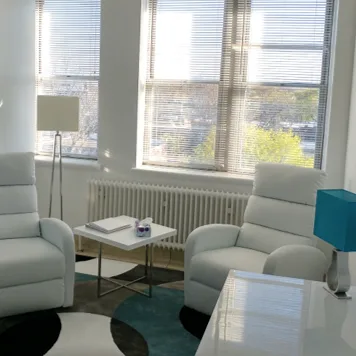
Some talk a lot, others little. Some record part of the session so you can listen to it again. Some work mainly in images, others in sensations. Some offer an armchair, others a table.
If you do not click with a practitioner, that is not a verdict on hypnosis. The relationship matters a great deal in this work, and it is perfectly legitimate to try another.
Book an appointment
Wherever you are in the world, video consultation follows exactly this process: the same conversation, the same induction, the same return, from home and with no journey or waiting room. We see people this way from France, Quebec, Morocco and well beyond. For a first session, simply plan a quiet place and an hour and a half ahead of you. Here is how it works. Still have a question this page has not covered? Write to us: we will answer before you book.
Where would you like to consult?
All areas
 Annie Mayrand
Gatineau - Cumberland (ON)
👤
🧑🎓
🚭
❤️
💻
Annie Mayrand
Gatineau - Cumberland (ON)
👤
🧑🎓
🚭
❤️
💻
 Christian Rocher
Beloeil
👤
🧑🎓
👶
🚭
❤️
💻
Christian Rocher
Beloeil
👤
🧑🎓
👶
🚭
❤️
💻
 David Veilleux
Montréal - Anjou
👤
🧑🎓
🚭
❤️
🤰
💻
David Veilleux
Montréal - Anjou
👤
🧑🎓
🚭
❤️
🤰
💻
 Florence Aton
Sutton
👤
🚭
❤️
💻
Florence Aton
Sutton
👤
🚭
❤️
💻
 Jessica Reid
Sherbrooke
👤
🚭
💻
Jessica Reid
Sherbrooke
👤
🚭
💻
 Julie Rocque
Montréal - Jean-Talon
👤
🧑🎓
👶
🚭
❤️
🤰
💻
Julie Rocque
Montréal - Jean-Talon
👤
🧑🎓
👶
🚭
❤️
🤰
💻
 Nuria Pérez de León
Montréal - Rosemont - Saint-Lambert
👤
🧑🎓
💻
Nuria Pérez de León
Montréal - Rosemont - Saint-Lambert
👤
🧑🎓
💻
 Romain Rastoin
Bromont
👤
🧑🎓
🚭
❤️
💻
Romain Rastoin
Bromont
👤
🧑🎓
🚭
❤️
💻
 Réjeanne LeBlanc
La Prairie
👤
🧑🎓
👶
💻
Réjeanne LeBlanc
La Prairie
👤
🧑🎓
👶
💻


Hypnosis as practised by the members of Solutions Hypnose is a complementary support approach. It is neither a medical act, nor a diagnosis, nor psychotherapy in the regulatory sense, and it in no way replaces a consultation, follow-up or treatment prescribed by a health professional.
Our practitioners do not assess and do not treat mental disorders or illnesses. They never ask for an ongoing treatment to be stopped or changed: that decision rests exclusively with your doctor.
No result can be guaranteed. The testimonials and examples presented on this page describe individual experiences and do not predict what you will experience.
In case of significant distress, unexplained physical symptoms or suicidal thoughts, contact a doctor, emergency services or a helpline without delay.

Page written by Patricia Jouannet
hypnotherapist and NLP coach
partner at Solutions Hypnose.
English version reviewed by David Veilleux
Updated .