
Hypnosis for Fear of Flying (Aviophobia)
The tickets have been booked since March. It's June, and you think about it every day.
You've read the statistics. It changes nothing, and that's precisely the problem: the part of you that knows has no authority over the part of you that reacts. So you start calculating. The train would take longer but it's possible. You could have people come to you. You could postpone.
And there's what nobody sees: the weeks beforehand, long before the airport. This page starts from one question that changes everything else: what exactly are you afraid of?
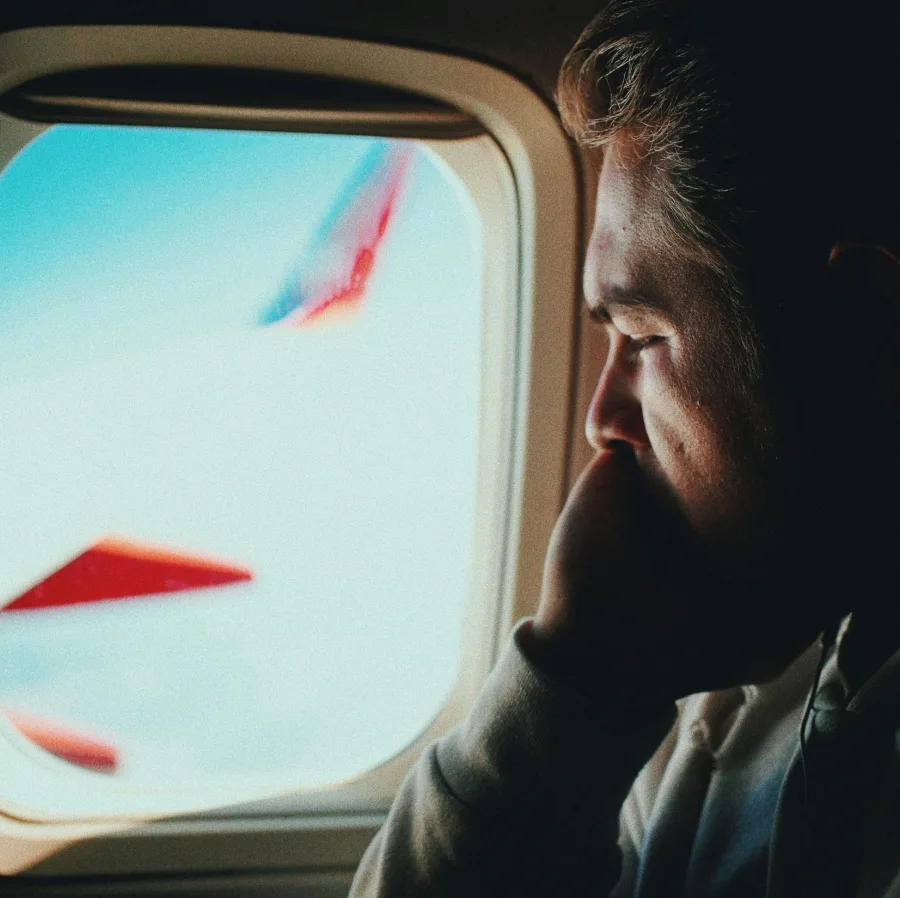
Video available in French

What exactly are you afraid of?
It's the first question a practitioner will ask you, because the answer determines all the work that follows. Very different fears hide behind the same word.
That the plane will fall. Fear of the crash, fed by images in the media and by the unexplained noises of a flight.
Not being able to get out. The enclosed space, the tight rows, the impossibility of stepping off for eight hours. That's a form of claustrophobia, and the plane is only the setting.
Height and the drop, even without any fear of an accident.
Not being in control. Entrusting your life to someone you can't see. It's common among very self-reliant people, and it's often the real subject.
And the most widespread by far: panicking on board. Fainting, losing your composure in front of everyone, in a place you can't leave. Here it isn't the plane you dread, it's your own reaction.
Why this distinction changes everything
If what you dread is panicking, air safety statistics will not help you. The danger you're anticipating isn't the crash, it's your body. People can tell you a thousand times that flying is safe: it simply doesn't answer your question.
Looking for ever more reassuring proof (checking the aircraft type, the airline's record, the day's weather) works like a loop. It relieves for a few hours, then reinforces the idea that there really was a danger worth checking.
In that case, the work is about sensations and about the fear of panic, not about aeronautics.
Two situations that belong elsewhere.
If your fear of flying is linked to a traumatic event, a dramatic flight or an accident, we recommend seeing a psychologist or psychotherapist first.
If you have panic attacks away from planes, or if you avoid other places that are hard to leave, talk to your doctor: this is no longer an isolated phobia. It is more common than people think: in one study of people with a severe fear of flying, more than a quarter also had panic disorder with agoraphobia. See also our page on panic attacks and on agoraphobia.
Our hypnotherapists make no diagnosis and replace no medical care.
What fear of flying really costs
The trips given up. A wedding, a birth, a funeral, a family holiday. It's often that giving-up which finally prompts someone to do something. Work, too: jobs turned down, trips dodged with excuses you end up finding questionable yourself. And the weeks before: the flight lasts a few hours, the dread sometimes occupies two months. That's the most expensive part, and the least visible. Sleep, finally, in the nights beforehand.
On sedatives and alcohol before a flight
It's a very widespread practice, and it deserves to be described precisely.
Medication is only taken on prescription, with the advice of the doctor who looks after you. Don't take someone else's tablet, and never combine it with alcohol.
Sedatives relieve anxiety for the duration of the flight, but they are not designed to make a phobia disappear over time. Some research suggests they may even limit the lasting benefit of exposure work: in a trial involving twenty-eight people, those who had taken an anxiolytic before a first flight felt more anxious on the next one. Other work doesn't find that effect, and nothing is settled.
The hypothesis is simple: you credit the tablet rather than yourself, and the next flight looks harder without it. If medication has been prescribed for you, that is between you and the person who prescribed it: stop nothing and change nothing without talking to them.
What exists besides hypnosis
Fear-of-flying courses. They combine technical explanations from a pilot, preparation with a psychologist, and a practical situation. It's the most complete format, and it remains largely unknown. But beware of one misconception: an actual accompanied flight is rare. Most courses end in a simulator.
In France, the Centre de Traitement de la Peur de l'Avion offers a day with an instructor pilot and a simulator; Fofly is the only one to include a real flight out of Paris. In Quebec, no airline or public service offers the equivalent: there is a programme in Quebec City pairing a psychologist with a flight instructor on a simulator, and simulator sessions in several cities run by an instructor, which is not the same thing as psychological support. On the English-speaking side, two British programmes really do include a flight: British Airways' Flying with Confidence and easyJet's Fearless Flyer.
Two cautions. The success rates these organisations advertise are marketing claims, with no published method: don't make them a criterion. And the course long associated with Virgin Atlantic no longer exists in that form.
Exposure therapy, the reference approach for specific phobias. It is the best documented approach in the field: a meta-analysis of 85 studies concludes that it is the treatment of choice, and that a single well-run session already achieves a great deal.
Virtual reality exposure, which gives results equivalent to real exposure for fear of flying: equivalent, not superior. A recent study even shows that a simple video does as well: it's the exposure that works, not the immersion.
A psychologist, after a traumatic event.
And understanding the aircraft. Knowing what the landing gear and the flaps sound like, why the engines change note after take-off. On the figures, it's better to be precise than reassuring: per distance travelled, flying really is the safest mode of transport, and the International Air Transport Association counts one fatal accident per 5.6 million flights over 2021-2025, against one per 3.5 million ten years earlier. Some years are marked by heavily covered accidents, and it's their rarity that makes them so visible.
On turbulence, the answer has two halves, and both matter. It shakes the cabin; it does not put the structure at risk: certification requires an aircraft to withstand 150 % of the maximum load expected in service, and during the 787 test the wings were flexed more than seven metres without breaking. In May 2024, a Singapore Airlines flight went through one of the most violent turbulence events ever recorded on an airliner; the official report lists the damage: broken ceiling panels, punctured overhead bins, cracked sidewall panels. Interior fittings. The aircraft landed normally.
That flight did, however, leave dozens seriously injured, and that is where the real risk lies. It has a disarmingly simple remedy: the seat belt. In the United States, among the passengers seriously injured in turbulence studied by the safety board over ten years, only one was wearing a seat belt. Transport Canada puts it plainly: keep it fastened for the whole flight, even when the sign is off.
This information helps some people. Not everyone. And if it does nothing for you, reread the first section: your fear is probably about something else.
Hypnosis is added to that list.
What Hypnosis can offer
The goal isn't to make you love flying. It's to make the journey comfortable and manageable: replacing the stress, the anxiety, even the panic, with a state of calm or detachment that lets you travel without suffering.
Going from panic to bearable discomfort is a considerable change. It's also an achievable objective, unlike the complete disappearance of the fear.
In practice, the work is about:
- Identifying your fear, among those described above. That's what the first session is for, and it steers everything else.
- A calm anchor: a relaxation reflex installed in session, discreetly reactivated in your seat.
- The stages of the flight, one by one, in imagination. The booking, the suitcase, the airport, boarding, the door closing, the engines, taxiing, take-off, the bumps. Each stage is worked separately, because it's never the whole flight that's the problem, but two or three precise moments.
- The anticipation, which fills the preceding weeks and often costs more than the flight itself.
- A specific memory, when there is one.
- And if what you dread is panicking, tolerance of physical sensations rather than the safety of the aircraft.
Between sessions, your practitioner may suggest reinforcing the anchors, sometimes breathing or heart-coherence exercises. They can also record part of a session for you, to listen to as self-hypnosis before and during your trip.
When to start
About a month before departure. That's the interval that allows each source of stress to be worked on in turn and the anchors to settle.
Then one session two or three days before the flight, to consolidate.
If you're reading this ten days before departure, nothing is lost: we then focus on the anchor and on the day itself rather than on deeper work.
How many sessions? That's discussed at the first meeting, depending on your deadline and on what exactly frightens you. Nobody can know before meeting you.
What the research says
There is no solid study specifically on hypnosis and fear of flying, and we prefer to tell you. What exists amounts to a 1981 follow-up with no comparison group, and an isolated case. The best documented approach for specific phobias remains gradual exposure.
What is documented on the hypnosis side is its effect on anxiety, with better results alongside other approaches than used alone. Our page on what science says about hypnosis goes through it subject by subject.
An example: Léa's case
*An illustrative example, built from situations we meet often. It is not one real person's account.*
Léa (name changed), a French woman living in Quebec, was due to marry in France the following summer. She came to us in the spring, seriously considering moving her wedding to Canada so as not to have to fly. It wasn't a whim: she had already started scouting possible venues near Montreal, and working out how she would tell the family back in France that the wedding was moving to another continent.
The first conversation showed that her fear was less about a crash than about the idea of panicking with no way to get off. The work focused on the sensations, and on the stages of the flight taken separately. She built a calm anchor tied to a very personal gesture, stroking her cat, which she could call up mentally at every bump.
This case describes one possible path. It predicts nobody's. The pace and the results vary from one person to another, and no support can guarantee an outcome.
On the day: a few markers
To combine with what you'll have worked on in session. Tell the cabin crew as you board: it's very common, they're used to it, and it changes how you'll be looked after. Arrive early, because running for a plane adds a surge of stress you don't need. Drink water, avoid alcohol and coffee. And use your anchor from the departure lounge onwards, not only when it starts rising.
Choose your seat according to your fear: aisle if it's the enclosure, window if seeing outside reassures you. And if it's the bumps, take a row over the wings: an aircraft pivots around its centre of gravity, which sits in that area, and in-flight measurements reported by the US safety board found loads 40 % higher at the back of the cabin. The difference is real but varies by aircraft, and it matters far less than the seat belt.
Keep it fastened for the whole flight, even when the sign is off. That's Transport Canada's recommendation, and it's the one thing that really separates being shaken from being hurt.
Book an appointment

Tell us the date of your flight: on this subject, it organises everything else. If your situation calls first for a psychologist or a doctor, we'll say so too, and it is never a refusal. Ask us a question or book an appointment. And if your departure is close, know that everything happens in the imagination: there is nothing real to face in order to begin, which is exactly what makes it possible even when the thought of the airport is still unbearable.
A video consultation therefore works perfectly well, and saves losing a day travelling. Our practitioners see people in Montreal, Sherbrooke, Gatineau, Paris and Lille, and by video wherever you are in the world.
Where would you like to consult?
All areas
 Annie Mayrand
Gatineau - Cumberland (ON)
👤
🧑🎓
🚭
❤️
💻
Annie Mayrand
Gatineau - Cumberland (ON)
👤
🧑🎓
🚭
❤️
💻
 Christian Rocher
Beloeil
👤
🧑🎓
👶
🚭
❤️
💻
Christian Rocher
Beloeil
👤
🧑🎓
👶
🚭
❤️
💻
 David Veilleux
Montréal - Anjou
👤
🧑🎓
🚭
❤️
🤰
💻
David Veilleux
Montréal - Anjou
👤
🧑🎓
🚭
❤️
🤰
💻
 Florence Aton
Sutton
👤
🚭
❤️
💻
Florence Aton
Sutton
👤
🚭
❤️
💻
 Jessica Reid
Sherbrooke
👤
🚭
💻
Jessica Reid
Sherbrooke
👤
🚭
💻
 Julie Rocque
Montréal - Jean-Talon
👤
🧑🎓
👶
🚭
❤️
🤰
💻
Julie Rocque
Montréal - Jean-Talon
👤
🧑🎓
👶
🚭
❤️
🤰
💻
 Nuria Pérez de León
Montréal - Rosemont - Saint-Lambert
👤
🧑🎓
💻
Nuria Pérez de León
Montréal - Rosemont - Saint-Lambert
👤
🧑🎓
💻
 Romain Rastoin
Bromont
👤
🧑🎓
🚭
❤️
💻
Romain Rastoin
Bromont
👤
🧑🎓
🚭
❤️
💻
 Réjeanne LeBlanc
La Prairie
👤
🧑🎓
👶
💻
Réjeanne LeBlanc
La Prairie
👤
🧑🎓
👶
💻


Frequently asked questions about Hypnosis for Fear of Flying (Aviophobia)
About a month beforehand, enough time to work through the stages and install the anchors, then one session two or three days before the flight to consolidate.
That's discussed at the first meeting, depending on your deadline and on what exactly frightens you. Nobody can know before meeting you.
No, and the goal isn't to make you love flying. It's to make the journey comfortable and manageable, which is already considerable.
That's normal, and it's useful information: your fear probably isn't about the safety of the aircraft, but about your own reaction on board. The two are not worked on in the same way.
That's a question for your doctor, and for them alone. Just know that sedatives relieve anxiety for the duration of the flight but are not designed to make a phobia disappear over time, and that some research suggests they may limit the benefit of exposure work.
That's workable. We then focus on the anchor and on the day itself rather than on deeper work.
Yes, since everything happens in the imagination. It's often the most practical format when a departure is approaching.
Sources and references
On air safety and turbulence
- Safety Report 2025. International Air Transport Association, published 9 March 2026: "one fatal accident for every 5.6 million flights (2021-2025)", against one per 3.5 million ten years earlier.
- Final Report — Turbulence Event over Myanmar, 21 May 2024. Transport Safety Investigation Bureau, Singapore. Damage recorded: ceiling panels, overhead bins, sidewall panels. No structural damage.
- Preventing Turbulence-Related Injuries in Air Carrier Operations. National Transportation Safety Board, 2021: "only 1 passenger was documented as having used a seat belt during the turbulence event"; loads 40 % higher at the aft galley than at the centre of gravity.
- In-flight safety. Government of Canada: turbulence is the leading cause of injury to passengers and crew; keep the seat belt fastened even when the sign is off.
On what works for phobias
- Odgers, K. et al. (2022). *The relative efficacy and efficiency of single- and multi-session exposure therapies for specific phobia: A meta-analysis*. Behaviour Research and Therapy, 159, 104203. pubmed.ncbi.nlm.nih.gov/36323055: 85 studies: "Exposure therapy is the preferred treatment for specific phobia."
- Ghorayeb, A. et al. (2026). *Virtual reality in treatment of psychological disorders: a systematic review*. Frontiers in Digital Health. pmc.ncbi.nlm.nih.gov/articles/PMC13017851: for fear of flying, virtual and in-vivo exposure do equally well.
On sedatives before a flight
- Wilhelm, F. H., & Roth, W. T. (1997). *Acute and delayed effects of alprazolam on flight phobics during exposure*. Behaviour Research and Therapy, 35(9), 831-841. pubmed.ncbi.nlm.nih.gov/9299803: the trial cited above, on twenty-eight people.
- Melani, R. et al. (2020). *Absence of definitive scientific evidence that benzodiazepines could hinder the efficacy of exposure-based interventions*. Depression and Anxiety, 37(12), 1231-1242. pubmed.ncbi.nlm.nih.gov/33241637: the systematic review that does not find that effect. Nothing is settled.
On hypnosis
- Valentine, K. E., Milling, L. S., Clark, L. J., & Moriarty, C. L. (2019). *The Efficacy of Hypnosis as a Treatment for Anxiety: A Meta-Analysis*. International Journal of Clinical and Experimental Hypnosis, 67(3), 336-363. pubmed.ncbi.nlm.nih.gov/31251710: "Hypnosis was more effective in reducing anxiety when combined with other psychological interventions than when used as a stand-alone treatment."
On the overlap with panic disorder
- Wilhelm, F. H., & Roth, W. T. (1997). *Clinical characteristics of flight phobia*. Journal of Anxiety Disorders, 11(3), 241-261. pubmed.ncbi.nlm.nih.gov/9220299: among sixty-six people with a severe fear of flying, 27 % had panic disorder with agoraphobia.
And the neighbouring articles
- The general subject is covered on Hypnosis for Fears and Phobias.
- If it is the enclosed space that weighs most, see Hypnosis for Claustrophobia.
- If the fear reaches well beyond planes, see Hypnosis for Agoraphobia and Panic Attacks.
Hypnosis as practised by the members of Solutions Hypnose is a complementary support approach. It is neither a medical act, nor a diagnosis, nor psychotherapy in the regulatory sense, and it in no way replaces a consultation, follow-up or treatment prescribed by a health professional.
Our practitioners do not assess and do not treat mental disorders or illnesses. They never ask for an ongoing treatment to be stopped or changed: that decision rests exclusively with your doctor.
No result can be guaranteed. The testimonials and examples presented on this page describe individual experiences and do not predict what you will experience.
In case of significant distress, unexplained physical symptoms or suicidal thoughts, contact a doctor, emergency services or a helpline without delay.

Page written by Jimmy Gaudreault
hypnotherapist and NLP coach
partner at Solutions Hypnose.
English version reviewed by David Veilleux
Updated .