
Hypnosis and ADHD in Adults
You open an email, think of three things, close the tab, and find it again the following week, still unread.
You started the day with a list. By six in the evening you have worked non-stop and none of the three important items is done.
And there is the sentence, the one you have heard since primary school in one form or another: you could manage it if you made an effort. In the end, you come to believe it.
Many adults discover their ADHD late, often after one of their children is diagnosed. The relief of understanding then comes with something else: anger at having spent thirty years believing you were lazy.


What this page does not do. Hypnosis does not treat ADHD and does not improve attention itself. No solid evidence supports that claim, and you deserve to read this before booking an appointment. ADHD is a neurodevelopmental disorder. Its diagnosis and care belong to qualified professionals: a doctor, psychiatrist or neurologist and, depending on the case, a psychologist or neuropsychologist. In Quebec, the assessment of neurodevelopmental disorders is a reserved activity. What hypnosis can accompany is what has built up around it: anxiety, sleep, self-esteem worn down by twenty years of reproach, shame, the emotional load. That is something else, and it is far from nothing.
What is ADHD in Adults?
It is a neurodevelopmental disorder, present since childhood even when it was never spotted, and linked to how the brain works. It is the result neither of poor upbringing nor of a lack of willpower.
In adults, it rarely looks the way it does in children. Visible restlessness often gives way to inner restlessness. What dominates:
- Inattention: losing the thread, forgetting, misplacing things, not finishing.
- Organisational difficulties: prioritising, estimating how long something will take, getting started.
- Impulsivity: interrupting, deciding fast, spending fast.
- Emotional regulation: strong, rapid reactions, and marked sensitivity to rejection or criticism. This is often what weighs most, and what is least often named.
- Hyperfocus: the ability to disappear for six hours into a task you love and stop hearing anyone. It is not the opposite of inattention; it is the same mechanism.
A diagnosis is not a box to tick online. A lot of online content describes traits that almost everyone shares. Recognising yourself in a list is not a diagnosis, and several situations produce exactly the same signs: a sleep disorder, including apnoea, an anxiety disorder, a depressive state, a thyroid disorder, certain medications, prolonged overload. Telling them apart is a medical act. It determines the care you receive, and following the wrong lead costs years. Talk to your GP, who will refer you. Our hypnotherapists make no diagnosis and assess no disorder.
And if a diagnosis is made, it opens up rights. Workplace adjustments, exam arrangements for students, care coverage. These are administrative and medical steps that make a concrete difference to daily life, far beyond what support can offer.
The impact on daily life

Work. Deadlines, meetings, files started. Many adults with ADHD compensate with a considerable amount of overwork, which explains why the diagnosis often comes after burnout. Admin, which piles up until it becomes a mountain, with the financial consequences that go with it. Relationships. A forgotten birthday, an interruption, a disproportionate reaction. And, conversely, sensitivity to the slightest sign of rejection, which does a great deal of damage in a couple.
Sleep, very frequently affected, which makes everything else worse.
And self-esteem, which is the real subject. Thirty years of "you could if you wanted to" leave a mark. Many adults arrive with a deep conviction that they are defective, and that conviction does not disappear on the day of diagnosis. It often feeds a stubborn impostor syndrome.
What exists, and in what order
- A diagnostic assessment, first. Your GP, then a psychiatrist, neurologist, psychologist or neuropsychologist depending on the pathway and the country.
- Medication, if the doctor thinks it appropriate. It is a medical decision, and it is theirs alone.
- Psychoeducation, in other words understanding how you work. Often the most powerful and least costly lever.
- Cognitive behavioural therapy adapted to ADHD, the best documented on the psychological side.
- ADHD coaching, focused on practical organisation.
- Adjustments, at work or in your studies.
- Patient associations, which do remarkable information work.
- Sleep and physical activity, whose effect is real and underestimated.
Hypnosis adds to this list, on the emotional side.
Video available in French
Video transcript
Bonjour. Vous ouvrez votre ordinateur pour travailler… et 40 minutes plus tard, vous êtes sur YouTube sans savoir comment vous êtes arrivé là. Vous commencez plein de choses, vous avez du mal à les terminer. Vous remettez à plus tard… même des choses importantes. Et au fond… vous savez que vous pourriez faire mieux. Mais vous n’y arrivez pas. C'est plus fort que vous. Si vous vous reconnaissez dans ce que je viens de dire, cette vidéo va sûrement vous intéresser.
Alors on vous a sûrement déjà dit : “Tu pourrais si tu voulais.” “Tu manques de discipline.” Mais soyons clairs : Le problème ce n’est pas votre volonté. Si vous vous reconnaissez dans ce que je décris, ça ne veut pas forcément dire que vous avez un TDAH. Il est essentiel d’avoir une évaluation sérieuse par un professionnel qualifié avant de tirer des conclusions. Parce que d’autres problématiques peuvent ressembler au TDAH et demandent une approche différente.
Alors le TDAH chez l'adulte, qu'est ce que c'est ? Ce n’est pas un manque d’intelligence. Ce n’est pas un manque de motivation. C’est un problème de régulation de l’attention. Le problème, ce n’est pas votre attention. C’est la façon dont elle est utilisée. Parce que votre cerveau fonctionne différemment : parfois il part dans tous les sens. Parfois il se fixe à 100% sur quelque chose qui vous intéresse. Et là, vous pouvez être hyper focus.
Vous pouvez passer 3 h sur un détail et être totalement incapable de rester concentré dix minutes sur une tâche importante. Et à force de ne pas finir, à force d'oublier, à force de vous disperser, il y a quelque chose qui s'installe : “Je ne suis pas capable.” “Je suis désorganisé.” “Je n’y arriverai jamais.” Et ça, c'est le vrai piège. Parce que le problème ce n’est pas le TDAH. C’est l’interprétation que vous en faites.
Parce qu'un cerveau TDAH, c'est aussi : une créativité élevée, une pensée rapide, une capacité d'adaptation forte, une énergie mentale importante. Mais sans structure, cette énergie devient du chaos. Donc la vraie question, ce n’est pas : “Comment devenir normal ?” c'est “comment structurer un cerveau qui ne fonctionne pas comme les autres.” Et c’est là que l’hypnose et toute l’équipe de Solutions Hypnose peut aider.
Évidemment, il n'y a pas de solution magique. L'objectif est d'utiliser l'hypnose comme un levier pour travailler directement sur vos automatismes, vos habitudes et vos réactions. Chaque hypnothérapeute a sa manière et sa couleur. De mon côté, ce que je propose pour débuter l'accompagnement n'est pas de travailler sur la concentration mais sur l'estime de soi. Parce que si vous vous voyez comme “pas assez” aucun outil ne tiendra.
Alors ensuite, on travaille sur le focus, sur l'impulsivité, sur les routines, sur la régulation émotionnelle. Et surtout on ne cherche pas à vous corriger, on vous apprend à utiliser votre fonctionnement de la meilleure manière possible. Une séance est simple : on identifie ce qui vous bloque vraiment. On travaille en hypnose avec des images, des sensations et on met en place des outils concrets. Maintenant, soyons clairs, l'hypnose ne remplace pas un suivi médical.
Comme déjà dit, ce n'est pas magique mais c'est un accélérateur. Donc si vous vous reconnaissez, sachez que le problème ce n'est pas vous. Peut être que vous n'avez tout simplement jamais appris à fonctionner avec votre cerveau. Et là, j'ai une bonne nouvelle parce que ça s'apprend. Le TDAH adulte, ce n’est pas une fatalité. c'est un fonctionnement. Et bien utilisé, ça peut devenir une force. Toute l'équipe de Solutions Hypnose est là pour vous accompagner dans votre cheminement et est bien sûr disponible à répondre à toutes vos questions.
De mon côté, je consulte à Montréal et par vidéo. Au plaisir de vous rencontrer.
Hypnotherapy is a complementary form of support and does not replace medical advice, diagnosis, or treatment. If you have any concerns about your health, please consult a physician first.
Hypnosis and ADHD in Adults: what it can accompany
Let us say it again: it does not repair attention. An anchor does not replace treatment and does not change a neurodevelopmental way of functioning. It guarantees no result.
What support can aim for, alongside follow-up care:
- Anxiety, which very often accompanies ADHD and which, for its part, can be worked on — see our page on stress and anxiety.
- Sleep, often the first change people notice, and the one that changes the rest — see our page on sleep and insomnia.
- Self-esteem. This is the main contribution, and it is considerable. Undoing thirty years of "I'm useless" does not happen through positive affirmations: it means revisiting the episodes that installed the conviction. It is also the ground of our page on self-confidence.
- Shame, which pushes you to hide, not to ask for adjustments, not to say you did not understand.
- Emotional reactivity, by installing a pause between the trigger and the response. Not to control yourself more, but to leave yourself a moment of choice.
- The emotional load of a late diagnosis, when there is one: relief, anger, grief for what might have been.
A word on attention. An anchor of calm can help you start a task or come back after an interruption. That is useful, and it is one tool among others. It is not an improvement in attentional capacity, and presenting the two as equivalent would be dishonest.
Our practitioners do not assess or treat neurodevelopmental disorders. They never ask you to stop, reduce or change a treatment, and they express no opinion on any medication: those decisions belong solely to the prescribing doctor.
About the session itself
A question comes up often: can you go into hypnosis with a brain that will not sit still? Yes, and the hypnotic state has nothing to do with stillness. Sessions are calibrated: shorter, more active, with materials that hold attention. Many people with ADHD actually know the state of absorbed concentration very well, since that is exactly what happens in hyperfocus.
What the research says
There is no solid evidence on hypnosis and ADHD. We will not claim otherwise.
What is documented is its effect on anxiety: a 2019 meta-analysis bringing together fifteen studies reports a large average effect, better as a complement to other psychological interventions than used alone. That concerns the anxious part, not the disorder itself.
An example of support: Farida's case
*An illustrative example, built from situations frequently encountered. It is not the testimony of a real person.*

Farida, 38, had received her diagnosis the year before, after her daughter's. She was being followed and was on treatment. What brought her in was not attention: it was what she called "the background noise", a sense of being an impostor at work, and the disproportionate reaction she had whenever a colleague took over one of her files. The work focused on two things. First, on a few specific memories from primary school, where the sentence had been said for the first time, and on what she had done with it for thirty years.
Then on the very short moment between a remark and her response, to install a breathing space there. Her medical follow-up and her treatment remained unchanged, and were never discussed in session.
This example describes one possible course of support. It predicts nobody's. Pace and results vary from one person to another, and no support can guarantee a result.
How a Hypnosis session on this subject unfolds
The first conversation begins with a question of framework. Do you have a diagnosis, and are you being followed? If the answer is no and you recognise yourself in the descriptions, we will refer you to your doctor before going any further. It is not a formality: without an assessment, nobody knows what they are working on.
We set a goal that is ours to work on. Not "concentrate better", but: sleep, stop calling myself incapable, dare to ask for an adjustment, not explode in meetings.
The induction, adapted to the person's pace, then the work itself. The general course of a session is described on the page what to expect in a hypnosis session.
Carrying it forward. A short exercise, genuinely short. Giving a twenty-minute protocol to someone who struggles to get started is manufacturing one more failure.
How many sessions? That is discussed at the first conversation. Nobody can know in advance.
Book an appointment
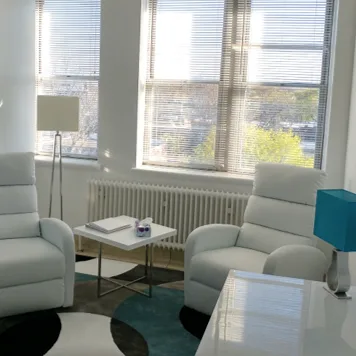
Wherever you are in the world, video consultation suits this subject well: no journey to organise, a session that fits more easily between two commitments, from a place you know, and that remains the same as in the consulting room. We see people this way from France, Quebec, Morocco and well beyond. Here is how it works. Tell us where you are: if a diagnostic assessment or ADHD coaching seems more of a priority to us, we will tell you so, and you can ask us your question before even booking.
Is it your child who has ADHD? See our page dedicated to ADHD in children.
Where would you like to consult?
All areas
 Annie Mayrand
Gatineau - Cumberland (ON)
👤
🧑🎓
🚭
❤️
💻
Annie Mayrand
Gatineau - Cumberland (ON)
👤
🧑🎓
🚭
❤️
💻
 Christian Rocher
Beloeil
👤
🧑🎓
👶
🚭
❤️
💻
Christian Rocher
Beloeil
👤
🧑🎓
👶
🚭
❤️
💻
 David Veilleux
Montréal - Anjou
👤
🧑🎓
🚭
❤️
🤰
💻
David Veilleux
Montréal - Anjou
👤
🧑🎓
🚭
❤️
🤰
💻
 Florence Aton
Sutton
👤
🚭
❤️
💻
Florence Aton
Sutton
👤
🚭
❤️
💻
 Jessica Reid
Sherbrooke
👤
🚭
💻
Jessica Reid
Sherbrooke
👤
🚭
💻
 Julie Rocque
Montréal - Jean-Talon
👤
🧑🎓
👶
🚭
❤️
🤰
💻
Julie Rocque
Montréal - Jean-Talon
👤
🧑🎓
👶
🚭
❤️
🤰
💻
 Nuria Pérez de León
Montréal - Rosemont - Saint-Lambert
👤
🧑🎓
💻
Nuria Pérez de León
Montréal - Rosemont - Saint-Lambert
👤
🧑🎓
💻
 Romain Rastoin
Bromont
👤
🧑🎓
🚭
❤️
💻
Romain Rastoin
Bromont
👤
🧑🎓
🚭
❤️
💻
 Réjeanne LeBlanc
La Prairie
👤
🧑🎓
👶
💻
Réjeanne LeBlanc
La Prairie
👤
🧑🎓
👶
💻


Frequently asked questions about Hypnosis and ADHD in Adults
No, never. We will never ask you to stop or change a treatment: that decision belongs solely to the doctor who prescribed it. If a practitioner suggests otherwise, leave their office.
Not attentional capacity itself. An anchor can help you start a task or come back to it, which is useful, but it is one more tool, not a correction of the disorder.
No, and no approach does. Be wary of any page that answers yes to this question.
Start with your doctor. Several situations produce the same signs, including sleep disorders, anxiety and depression, and they do not call for the same response.
That is discussed at the first conversation. We give no figure in advance.
Yes. The hypnotic state requires neither stillness nor sustained effort of concentration. Sessions adapt, and if hyperfocus is familiar to you, you already know something very close to it.
That is extremely common and it is legitimate. The relief of understanding often comes with grief. It is a reason for coming in its own right.
Sources and references
In English
- Attention deficit hyperactivity disorder (ADHD) — Gouvernement du Québec
- Canadian ADHD Practice Guidelines, 4.1 edition — CADDRA, Canadian ADHD Resource Alliance
In French
- Diagnosing ADHD in adults: how the consultations work — HyperSupers TDAH France, in French
The study cited on Hypnosis
- Valentine, K. E., Milling, L. S., Clark, L. J., & Moriarty, C. L. (2019). The Efficacy of Hypnosis as a Treatment for Anxiety: A Meta-Analysis. International Journal of Clinical and Experimental Hypnosis, 67(3), 336-363. doi.org/10.1080/00207144.2019.1613863 — it covers anxiety, not ADHD.
Hypnosis as practised by the members of Solutions Hypnose is a complementary support approach. It is neither a medical act, nor a diagnosis, nor psychotherapy in the regulatory sense, and it in no way replaces a consultation, follow-up or treatment prescribed by a health professional.
Our practitioners do not assess and do not treat mental disorders or illnesses. They never ask for an ongoing treatment to be stopped or changed: that decision rests exclusively with your doctor.
No result can be guaranteed. The testimonials and examples presented on this page describe individual experiences and do not predict what you will experience.
In case of significant distress, unexplained physical symptoms or suicidal thoughts, contact a doctor, emergency services or a helpline without delay.

Page written by Jean-Marie Balestrat
hypnotherapist and NLP coach
partner at Solutions Hypnose.
English version reviewed by David Veilleux
Updated .