
Hypnosis for Artistic Creativity
You open the file. You reread the last four lines. You delete them.
The project has been there for months, in a corner of your mind and a corner of your hard drive. You mention it less and less, because people ask how it is coming along. You tidy the studio, you answer emails, you do a bit more research. Anything but start.
It is not that you have no ideas. You have them, and you find them bad before you have even tried them. A voice that knows your work very well explains, at every attempt, that it is not enough, that it has been done before, that other people do it better.
And there is guilt on top, the guilt of not producing, which finishes off any chance of making a mark.
This block is the most widely shared experience in the world of creative work, and one of the loneliest. It has identifiable mechanisms, and they do not look like what is usually said about them.


What is a creative block?
Let us start by setting aside the romantic explanation, because it stops you looking in the right place.
A creative block is rarely a lack of ideas. It is most often an excess of judgement: ideas arrive and are eliminated before they exist, by a highly demanding inner authority that has excellent reasons to be demanding. Inspiration has not gone away, it is being filtered upstream.
Which explains something every creator knows: the best ideas come in the shower, while walking, as you fall asleep. Not because those moments are magical, but because the censor is off duty there.
Several situations hide behind the same word
- The starting block. Every beginning is bad by definition, and perfectionism makes the first draft unbearable.
- The finishing block, more common than people think: the project stays permanently in progress, because finishing it would mean showing it.
- The block that follows. After a rejection, a review, a commercial failure, or sometimes after a success that would have to be matched.
- The loss of meaning, when you no longer know why you do what you do. That one is not solved by techniques, and it deserves time.
- And exhaustion, which is not a block at all. See the note below.
What belongs to the stage rather than the studio is covered on our page Hypnosis for Artistic Performance: stage fright, auditions, memory blanks, the performance that went wrong.
When the block is a symptom.
"I cannot get anything done any more" is one of the first sentences of a depressive episode or of burnout, long before the person thinks of seeking help. If, for at least two weeks and on top of the block, you are sad most of the time, if nothing appeals to you, if you sleep too much or too little, if you feel worthless, or if you have dark thoughts, talk to a doctor. This is not a creativity problem, and it can be treated.
The artistic world also stacks up well-identified factors. A 2022 survey of 518 French music professionals, funded by France's national music centre, describes a sector where 18% of respondents live below the poverty line, where 83% work even when ill, where 70% say they have no access to care, and where 40% feel depressed at least once a month. Add the isolation of creative work and a socially normalised alcohol intake. If that last point speaks to you, see Hypnosis for Alcohol.
Quebec: Info-Social 811, option 2, and 1 866 APPELLE (1 866 277-3553). France: 3114. Both services are in French.
The daily impact of a creative block

Time goes by with nothing produced. Days fill up with preparation, research, tidying, tasks that resemble work without being it. You answer emails, sort references, reorganise folders, and all of that takes real energy. By evening nothing has moved on the project itself, and guilt adds to the block rather than lifting it. That is the first turn of the loop, and the one that wears you down fastest.
Avoidance sets in. You stop sitting down at the desk, you stop reopening the file, and every day without touching it makes the next one harder. This is the familiar mechanism of avoidance: it relieves in the moment and enlarges the obstacle.
Relationships get tense. The question "so, how is it going?" becomes unbearable. You turn down invitations where you will have to talk about it.
Identity wobbles. When you have produced nothing for a long time, you end up no longer daring to call yourself an artist, a writer or a musician. This meets the question of shame, covered on Hypnosis for Shame.
And comparison completes the picture, fed continuously by social media, where only finished projects and other people's good news circulate.
What helps, apart from Hypnosis
If the block comes with the signs described above, the entry point is a doctor. Otherwise, what follows has proved itself for many creators.
- A regular production constraint, however modest. Almost all creators who produce a great deal describe a routine, not flashes of lightning. Discipline is not the enemy of inspiration, it is its most ordinary condition.
- Separating the two tasks: creating and judging do not happen on the same day, and certainly not in the same hour.
- The collective: a writing group, a peer group, a residency, feedback from a trusted reader. Isolation is a cause of blocks in its own right.
- Professional support from within the craft: an editor, an art director, a creative coach, who work on the structure of the project rather than your inner state.
- Psychotherapy, which belongs to a qualified professional and whose indication is theirs to determine.
- Rest, genuinely taken. Sometimes a breakdown is simply tiredness you refuse to acknowledge.
Hypnosis sits alongside these approaches, on the side of the inner state and the relationship to judgement.
Hypnosis for creativity: goals and benefits
Let us start with what hypnosis does not do, because promises are plentiful on this subject.
It produces no idea in your place. It does not make you talented, it replaces neither the craft, nor the hours of work, nor the technique. It gives access to no hidden reservoir of ready-made works. And it does not replace medical care if the block comes with the signs described above.
What support aims at
- Putting the censor on standby during the creating phase. This is the main lever. The point is not to remove it, since it is what makes the work good when the time comes to revise, but to keep it out of the room during the first draft.
- Regaining access to the absorbed state, the one where you do not see time pass. It is a familiar state that most creators have known and believe they have lost.
- Getting back to work, quite simply. Many blocks live in the ten minutes before sitting down, and that can be worked on very concretely.
- Taking up at a distance a memory that still weighs at the moment of starting: a rejection, a wounding review, a family remark about doing something serious for a living.
- Perfectionism, keeping the standards and unplugging the paralysis.
- Impostor feelings, which overlap with Hypnosis for Self-Confidence.
Attention and the ability to work at length without scattering belong to our page Focus and Exams. And if anxiety is what dominates, see Hypnosis for Stress and Anxiety.
Why Hypnosis and creating resemble each other
The comparison gets made carelessly all the time. It does rest on something precise, provided we say exactly what.
The state of deep creative work, commonly called flow, is characterised by attention entirely absorbed by the task, a loss of the sense of time, a withdrawal of the critical gaze on oneself, and the impression that things almost make themselves. These are characteristics found in descriptions of the hypnotic state, and the resemblance stops there: as far as we know, a single study has directly compared the two states, in seven people, and concluded that the lived experience was similar without settling anything further. It is an analogy, not a result.
The best-studied bridge is elsewhere. The capacity for absorption, that is, the ease with which you let yourself be entirely taken by a book, a piece of music or a landscape, is the personality trait that holds up best when researchers look for what predicts responsiveness to hypnosis, and roughly the only one. The link exists, it is real, and it is modest: depending on the studies, absorption explains something like a tenth of what separates people on this ground. That is enough to explain why many artists feel quickly at ease in hypnosis. It is not enough to make it a rule, and we will not present it as one.
What support contributes is therefore modest to describe and useful in practice: learning to return deliberately to a state you already know, instead of waiting for it to come.
Will I lose my creativity if I get better?
This is the question almost every artist asks, often in a low voice, and no page on the subject answers it.
Behind it lies the idea of the tortured artist: suffering as fuel, and the fear that easing the torment will put out the work along with it.
Three things can be said honestly.
The first is that the fear is not silly, and it should be acknowledged rather than brushed aside. Large Swedish registry studies, covering hundreds of thousands and then more than four million people, do find an overrepresentation of certain disorders among those who have had an artistic education. Nobody serious says otherwise.
The second is that these same studies do not say what the legend makes them say. The link is with the risk of developing a disorder, not with the illness in progress: people with a diagnosis of bipolar disorder do not rate themselves as more creative and do not score higher on creativity tests, they show difficulties with mental flexibility instead. The few studies that have looked at the work itself point the same way. With Schumann, the high periods produced more pieces, but the mood state at the time of composing had no bearing on how those pieces lasted. With Virginia Woolf, production was concentrated in the periods when she was well. And when the question was put directly to twenty-four artists stabilised on treatment, twelve reported increased output, six unchanged output, six reduced output.
In other words, it is not suffering that writes: it is the capacity to work. The two do not go together.
The third is that we are not trying to smooth you out. Support on creativity aims neither to remove your sensitivity, nor to flatten what runs through you, nor to turn you into someone serene with nothing left to say. It aims to let you work with all of that, rather than be stopped by it. And if a mood disorder is involved, the question of treatment is not ours: it is discussed with your doctor, to whom this fear can be said exactly as it is.
What the research says
We need to be direct: no clinical trial has evaluated hypnosis with blocked artists, and creativity is hard to measure.
What exists is older and narrower. A series of controlled experiments, run between 1967 and 2007 on students rather than on creators, compared creativity tests taken after a hypnotic induction or in a control condition. The two best-conducted ones find better results on the hypnosis side. The most recent, a randomised trial from 2007 on still-life drawing, concludes that the hypnotic procedure had significantly greater effects on creativity in drawing.
But it adds a caveat we would rather quote: that effect depended neither on the participants' hypnotisability nor on their capacity for absorption. A 1989 study had found the same thing, and noted in passing that participants judged themselves more creative without their output being any more so. That caution applies to this whole page.
In other words: a few old, small experiments, never repeated in almost twenty years, pointing in the right direction without confirming the explanation usually given for them. And nothing on what concerns us here, an artist who can no longer work. We would rather write it down.
An example of support
*Illustrative example. The first name has been changed and the course described commits only the person who lived it.*
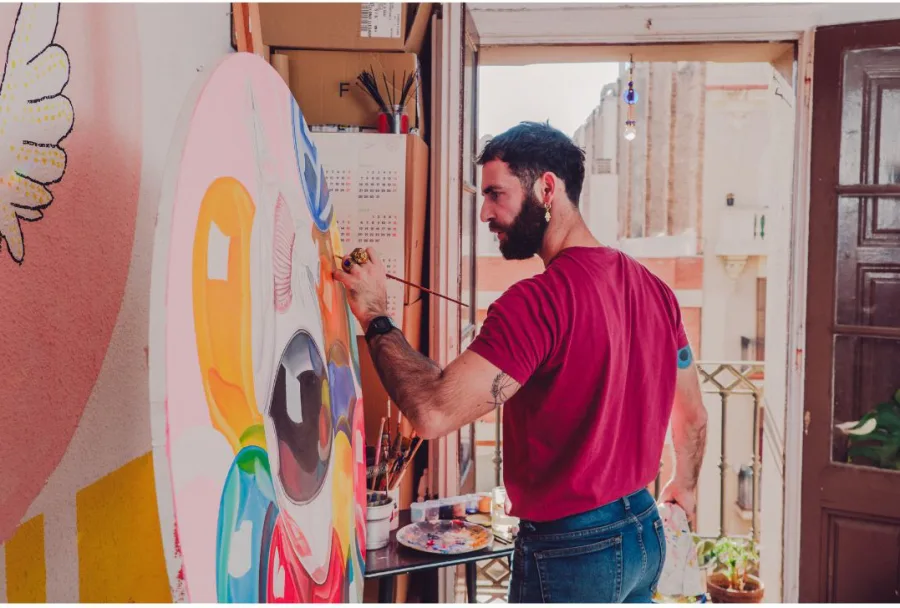
Simon, a painter, had started nothing personal in almost two years. He was fulfilling his commissions, murals and illustrations, which kept alive the idea that he was working, and he kept putting off the series that mattered to him. He arrived saying he had lost something, without being able to name it. The first interview served to take stock of the situation: he was sleeping properly, the rest of his life was going well, and nothing called first for a medical consultation.
What came back next was a precise, very old memory, of a class where a teacher had commented on a piece of work in front of everyone. We took it up at a distance, without making it the explanation for everything.
The work focused on three points. That memory. The first marks on the canvas, with a simple rule he set himself: judge nothing before the end of the week. And the ten minutes before standing in front of it, which were the real obstacle.
> "I thought I had no ideas left. I had about ten a day, and I killed them all before lunch." > Simon, name changed
He started his series. He points out that he still finds it mediocre on some days, and that he carries on anyway. Every situation is different, and Simon's course says nothing about what you will experience.
How a Hypnosis session on this subject unfolds
The interview. Your practice, what you are working on, how long it has been stuck, and at which precise point in the process. If what you describe goes beyond creative work, your sleep, your drive, your mood day to day, we will invite you to raise it with a doctor first. It is not for us to judge, and we will not wait for their answer to support you on what does fall to us.
The goal. Set together and deliberately small. Not "get my creativity back", but for instance: produce one page a day without rereading it, or reopen the project set aside.
The induction. A natural state of focused attention that you already know. You stay conscious, you hear everything, you can speak and stop whenever you wish.
The work. It most often bears on putting the censor on standby, on access to the absorbed state, on the minutes before getting down to it, and sometimes on an old memory that returns at the moment of sitting down.
The debrief and the exercise. A conversation about what you experienced, and a self-hypnosis exercise to take away, generally designed to be used just before starting a work session. It is the daily practice that counts, not the session.
In practice, video changes everything on this subject. Creativity has no borders and artists are not concentrated in one city: video consultations work as well as an in-person office, wherever you are, and here they carry a particular advantage. You are at home, in your studio or at your desk, which is exactly where the block happens, and where the exercise will have to be used.
The number of sessions is defined during the first interview.
Consulting about creativity, wherever you are
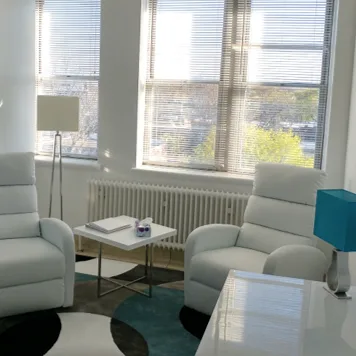
On this subject, video is not a fallback. Creativity has no borders and artists are not concentrated in one city. You are in your studio, in front of your instrument or at your work table, which is where the block takes place and where the exercise will be used. Time differences are manageable, France and Europe included, and many courses of support take place entirely at a distance, from the first interview to the last session.
In person, our practitioners see clients in Montreal, Sherbrooke, Gatineau, Paris and Lille. By video, wherever you are in the world. The how-to is here.
A question before you decide? Write to us describing your situation.
Where would you like to consult?
All areas
 Annie Mayrand
Gatineau - Cumberland (ON)
👤
🧑🎓
🚭
❤️
💻
Annie Mayrand
Gatineau - Cumberland (ON)
👤
🧑🎓
🚭
❤️
💻
 Christian Rocher
Beloeil
👤
🧑🎓
👶
🚭
❤️
💻
Christian Rocher
Beloeil
👤
🧑🎓
👶
🚭
❤️
💻
 David Veilleux
Montréal - Anjou
👤
🧑🎓
🚭
❤️
🤰
💻
David Veilleux
Montréal - Anjou
👤
🧑🎓
🚭
❤️
🤰
💻
 Florence Aton
Sutton
👤
🚭
❤️
💻
Florence Aton
Sutton
👤
🚭
❤️
💻
 Jessica Reid
Sherbrooke
👤
🚭
💻
Jessica Reid
Sherbrooke
👤
🚭
💻
 Julie Rocque
Montréal - Jean-Talon
👤
🧑🎓
👶
🚭
❤️
🤰
💻
Julie Rocque
Montréal - Jean-Talon
👤
🧑🎓
👶
🚭
❤️
🤰
💻
 Nuria Pérez de León
Montréal - Rosemont - Saint-Lambert
👤
🧑🎓
💻
Nuria Pérez de León
Montréal - Rosemont - Saint-Lambert
👤
🧑🎓
💻
 Romain Rastoin
Bromont
👤
🧑🎓
🚭
❤️
💻
Romain Rastoin
Bromont
👤
🧑🎓
🚭
❤️
💻
 Réjeanne LeBlanc
La Prairie
👤
🧑🎓
👶
💻
Réjeanne LeBlanc
La Prairie
👤
🧑🎓
👶
💻


Frequently asked questions about Hypnosis for Artistic Creativity
No, and be wary of anyone who promises it. It produces nothing in your place and contains no reservoir of ready-made works. What it can do is more modest and more useful: lift what stops the ideas you already have from reaching the page.
It is the most widespread fear among artists, and it deserves better than a flat denial. Large population studies do find more mood disorders among people who have had an artistic education. But when you look at the work rather than the legend, the picture changes: it is the capacity to work that produces the work, and the most productive periods are not the most tormented ones. Support does not aim to smooth you out, but to let you work with who you are. If you are being treated for a mood disorder, that question belongs with your doctor, not with us.
No. The hypnotic state is one of focused attention, not sleep and not submission. You stay conscious, you hear everything, and you keep the ability to decline a suggestion, to speak, or to stop the session. Nothing will come out of you that you have not decided to say.
That is a question for the doctor who follows you, and only they can answer it for your situation. What we can say on our side: hypnosis is a non-medicinal approach that is added to your care and never replaces it. We do not change, interrupt or comment on any treatment. Simply tell us what you are taking at the first interview.
Psychotherapy is a regulated field, practised by professionals whose title is protected, and it can address the whole of psychological functioning. Hypnosis as we practise it is a narrower form of support, centred on a specific goal, and it combines well with ongoing care. If you are wondering which of the two fits your situation, that is a question for a doctor or a psychologist: they are best placed to answer it, and we do not stand in for them.
Then it is the other page: Hypnosis for Artistic Performance, which covers stage fright, auditions, competitions and memory blanks. Many artists work on both, and it is not the same work.
No. An amateur who writes at weekends feels a block exactly the way a professional does, and sometimes more, since that creative time is the only time they have for themselves. The only difference is the economic stake, not the mechanism.
Yes, and particularly on this subject. All the work happens in imagination, no contact is needed, and you are at home, in the very place where you create. That is often an advantage rather than a compromise.
The number of sessions is defined during the first interview. On this subject, what counts most is getting back to a regular practice between appointments.
Sources and references
Resources
- Santé mentale et bien-être dans l'industrie de la musique. Collectif CURA, with the Centre national de la musique and Audiens, 2022. Survey of 518 professionals, in French. A self-selected, young and heavily Paris-based sample: this is not a prevalence measure in the general population.
- Dépression. Government of Quebec, in French. Signs, duration and resources.
- Médecine des Arts, resources on artists' health, mainly physical. In French.
Scientific references
- Hypnotic enhancement of creative drawing. Council, J. R., Bromley, K. A., Zabelina, D. L., & Waters, C. G. (2007). International Journal of Clinical and Experimental Hypnosis, 55(4), 467-485.
- Artifact in the hypnosis-creativity relationship. Jackson, L. M., & Gorassini, D. R. (1989). Journal of General Psychology, 116(4), 333-344.
- Openness to absorbing and self-altering experiences ("absorption"), a trait related to hypnotic susceptibility. Tellegen, A., & Atkinson, G. (1974). Journal of Abnormal Psychology, 83(3), 268-277.
- Artistic creativity and risk for schizophrenia, bipolar disorder and unipolar depression. MacCabe, J. H., Wicks, S., Löfving, S. et al. (2018). British Journal of Psychiatry, 212(6), 370-376.
- Creativity and bipolar disorder: touched by fire or burning with questions? Johnson, S. L., Murray, G., Fredrickson, B. et al. (2012). Clinical Psychology Review, 32(1), 1-12.
- Artistic productivity and lithium prophylaxis in manic-depressive illness. Schou, M. (1979). British Journal of Psychiatry, 135, 97-103.
- The Efficacy of Hypnosis as a Treatment for Anxiety: A Meta-Analysis. Valentine, K. E., Milling, L. S., Clark, L. J., & Moriarty, C. L. (2019). International Journal of Clinical and Experimental Hypnosis, 67(3), 336-363.
- Csikszentmihalyi, M. (1990). *Flow: The Psychology of Optimal Experience*. Harper & Row.
And the neighbouring articles
- If the problem is the stage rather than the studio, see Hypnosis for Artistic Performance.
- On impostor feelings, see Hypnosis for Self-Confidence.
- On working at length without scattering, see Focus and Exams.
Hypnosis as practised by the members of Solutions Hypnose is a complementary support approach. It is neither a medical act, nor a diagnosis, nor psychotherapy in the regulatory sense, and it in no way replaces a consultation, follow-up or treatment prescribed by a health professional.
Our practitioners do not assess and do not treat mental disorders or illnesses. They never ask for an ongoing treatment to be stopped or changed: that decision rests exclusively with your doctor.
No result can be guaranteed. The testimonials and examples presented on this page describe individual experiences and do not predict what you will experience.
In case of significant distress, unexplained physical symptoms or suicidal thoughts, contact a doctor, emergency services or a helpline without delay.

Page written by Sandra Djina Ravalia
hypnotherapist and art therapist
partner at Solutions Hypnose.
English version reviewed by David Veilleux
Updated .