
Hypnosis for Mental Load
It's ten in the evening. The day is over, and yet it carries on. The dentist on Thursday. The shoes that have got too small. The birthday present for Saturday. The school form nobody else noticed.
And that's the heart of it: nobody else is thinking about it. You can be helped, people can do you favours, and you remain the one who knows, who anticipates, who reminds and who checks. That's why a day when you "did nothing in particular" can be exhausting.
This page does not offer to help you carry what shouldn't have been yours alone. It sets out what hypnosis can ease, what calls for a different split, and how to prepare the conversation.


What mental load actually is
The phrase is used today for anything that clutters the mind. Its original definition is more precise, and far more useful.
Mental load isn't doing the tasks. It's being the one who thinks of them. Planning, anticipating, remembering, allocating, reminding, checking. Permanent work, invisible, and one that never really stops, not even on holiday.
The distinction is decisive. Someone can take on plenty of tasks and carry no mental load at all, if they wait to be told what to do. Delegating doesn't relieve you if you stay the project manager: the person who has to ask, explain, remind and check is still working.
Where it builds up
At home: timetables, appointments, admin, supplies, clothing sizes, birthdays, meals.
At work: too many files in parallel, an inbox that overflows, meetings that fill the day, unreachable targets.
And for the so-called sandwich generation, young children and ageing parents at the same time, with a caregiver's role nobody chose. Resources exist specifically for caregivers on both sides of the Atlantic.
Something this page has to say.
Mental load is not, first and foremost, a failure of organisation. It is most often an uneven split, at home as at work. Time-use surveys measure the time spent doing tasks — in Quebec in 2022, 3.4 hours a day for women against 2.4 for men — and mental load itself is far less well measured: Statistics Canada notes that such tasks "are not measured in time use surveys". The few data that come close point the same way without being unanimous.
No amount of work on yourself rebalances a split. What can change is what you go through because of it, and your capacity to raise the question. This page will help with both, without letting you believe that everything depends on your state of mind.
And if you are carrying it all alone because you actually are alone — a single parent, a caregiver — then it isn't a question of splitting but of resources. Look into the support schemes: they exist.
What it costs

Sleep is often the first place the load makes itself felt. It's in the evening that the list unrolls, and many people wake in the night with a task in mind. Concentration and memory follow: the forgotten things, the careless mistakes, the sense of becoming less reliable — when it's the opposite, too much is being held at once. Then irritability, often over the tiniest of details, and the guilt that comes right after it.
Worry and rumination are consistently associated with poorer sleep quality and longer time falling asleep. The effect is real but moderate, and it runs both ways: the load damages the nights, and short nights make the load heavier.
Availability, too. You're physically present and mentally occupied, which the people around you pick up perfectly well.
And exhaustion. The greater the share of mental load someone carries, the more exhaustion they report — that is measured, but in studies taken at a single point in time: they show the two go together, not that one causes the other.
When it stops being mental load.
If rest no longer repairs anything, if the exhaustion persists despite a holiday, see our page on burnout and talk to your doctor.
If the emptiness follows you everywhere, affects your sleep, your appetite, your relationships, or comes with dark thoughts, it is no longer a question of load: seek advice without waiting, and see our page on depression.
Dark thoughts: Quebec 1 866 APPELLE (277-3553) or Info-Social 811 option 2 · elsewhere in Canada 988 · France 3114, free and around the clock.
What actually helps, before we talk about hypnosis
Getting the list out of your head. One single, shared place — notebook, app, board — where everything is written down. As long as the information lives in one head only, nobody else can take it on.
Transferring whole domains, not tasks. "You take medical appointments, from start to finish" relieves you; "can you call the dentist?" relieves nothing, because you're still the one who thought of it.
Accepting that it will be done differently. That's the real obstacle, and it's more common than people admit: redoing it behind the other person cancels the transfer.
At work, negotiating priorities with a manager, and the occupational physician if the load becomes unbearable. In France you can approach them yourself, at any time and without justifying it: the Labour Code states that such a request cannot ground any sanction, and what is said there is covered by medical confidentiality.
And caregiver resources, if that's your situation. They exist in both countries, and many people entitled to them have never heard of them.
What Hypnosis can offer
It rebalances no split, makes no task disappear, and replaces no conversation you will have to have. It guarantees no result, and no change to your family or working situation can be promised.
What it can ease, and that's already a great deal:
- Evening rumination, when the list unrolls at bedtime.
- Sleep, often the first change people notice — we have a whole page on sleep problems.
- Hypervigilance, that part of your attention always on standby, even on holiday.
- The guilt of stopping, which prevents rest even when the chance comes.
- The reflex of taking everything back on yourself, which often comes from an old expectation more than from a choice.
- Preparing the conversation. This is a concrete and underrated use: raising the question of how things are shared takes courage, and it can be prepared like any piece of speaking up.
- Setting a limit, and holding the discomfort that follows.
What the research says
There is no study specifically on hypnosis and mental load, which is a concept from sociology rather than a medical object. What is documented on the hypnosis side is its effect on anxiety, and better as a complement to other approaches than used alone. Our page on what science says about hypnosis goes through it subject by subject.
Three exercises to try
The restoring bubble. Settle somewhere quiet, without your phone. Eyes closed, picture a bubble around you, filled with a soothing light that absorbs the tension. Breathe slowly, lengthening the out-breath.
The calm anchor. Call to mind a situation that evokes calm for you — a place, a piece of music, a memory. Pair it with a precise gesture, pressing thumb and forefinger together for instance. Repeat the gesture while finding the sensation again, until it becomes a reflex.
The worry box. Before sleeping, picture a box beside the bed. Put the day's concerns in it, close it, let it drift away.
One caveat about the worry box: it works well for sleep, and that's why we suggest it. But it makes nothing disappear. If you notice you've had to fill it every evening for months, it isn't your sleep that needs working on any more, it's the split.
An example: Julie's case
*An illustrative example, built from situations we meet often. It is not one real person's account.*

Julie (name changed), a finance manager, would wake in the night with a task in mind and couldn't get back to sleep. She had tried yoga, sport and meditation, with real relief that didn't hold. What kept coming back in her first conversation wasn't the amount of work: it was being the only one who knew what needed doing, at home as at the office, and never really setting that down anywhere.
The work focused on evening rumination and night waking, then on what stopped her from genuinely transferring a domain to her partner — the habit of redoing things behind him above all. Part of the sessions went into preparing that conversation, which she had been putting off for two years.
This example describes one possible course of work. It predicts nobody's. The pace and the results vary from one person to another, and no support can guarantee an outcome.
How a session on this subject unfolds
The conversation. What weighs on you, since when, and above all what is shared and what isn't. That question steers everything else, and it is rarely asked elsewhere.
A concrete objective. Not "feel better", but: sleep without unrolling the list, have the conversation with my partner before the holidays, stop redoing things behind him.
The induction, then the work itself: rumination, sleep, guilt, hypervigilance, or preparing a conversation depending on the case.
The follow-through. A short exercise. On this subject in particular it has to stay short: adding a twenty-minute practice for someone short of time is adding a line to their list.
How many sessions? That's discussed at the first meeting. Nobody can know in advance.
Book an appointment
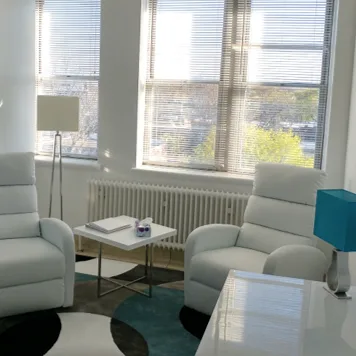
Tell us about your situation. If it calls first for a doctor, or for a conversation to be had at home, we'll say that too — and it is never a refusal. Ask us a question or book an appointment. If it's the relationship itself that's at stake, see our page on relationships and intimacy; if it's drive that's missing at work, the one on motivation. Just tell us what weighs on you and since when.
Our practitioners see people in Montreal, Sherbrooke, Gatineau, Paris and Lille, and by video wherever you are in the world.
Where would you like to consult?
All areas
 Annie Mayrand
Gatineau - Cumberland (ON)
👤
🧑🎓
🚭
❤️
💻
Annie Mayrand
Gatineau - Cumberland (ON)
👤
🧑🎓
🚭
❤️
💻
 Christian Rocher
Beloeil
👤
🧑🎓
👶
🚭
❤️
💻
Christian Rocher
Beloeil
👤
🧑🎓
👶
🚭
❤️
💻
 David Veilleux
Montréal - Anjou
👤
🧑🎓
🚭
❤️
🤰
💻
David Veilleux
Montréal - Anjou
👤
🧑🎓
🚭
❤️
🤰
💻
 Florence Aton
Sutton
👤
🚭
❤️
💻
Florence Aton
Sutton
👤
🚭
❤️
💻
 Jessica Reid
Sherbrooke
👤
🚭
💻
Jessica Reid
Sherbrooke
👤
🚭
💻
 Julie Rocque
Montréal - Jean-Talon
👤
🧑🎓
👶
🚭
❤️
🤰
💻
Julie Rocque
Montréal - Jean-Talon
👤
🧑🎓
👶
🚭
❤️
🤰
💻
 Nuria Pérez de León
Montréal - Rosemont - Saint-Lambert
👤
🧑🎓
💻
Nuria Pérez de León
Montréal - Rosemont - Saint-Lambert
👤
🧑🎓
💻
 Romain Rastoin
Bromont
👤
🧑🎓
🚭
❤️
💻
Romain Rastoin
Bromont
👤
🧑🎓
🚭
❤️
💻
 Réjeanne LeBlanc
La Prairie
👤
🧑🎓
👶
💻
Réjeanne LeBlanc
La Prairie
👤
🧑🎓
👶
💻


Frequently asked questions about Hypnosis for Mental Load
That isn't the angle. The problem is rarely organisation: it's being the only one holding the list. What gets worked on is what you go through because of it, and your capacity to raise the question of how things are shared.
Helping and carrying are not the same thing. If you have to ask, explain, remind and check, you're still the project manager, and the load is still yours.
That is extremely common, and it's a reason to consult in its own right. Preparing that conversation is a concrete, reachable goal.
Then the question isn't the split but resources and support. Look into the schemes available, particularly if you are a caregiver: they exist.
No, but one can precede the other. Mental load is thinking about everything; burnout is no longer being able to. If rest no longer repairs anything, see our dedicated page and talk to your doctor.
Surveys on the sharing of household tasks show a clear gap, and it is consistent from one edition to the next. That said, men, single parents and caregivers are concerned too, and we see them.
That's discussed at the first meeting. Nobody can know in advance.
Sources and references
On the concept and its definition
- Haicault, M. (1984). *La gestion ordinaire de la vie en deux*. Sociologie du travail, 26(3), 268-277. doi.org/10.3406/sotra.1984.2072 — the article that introduced the notion (in French).
- Daminger, A. (2019). *The Cognitive Dimension of Household Labor*. American Sociological Review, 84(4), 609-633. doi.org/10.1177/0003122419859007 — "anticipating needs, identifying options for filling them, making decisions, and monitoring progress"; the gap concerns anticipation and monitoring above all, less so decision-making.
- Reich-Stiebert, N., Froehlich, L., & Voltmer, J.-B. (2023). *Gendered Mental Labor: A Systematic Literature Review*. Sex Roles, 88(11-12), 475-494. pmc.ncbi.nlm.nih.gov/articles/PMC10148620 — five constitutive elements: cognition, management, communal orientation, anticipation, invisibility.
On how it is shared
- Emploi du temps — Institut de la statistique du Québec (in French), from the 2022 Time Use Survey: unpaid work 3.4 h/day against 2.4 h/day.
- Women in Canada — Statistics Canada, 89-503-X: these mental and emotional tasks "are not measured in time use surveys".
- Le travail domestique : 60 milliards d'heures en 2010 — Insee Première no. 1423 (in French): women perform 64 % of domestic working hours.
- Prise en charge des jeunes enfants — DREES, 20 November 2025 (in French): in one couple in two the mother carries the organising; in four families in ten it is evenly shared.
On sleep and rumination
- L'insomnie — Institut national du sommeil et de la vigilance (in French): anxious sleepers mostly struggle to fall asleep, with thoughts and worries arriving at bedtime.
- Clancy, F. et al. (2020). *The association between worry and rumination with sleep in non-clinical populations: a systematic review and meta-analysis*. Health Psychology Review, 14(4), 427-448. pubmed.ncbi.nlm.nih.gov/31910749 — small to moderate associations, running both ways.
On exhaustion
- Épuisement professionnel ou burnout — INRS, France (in French): burnout describes the consequences of chronic occupational stress, and "is not an illness".
- Aviv, E. et al. (2025). *Cognitive household labor and maternal mental health*. Archives of Women's Mental Health. pmc.ncbi.nlm.nih.gov/articles/PMC11761833 — among 322 mothers, a greater share of the cognitive load went with more reported personal burnout; a cross-sectional study, so an association rather than a cause.
On hypnosis
- Valentine, K. E., Milling, L. S., Clark, L. J., & Moriarty, C. L. (2019). *The Efficacy of Hypnosis as a Treatment for Anxiety: A Meta-Analysis*. International Journal of Clinical and Experimental Hypnosis, 67(3), 336-363. doi.org/10.1080/00207144.2019.1613863 — "Hypnosis was more effective in reducing anxiety when combined with other psychological interventions than when used as a stand-alone treatment."
For caregivers
- Ligne Info-aidant — L'Appui pour les proches aidants, Quebec (in French): 1 855 852-7784, listening, information and referrals.
- Portail national d'information pour les personnes âgées et leurs proches — CNSA, France (in French): caregiver leave, daily allowance, right to respite.
Need help? Quebec: 1 866 APPELLE (277-3553) · Info-Social 811 option 2. Elsewhere in Canada: 988, call or text. France: 3114, free and around the clock.
Hypnosis as practised by the members of Solutions Hypnose is a complementary support approach. It is neither a medical act, nor a diagnosis, nor psychotherapy in the regulatory sense, and it in no way replaces a consultation, follow-up or treatment prescribed by a health professional.
Our practitioners do not assess and do not treat mental disorders or illnesses. They never ask for an ongoing treatment to be stopped or changed: that decision rests exclusively with your doctor.
No result can be guaranteed. The testimonials and examples presented on this page describe individual experiences and do not predict what you will experience.
In case of significant distress, unexplained physical symptoms or suicidal thoughts, contact a doctor, emergency services or a helpline without delay.
Page written by Jessica Reid
hypnotherapist
partner at Solutions Hypnose.
English version reviewed by David Veilleux
Updated .