
Hypnosis and Anxiety in Children
He calls you for the fourth time. He's thirsty, he heard a noise, he wants to check that you're there.
Or it's morning, and the stomachache is back. You no longer know whether to send him to school or believe him.
Or he asks you ten times a day whether everything is all right, whether you'll come and pick him up, whether you're sure. You reassure him. It works for five minutes. And he asks again.
It is exhausting, and it is more common than people think: anxiety disorders are the most common mental health problem among children and adolescents in Canada, and close to 9 % of children and 11 to 19 % of adolescents report having one. This page sets out what is normal at each age, what you can change tonight — the most useful part, and it costs nothing — and what hypnosis can offer alongside proper care, without ever delaying it. Is it you the anxiety concerns, rather than your child? See our page on anxiety and anxiety disorders in adults instead.
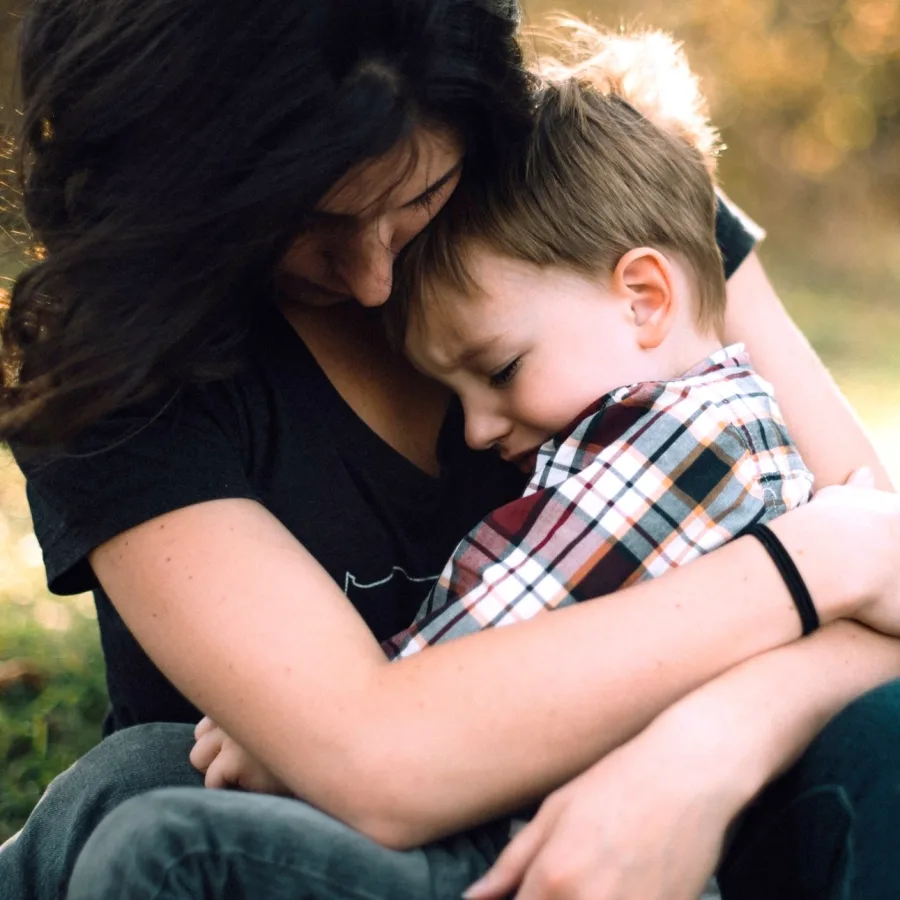

What is normal in a child's anxiety, and what is less so
A child who is frightened is not abnormal. Some fears are even expected at certain ages, and they are a sign of development taking place.
In the youngest, separation anxiety. Tears at the moment of parting in the morning, clinging to whichever parent is there, sometimes simply in front of new people. It is a normal stage in learning a new environment. It becomes a subject when it persists, worsens, or tips into panic.
Fear of the dark and of monsters, around the age of 3. With language and the imagination that stories feed, children come to dread darkness, unfamiliar noises, whatever might be under the bed — at that age the line between what is real and what isn't has not yet been drawn. It is commonplace, and it can wreck a household's nights.
School anxiety. Fear of failing, pressure, difficulty making friends. Some children develop an excessive perfectionism, others refuse to go to school for fear of being judged. When it lasts all year it is the subject of our page on school stress; when it concentrates on September, that of going back to school.
Performance anxiety and social anxiety, which appear later — the end of primary school and the start of adolescence — as expectations rise and other people's eyes become very present.
How it shows
A child's anxiety is rarely named with the word "anxiety". It shows elsewhere:
- marked fears — the dark, school, being abandoned;
- sleep problems and nightmares;
- avoidance, a strong need to be reassured, clinging to a parent, or on the contrary withdrawing;
- a tendency to ask a great many questions, often the same ones;
- stomachaches or headaches with no cause found, sometimes vomiting;
- difficulty concentrating or remembering, and slipping results.
It is often made worse by whatever unsettles the child's world: the start of a school year, a change of school or daycare, a move, parents separating, a bereavement, or the arrival of a little brother or sister.
When to see your paediatrician or your doctor.
If the anxiety overwhelms your child, or if it has a lasting effect on his sleep, his eating or his relationships.
If he refuses to go to school, or if the stomachaches are daily.
And without waiting if he voices dark thoughts.
A consultation also allows what needs checking to be checked: sleep, hearing, possible learning difficulties, or a situation of bullying. These produce very similar signs and do not call for the same answer.
Our practitioners make no diagnosis and replace no follow-up.
What parents can change tonight
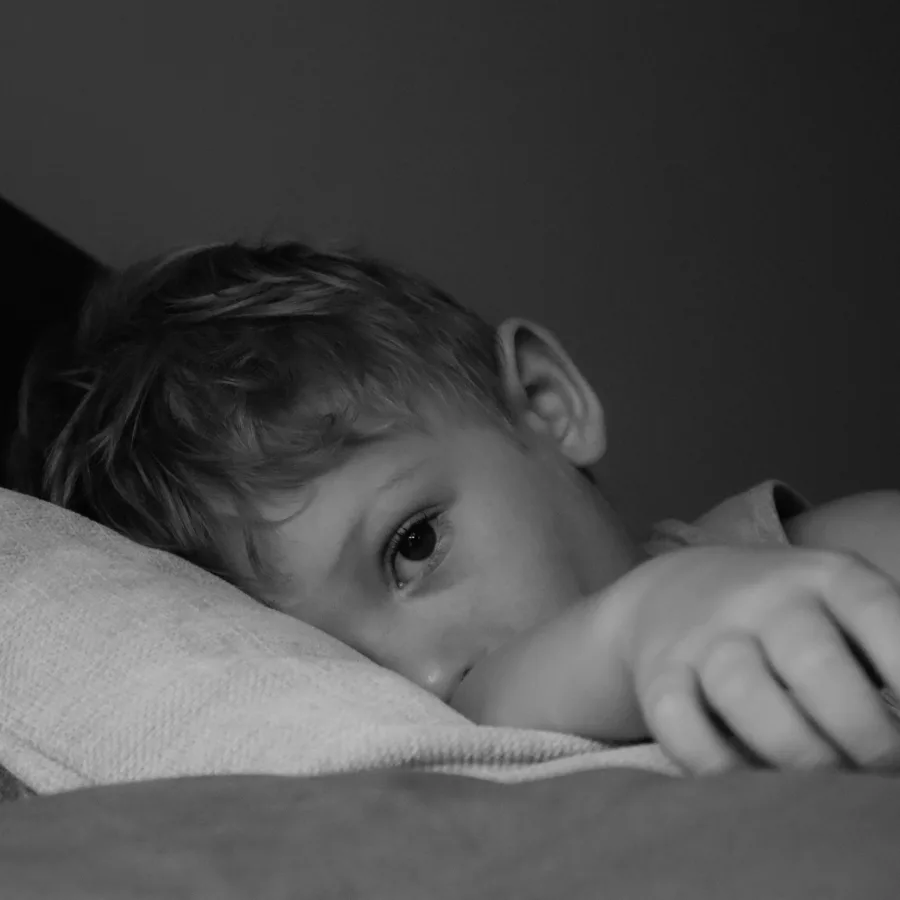
This is the most useful part of this page, and it costs nothing: no appointment, no assessment, no equipment. It comes down to a handful of gestures, and above all to one reversal that surprises most parents — what relieves your child in the moment is often what keeps his fear alive. Nothing that follows is an accusation: these reflexes are everyone's, and they come from the love you have for your child, not from a mistake in how you raise him.
The reassurance trap
Your child asks to be reassured. You reassure him, because it is natural and because it relieves him. And that is precisely what keeps the loop going.
The relief is real, and it lasts a few minutes. Then the doubt comes back, a little stronger, because the child has just recorded that he needed you in order to feel better. Next time, it will take more.
Please don't read the opposite of what we are saying. This is not about no longer comforting a frightened child: listening, explaining, putting words to the feeling — all of that stays recommended, and Quebec's public health guidance says so to parents in plain terms. What is at issue here is reassurance on a loop — the same question ten times a day, the same answer ten times a day — which ends up running on empty.
The same goes for what is called accommodation: sleeping in his room so he can fall asleep, answering for him, excusing him from the birthday party that frightens him, phoning the school on his behalf. Each gesture relieves the moment and confirms to the child that the situation really was too hard for him.
It is nobody's fault. Every parent does it, because watching your child in distress is unbearable.
What helps instead
Two things, and they go together.
Validate the feeling. "I can see that frightens you, it's hard for you." Without minimising, without "come on, there's nothing there".
And express your confidence in what he can do. "I know you can manage it, and I'll be here." The Canadian Paediatric Society gives parents exactly that sentence, with the and in capitals: "I know you're feeling scared, AND I know you're brave to do this."
It is the combination that counts. Validating without encouraging leaves the child alone with his feeling. Encouraging without validating amounts to denying what he feels. The two together tell the child: your feeling is real, and you are sturdier than you think.
And a few simple markers
- Listen to his fears, yes; don't make it an evening ritual. Your child needs to be able to say what frightens him. What helps less is the detailed review of the same worries, every single evening. Same for morning goodbyes: warm, and then you don't go back to them.
- Announce things in advance, without three days' notice that only draw out the waiting.
- Don't comment in front of him — "he's very anxious", said in his presence, becomes an identity.
- Reduce the accommodations gradually, not all at once. One step at a time, telling him first.
- And keep an eye on sleep, which makes everything worse when it is short.
Video available in French
Video transcript
Est-ce que ton enfant vit des symptômes d'anxiété et tu aimerais l'aider ? Malgré que tu le rassures régulièrement, tu te sens à bout d'outil pour l'accompagner ou bien encore son anxiété ressort par des symptômes physiques. Alors, ce que je rencontre le plus souvent dans les accompagnements que je fais, c'est les tic nerveux, le syndrome du colon irritable, etc... Alors dans cette série vidéo "en thérapie", je t'ouvre la porte de mon bureau d'hypnothérapeute.
Je te raconte ce qu'il s'y passe et comment l'hypnose peut accompagner les enfants dans leurs symptômes de l'anxiété. Alors, ce qui est vraiment intéressant tout d'abord, c'est de comprendre qu'est-ce qui crée de l'anxiété chez l'enfant. Alors souvent ça va être vraiment l'accumulation des émotions, des sensations dans la journée, des stimuli extérieurs, dans nos vies aujourd'hui, dans nos sociétés, il y a beaucoup de mouvements, beaucoup d'adaptation parfois dans les structures scolaires à mettre en œuvre, beaucoup d'élèves dans les groupes, des fois de changement de classe etc...
Donc tout ce mouvement- là, cet ensemble de stimulis, les éclairages, les sons, les connaissances à apprendre, la concentration que ça demande, c'est vraiment beaucoup d'informations pour l'enfant et ça peut parfois être vraiment imposant pour son système nerveux, ce qui crée de l'anxiété, un peu comme si on avait un réservoir à émotions et sensations un peu exigeantes, puis que elle se remplissait au fur et à mesure de la journée puis qu'arrivait à la fin ou au milieu selon les enfants, ça peut même être plutôt que ça.
ça déborde et là les symptômes d'anxiété apparaissent. C'est pour cette raison-là qu'on peut voir des fois dans les tic nerveux qui deviennent plus importants ou qu'ils apparaissent le soir. Donc c'est vraiment l'accumulation des émotions au fil de la journée. Donc ce qui est vraiment intéressant c'est de donner des outils à l'enfant pour lui permettre de comprendre non seulement ses émotions, selon l'âge évidemment parce que on peut accompagner les enfants en hypnose, en tout cas, moi je les accompagne à partir de 4 ans.
Donc on adapte toujours le langage et les informations transmises selon l'âge de l'enfant, mais de vraiment donner de l'information le plus possible à l'enfant sur les émotions et sa conscience émotionnelle, la déployer parce que lorsqu'il a conscience qu'il vit des émotions, surtout les émotions désagréables, les trois majeures qu'on nomme tristesse, peur et colère, donc les grandes familles de l'émotion. Quand l'enfant conscience qu'il vit ça, alors il peut mieux prendre le temps de les extérioriser, de les sortir de lui-même.
Alors soit en me parlant, en parlant à des adultes, en parlant à des amis ou alors par des outils imaginaires, par la pensée magique. Donc je vous réfère vraiment à ma vidéo sur l'hypnose pour les enfants pour comprendre comment fonctionne l'hypnose avec les enfants. Mais le fait d'extérioriser son émotion permet que si le réservoir était rempli jusqu'ici, hop, de descendre ce qui est contenu dans le réservoir et de laisser un peu plus d'espace disponible pour que de nouveau il y ait des nouvelles émotions et des sensations qui se vivent dans le reste de la journée.
Donc avec la séance d'hypnose, on peut aussi ancrer des ressources de sécurité intérieure, de calme et d'apaisement pour l'enfant. Pour en savoir plus, encore une fois, je vous invite à visualiser la vidéo sur l'hypnose avec les enfants pour bien comprendre comment on peut ancrer des ressources intérieures chez l'enfant à l'aide des symboles qu'il développe dans la séance d'hypnose. Alors, s'il y a quelques éléments clés à retenir, c'est l'anxiété à quoi elle correspond, c'est-à-dire l'accumulation des émotions, des sensations, des stimulis dans la journée, de l'adaptation que l'enfant a besoin de mettre en œuvre.
Ce qui est important pour l'enfant, c'est d'avoir des outils pour mieux se comprendre, son vécu émotionnel et peut-être identifier qu'il vit des émotions selon son âge. Et surtout avoir des outils pour extérioriser ses émotions au fil de la journée, à travers les visualisations, à travers la verbalisation si il est un peu plus grand et qu'il est capable de le verbaliser et aussi la possibilité d'ancrer des ressources à travers l'hypnose sur le calme intérieur, l'apaisement et la sécurité.
Alors, au plaisir devrait ensemble au mieux-être de votre enfant.
Hypnotherapy is a complementary form of support and does not replace medical advice, diagnosis, or treatment. If you have any concerns about your health, please consult a physician first.
What hypnosis can offer
Hypnosis replaces neither your paediatrician nor a psychologist when the situation calls for one. For anxiety disorders in children, the Canadian Paediatric Society recommends psychotherapy first — most often cognitive behavioural therapy, with graded exposure to what frightens the child. Where the disorder is moderate to severe, it recommends considering medication alongside it. That is what to turn to first if the anxiety is established.
What hypnosis offers alongside rests on a real advantage: it goes through imagination, play and relaxation, which is to say through a child's natural ground. He has nothing to explain and nothing to analyse.
The work can be about managing emotions and bringing down the day-to-day tension; about gently getting used to what he avoids, through play and imagination; about sleep, often the first change parents notice; about confidence in school and social situations; about day-to-day comfort, when the tension lodges in the body; and about a tool of his own, a gesture or an image he can call up alone, without you.
That last point is central: the aim is not for him to be reassured, it is for him to discover that he can calm himself down.
Carrying on at home
If your child is willing, the work continues between sessions: a breathing exercise, an imagined place of calm found again before sleep, a metaphor picked up together.
Some children, and teenagers especially, would rather not talk about it with their parents. That is to be respected.
What the research says
There is no solid evidence on hypnosis and anxiety disorders in children. A French review of the clinical studies concluded that the evidence is "negative or insufficient" across every category of anxiety disorder, at any age. We prefer to tell you.
Where paediatric research does exist, it is on a neighbouring but different subject: the anxiety and pain that come with medical procedures. A Cochrane review of needle procedures in children lists hypnosis among the effective approaches, while rating the quality of that evidence as very low. That is in fact the subject of our page on fear of blood draws.
For anxiety in general, a meta-analysis reports better results when hypnosis comes alongside other psychological approaches than when it is used on its own. That is exactly the place we claim here, and our page on what science says about hypnosis goes through it subject by subject.
An example: Tiffany's case
*Name changed, published with the parents' written consent held on file.*
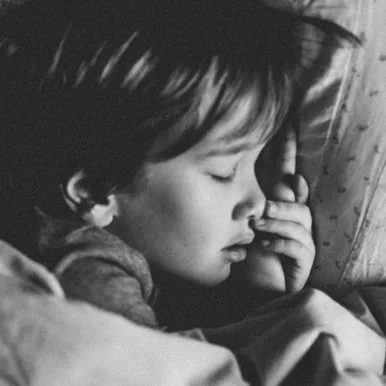
Tiffany, 8, had refused to sleep alone for several months. She feared something would happen to her parents during the night, which brought on fits of tears and broken nights. In session, she built a story in which she was the heroine, with a place of her own where she felt safe, and a discreet gesture to return to it when the worry rose. Her parents, for their part, cut down the night-time comings and goings one step at a time rather than all at once.
This case describes one possible path. It does not predict your child's. The pace and the results vary from one child to another, and no support can guarantee an outcome.
How a session with a child unfolds
Before the session, a phone conversation with at least one parent, to understand the situation and check that we are the right resource. Sometimes the answer is no, and we say so.
Your child has to be willing. That's a condition. Show him the practitioner's photo or introduction video: he'll decide whether he feels like meeting this person who tells slightly magical stories. Often the word hypnosis alone sparks their curiosity.
The session starts with the three of you, parent and child present, then generally continues with the child alone.
At the end, a quick debrief with you. If all is well we don't go into detail: children like to keep it to themselves, and he'll talk about it when he wants to.
Worried about what happens during the session? Do discuss it with your practitioner. Some members of the team offer a video monitor, without sound, allowing you to follow the session from the waiting room.
From what age? Around 5 or 6 depending on maturity, and from 6 by video. Some of our practitioners see children from the age of 4 — that is the case for the practitioner you hear in the video on this page — with the parent staying in the room.
How many sessions? That's discussed at first contact. We don't give a number in advance.
Book an appointment
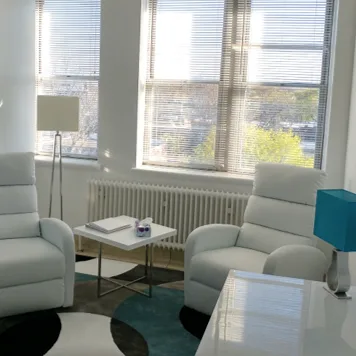
Tell us where you are in the process, and we'll tell you honestly whether we are the right resource for your child. If your paediatrician or specialist care seems to us the priority, we'll say so — and it is never a refusal, simply the right order of things. Ask us a question or book an appointment. Our practitioners who work with children in English see families in Montreal, La Prairie and Beloeil, as well as in Paris and Lille.
And by video from the age of 6, wherever you are in the world — often the real answer when no office is within reach.
Does your child's anxiety have a more precise face? Each has its own page: school stress, going back to school, selective mutism, bedwetting, fear of water, tics, anger, ADHD and fear of blood draws.
Where would you like to consult?
All areas
 Annie Mayrand
Gatineau - Cumberland (ON)
👤
🧑🎓
🚭
❤️
💻
Annie Mayrand
Gatineau - Cumberland (ON)
👤
🧑🎓
🚭
❤️
💻
 Christian Rocher
Beloeil
👤
🧑🎓
👶
🚭
❤️
💻
Christian Rocher
Beloeil
👤
🧑🎓
👶
🚭
❤️
💻
 David Veilleux
Montréal - Anjou
👤
🧑🎓
🚭
❤️
🤰
💻
David Veilleux
Montréal - Anjou
👤
🧑🎓
🚭
❤️
🤰
💻
 Florence Aton
Sutton
👤
🚭
❤️
💻
Florence Aton
Sutton
👤
🚭
❤️
💻
 Jessica Reid
Sherbrooke
👤
🚭
💻
Jessica Reid
Sherbrooke
👤
🚭
💻
 Julie Rocque
Montréal - Jean-Talon
👤
🧑🎓
👶
🚭
❤️
🤰
💻
Julie Rocque
Montréal - Jean-Talon
👤
🧑🎓
👶
🚭
❤️
🤰
💻
 Nuria Pérez de León
Montréal - Rosemont - Saint-Lambert
👤
🧑🎓
💻
Nuria Pérez de León
Montréal - Rosemont - Saint-Lambert
👤
🧑🎓
💻
 Romain Rastoin
Bromont
👤
🧑🎓
🚭
❤️
💻
Romain Rastoin
Bromont
👤
🧑🎓
🚭
❤️
💻
 Réjeanne LeBlanc
La Prairie
👤
🧑🎓
👶
💻
Réjeanne LeBlanc
La Prairie
👤
🧑🎓
👶
💻


Frequently asked questions about Hypnosis and Anxiety in Children
What matters isn't how intense his fears are but what they cost him: what he avoids, what he no longer does, how much room it takes up in his days and in yours.
Once, yes. Ten times a day, no: it relieves the moment and feeds the need. What helps is to validate the feeling while expressing your confidence in what he can do.
Neither force him nor excuse him. You move forward in steps small enough to be manageable, telling him in advance, and acknowledging every step taken.
Have your doctor see him: it is common in anxiety, and it still deserves to be checked.
Start with your doctor. School refusal is neither laziness nor defiance, and it calls for an assessment.
No. Anxiety in children has many origins, and reassuring a frightened child is every parent's reflex. What changes is the way you answer, not the person you are.
Around 5 or 6 depending on maturity, and from 6 by video. Some of our practitioners see children from the age of 4, with the parent staying in the room.
That's discussed at first contact. We don't give a number in advance.
Sources and references
On the disorder and how common it is
- Klein, B., Rajendram, R., Hrycko, S. et al. (2023). *Anxiety in children and youth: Part 1 — Diagnosis*. Paediatrics & Child Health, 28(1), 37-44. cps.ca — "11% to 19% of adolescents and almost 9% of children self-reporting an anxiety disorder"; Table 3 gives the usual age of onset for each disorder.
- Anxiety and anxiety disorders — Caring for Kids, Canadian Paediatric Society: the version written for parents, and the marker for when to seek help — "their fears are starting to interfere with their normal daily activities, such as attending school, playing sports, or making friends".
- Les peurs au moment du coucher — Naître et grandir (in French): "Vers 3 ans, les peurs les plus fréquentes sont celles du noir, des monstres et des bruits."
On what parents can do
- Soutenir votre enfant ou votre adolescent pour gérer le stress et l'anxiété — Government of Quebec (in French): the list of signs and triggers, and the instruction that bounds this page — "Votre enfant a surtout besoin d'exprimer ses craintes."
- Bobbitt, S., Kawamura, A., Saunders, N. et al. (2023). *Anxiety in children and youth: Part 2 — The management of anxiety disorders*. Paediatrics & Child Health, 28(1), 52-59. cps.ca — the box written for parents: "I know you're feeling scared, AND I know you're brave to do this." It is also the source for "Psychotherapy with a trained therapist is recommended as the first-line treatment", for the place of SSRIs in moderate to severe anxiety, and for the passage on school refusal.
- Lebowitz, E. R., Marin, C., Martino, A., Shimshoni, Y., & Silverman, W. K. (2020). *Parent-Based Treatment as Efficacious as Cognitive-Behavioral Therapy for Childhood Anxiety*. Journal of the American Academy of Child & Adolescent Psychiatry, 59(3), 362-372. pmc.ncbi.nlm.nih.gov — the source of the family accommodation concept, and the randomised trial comparing work with the parents alone to therapy with the child. Non-inferiority, not superiority, in 124 children.
On hypnosis
- Pelissolo, A. (2016). *Hypnose et troubles anxieux et phobiques : revue des études cliniques*. La Presse Médicale, 45(3), 284-290. PMID 26944812 — "evidence is negative or insufficient to support the efficacy of hypnosis in chronic anxiety disorders, in any categories whatsoever".
- Birnie, K. A., Noel, M., Chambers, C. T., Uman, L. S., & Parker, J. A. (2018). *Psychological interventions for needle-related procedural pain and distress in children and adolescents*. Cochrane Database of Systematic Reviews, 10, CD005179. PMID 30284240 — hypnosis is among the approaches found effective on needle-related pain and distress, on "very low-quality evidence".
- Valentine, K. E., Milling, L. S., Clark, L. J., & Moriarty, C. L. (2019). *The Efficacy of Hypnosis as a Treatment for Anxiety: A Meta-Analysis*. International Journal of Clinical and Experimental Hypnosis, 67(3), 336-363. doi.org — "Hypnosis was more effective in reducing anxiety when combined with other psychological interventions than when used as a stand-alone treatment." This meta-analysis covers anxiety in general and draws no paediatric conclusion.
Hypnosis as practised by the members of Solutions Hypnose is a complementary support approach. It is neither a medical act, nor a diagnosis, nor psychotherapy in the regulatory sense, and it in no way replaces a consultation, follow-up or treatment prescribed by a health professional.
Our practitioners do not assess and do not treat mental disorders or illnesses. They never ask for an ongoing treatment to be stopped or changed: that decision rests exclusively with your doctor.
No result can be guaranteed. The testimonials and examples presented on this page describe individual experiences and do not predict what you will experience.
In case of significant distress, unexplained physical symptoms or suicidal thoughts, contact a doctor, emergency services or a helpline without delay.

Page written by Rachelle Letarte
hypnotherapist and family coach
partner at Solutions Hypnose.
English version reviewed by David Veilleux
Updated .