
Hypnosis for Tics (motor tics, vocal tics, Tourette)
You blink in a meeting. You feel it coming, you try to hold it in, and for the thirty seconds you manage it you hear nothing of what is being said. Then it comes out anyway, harder.
Or it is your son, clearing his throat since the start of term. At the table, in front of the television, in class. You have tried telling him to stop. He stopped for two minutes, then it started again, and he burst into tears.
What wears you out most with a tic is not the movement. It is everything built around it: the anticipation, the effort of containing it, the watching of other people's reactions, and, for a child, the impression of being blamed for something he has no grip on.


What is a Tic?
A tic is a sudden, rapid, recurring movement or sound. It is often described as involuntary, but that is not quite accurate, and that nuance is the key to everything else.
The premonitory urge, the part almost nobody explains to you
Most tics are preceded by an uncomfortable sensation: an itch, a pressure, a localised tension, an urge that is hard to name. The tic relieves it. Then it comes back.
This sensation is reported by around 92% of adults and 79% of children affected by Tourette syndrome. It becomes clearer with age: by about twelve, most young people recognise it.
That is why people sometimes speak of "unvoluntary" rather than involuntary acts: the person decides to release the tic, but in order to relieve a sensation they did not choose. And that sensation-relief cycle is precisely what reinforces the tic over time.
The whole reference behavioural approach rests on this. It is not about holding back, but about noticing the sensation and responding to it differently.
Types of Tics
Simple motor: blinking, shoulder shrugging, grimacing, head jerks. Complex motor: more elaborate sequences that can look intentional, touching objects, jumping, turning. Simple vocal and respiratory: throat clearing, sniffing, tongue clicking, grunting. Complex vocal: repeating words or phrases, echoing other people's words, more rarely socially unacceptable words.
They are called transient under a year, chronic beyond. When multiple motor and vocal tics coexist lastingly, we speak of Tourette syndrome, a neurodevelopmental disorder frequently associated with ADHD or OCD.
Tics in children
They are common, often appear between 5 and 7, peak around 8 to 12, and resolve on their own in most cases after a few weeks or months. Stress, tiredness and change amplify them without causing them.
When to see a doctor. Before anything else, if the tics persist beyond a few months, if they worsen, if they get in the way of school, work or social life, if they cause pain, or if they come with attention difficulties, rituals or significant anxiety. Without waiting, in case of sudden onset: tics that appear all at once, within a few days, in a child or adolescent, warrant medical assessment. Several distinct situations can be involved and they do not call for the same response. The right person is the paediatrician or family doctor, then, depending on the case, a neurologist or paediatric neurologist. Our hypnotherapists make no diagnosis and assess no disorder.
The impact on daily life

The effort of holding back. Many people contain their tics in public. It works, for a while, but it is costly: suppression demands concentration, it is never sustainable, and above all the urge to tic does not diminish during that time. You spend a whole meeting managing your body instead of listening. The gaze of others. The remarks, the imitations, the mockery at school. And the most hurtful misreading of all: thinking the person is doing it on purpose or being rude.
Avoidance. You turn down an invitation, you stop speaking up, you take the seat at the back. And avoiding stressful situations can itself keep the cycle going.
Tiredness. Some tics draw on the neck, the shoulders, the throat, to the point of causing real pain.
For a child, there is also what those around them add without meaning to. A child who is repeatedly told to stop learns that he ought to manage it and that he is failing. That is neither true nor useful. When anxiety in children or school stress are added to it, that is often where to act first.
The reference approaches, outside Hypnosis
- Medical assessment first. Paediatrician, family doctor, then a neurologist if needed.
- Habit reversal therapy, and its extended version known as comprehensive behavioural intervention for tics. It is the first-line behavioural treatment. The principle: notice the sensation that announces the tic, then produce at that moment a movement incompatible with it. The aim is to undo the association between the sensation and the tic, not to hold back.
- A more recent European approach, aiming at the same goal through relaxation, acceptance and mental imagery.
- Medication, if the doctor judges it necessary, for severe tics.
- Psychoeducation for those around, family and school. Often what changes a child's life fastest.
- Care for associated conditions, ADHD, OCD or anxiety, which often weigh more heavily than the tics themselves.
Hypnosis adds itself to that list, after the medical opinion.
Hypnosis for Tics: its place and its limits
What we do not do, and why
You will often read that the idea is to strengthen voluntary control, or to imagine situations without tics. Both of those are problematic.
Holding back does not extinguish the sensation that precedes the tic: suppression is an effort of concentration, temporary, during which the urge persists. Aiming at control through willpower therefore keeps the struggle going instead of undoing it, and in a child it manufactures the idea that his tic depends on his good will.
As for imagining yourself without tics, that installs an expectation which the very next tic will contradict.
The useful work lies elsewhere: on the premonitory urge, on awareness of its arrival, and on what you do with that instant.
What Hypnosis can bring
- Sharpening the perception of the warning signal. It is the entry point of all behavioural work on tics, and it is what hypnosis does best: bringing attention back onto a subtle sensation.
- Learning to stay with the discomfort without responding to it immediately. Not through willpower, but through tolerance.
- Supporting a competing gesture, in the logic of habit reversal.
- Bringing down background tension, which does not cause tics but amplifies them — the ground of stress and anxiety management.
- Easing the shame and the social anticipation, often more disabling than the tic. It is frequently the main request from adults, and it joins the work on self-confidence.
- Improving sleep, when it is affected.
- Supporting those close, by replacing "stop it" with something that genuinely helps.
What the research says, and a note of honesty
There is no solid study showing that hypnosis reduces tics. The reference behavioural treatment remains habit reversal.
And one warning must be added that almost no site mentions: tics fluctuate naturally. They rise and fall on their own in waves, over weeks or months. That fluctuation sometimes gives the impression that they responded to a treatment, whatever it was. That is true of hypnosis as of everything else, and it is one more reason to be wary of spectacular testimonials, including ours.
What is documented is the effect of hypnosis on anxiety: a 2019 meta-analysis bringing together fifteen studies reports a large average effect, better alongside other approaches than used alone.
An example of support: Vanessa's case
*An illustrative example, built from situations frequently encountered. It is not the testimony of a real person.*

Vanessa, 28, blinked in meetings. Not elsewhere, or far less. She had taken to speaking while looking at her notes, and turned down video calls where her face fills half the screen. What tired her most was not the blinking: it was the half-hour spent containing it, during which she heard nothing of what was being said. She would come out of meetings without knowing what had been decided in them, and that, she said, was what ended up costing her.
She had seen a doctor first, and an ophthalmologist had ruled out an ocular cause. The work began with a question nobody had ever asked her: did she feel anything just before? She said no, then at the following session described a fine tension at the corner of her eye that she had never noticed in ten years. The rest was about that instant, about what she could do with it other than hold back, and about the anticipation that started the day before a meeting.
This example describes one possible course of support. It predicts nobody's. Pace and results vary from one person to another, no support can guarantee a result, and tics fluctuate naturally in any case.
How a Hypnosis session on Tics unfolds
The conversation. Which tics, since when, in which situations, what amplifies them. The practitioner will also ask whether you have already seen a doctor; if not, they will send you there before going any further.
An unusual question will be put to you: do you feel anything just before? Many people have never paid attention to it and discover the answer in session. It is the starting point of the work.
A concrete aim is set. Not "stop having tics", but: get through a meeting without spending it holding back, speak up in class again, stop dreading family meals.
The induction, then the work itself: sharpening the perception of the sensation, learning to let it rise without responding at once, installing a competing gesture, easing background tension. The general shape of a session is described on the page what to expect in a hypnosis session.
With a child, the format is shorter and more playful, and their agreement is required. A child brought against their will does not engage. Time is set aside for the parents, in particular to move beyond the instruction "stop it". Our page on hypnosis for children sets out what is done at that age.
How many sessions? That is discussed at the first conversation. Nobody can know in advance.
Book an appointment
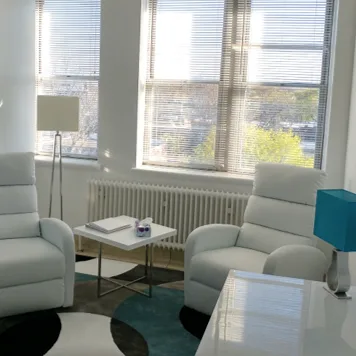
Wherever you are in the world, video consultation suits this subject well, and most members of the team offer it, in France, Quebec and Morocco. One point that often reassures people: nobody will ask you to "show" your tic, neither in person nor on camera. The work is on the sensation that precedes it, not on performing it, and many people are relieved to learn that before the first appointment even happens. Here is how it works.
Tell us about the situation. Ask us your question: if a medical opinion or specialist behavioural care takes priority, we will say so.
Where would you like to consult?
All areas
 Annie Mayrand
Gatineau - Cumberland (ON)
👤
🧑🎓
🚭
❤️
💻
Annie Mayrand
Gatineau - Cumberland (ON)
👤
🧑🎓
🚭
❤️
💻
 Christian Rocher
Beloeil
👤
🧑🎓
👶
🚭
❤️
💻
Christian Rocher
Beloeil
👤
🧑🎓
👶
🚭
❤️
💻
 David Veilleux
Montréal - Anjou
👤
🧑🎓
🚭
❤️
🤰
💻
David Veilleux
Montréal - Anjou
👤
🧑🎓
🚭
❤️
🤰
💻
 Florence Aton
Sutton
👤
🚭
❤️
💻
Florence Aton
Sutton
👤
🚭
❤️
💻
 Jessica Reid
Sherbrooke
👤
🚭
💻
Jessica Reid
Sherbrooke
👤
🚭
💻
 Julie Rocque
Montréal - Jean-Talon
👤
🧑🎓
👶
🚭
❤️
🤰
💻
Julie Rocque
Montréal - Jean-Talon
👤
🧑🎓
👶
🚭
❤️
🤰
💻
 Nuria Pérez de León
Montréal - Rosemont - Saint-Lambert
👤
🧑🎓
💻
Nuria Pérez de León
Montréal - Rosemont - Saint-Lambert
👤
🧑🎓
💻
 Romain Rastoin
Bromont
👤
🧑🎓
🚭
❤️
💻
Romain Rastoin
Bromont
👤
🧑🎓
🚭
❤️
💻
 Réjeanne LeBlanc
La Prairie
👤
🧑🎓
👶
💻
Réjeanne LeBlanc
La Prairie
👤
🧑🎓
👶
💻


Frequently asked questions about Hypnosis for Tics (Motor Tics, Vocal Tics, Tourette)
No, and nobody should tell you it does. The reference behavioural treatment is habit reversal. Hypnosis can support that process, work on the sensation that precedes the tic, and ease what weighs around it.
Because suppression is an effort of concentration that does not lower the urge to tic. It works for a few minutes and costs a great deal of attention. The work is on the sensation that comes before, not on holding back.
Tics are common at that age and resolve on their own in most cases. What warrants a consultation is persistence beyond a few months, worsening, difficulty at school, or the appearance of other difficulties. In the meantime, avoid correcting them.
As little as possible about the tic itself. Telling them to stop does not work and adds shame. What helps: explaining to siblings and to the school, not commenting every time, and treating mockery as the problem it is.
It is a neurological disorder, diagnosed and followed medically. Hypnosis is no substitute for that. It can support how it is lived, the anxiety, sleep and the gaze of others, as a complement.
That is frequent: tics often come with OCD or ADHD. Mention it, and speak to your doctor first. We have dedicated pages on OCD and on ADHD.
Yes. Mention it at the first conversation. We will never ask for a treatment to be stopped or changed: that decision belongs solely to the doctor who prescribed it.
That is discussed at the first conversation. Bear in mind too that tics fluctuate naturally, which makes any promised figure unserious.
Sources and references
In French
- Treatments for Tourette syndrome — Institut du Cerveau (in French)
- Tics and Tourette syndrome in children and adolescents — MSD Manuals (in French)
- Tourette syndrome — Quebec association of neuropsychologists (in French)
In English
- Behavioral treatments for tic disorders: a structured review of HRT, ERP, and CBIT — a synthesis of behavioural treatments and data on the premonitory urge
The study cited on Hypnosis
- Valentine, K. E., Milling, L. S., Clark, L. J., & Moriarty, C. L. (2019). The Efficacy of Hypnosis as a Treatment for Anxiety: A Meta-Analysis. International Journal of Clinical and Experimental Hypnosis, 67(3), 336-363. doi.org/10.1080/00207144.2019.1613863 — it covers anxiety in general, not tics.
Tics often coexist with other difficulties: see our pages on OCD and repetitive behaviours and on ADHD in children.
Hypnosis as practised by the members of Solutions Hypnose is a complementary support approach. It is neither a medical act, nor a diagnosis, nor psychotherapy in the regulatory sense, and it in no way replaces a consultation, follow-up or treatment prescribed by a health professional.
Our practitioners do not assess and do not treat mental disorders or illnesses. They never ask for an ongoing treatment to be stopped or changed: that decision rests exclusively with your doctor.
No result can be guaranteed. The testimonials and examples presented on this page describe individual experiences and do not predict what you will experience.
In case of significant distress, unexplained physical symptoms or suicidal thoughts, contact a doctor, emergency services or a helpline without delay.
Page written by Julie Rocque
hypnotherapist
partner at Solutions Hypnose.
English version reviewed by David Veilleux
Updated .