
Hypnosis for Claustrophobia (Fear of enclosed spaces)
The lift doors close and something tightens. You watch the floors go by, breathing too fast, and you get out at the first stop even though it is not yours. Since then you take the stairs, and you have a ready explanation when someone is surprised.
It is not only the lift. It is the seat in the middle of a row at the cinema, the aisle seat on a plane, the toilet door you do not lock, the underground at rush hour, the idea of not being able to get out when you want to.
And there may be that envelope that has been on the table for three weeks, with an appointment date on it, and the tunnel of the machine taking up your nights.
What you are going through is common, and people who do not experience it cannot imagine what it is like. It is not a whim, and it is not a lack of courage.

Do you have a scan coming up?
Tell the imaging department before the day of the scan, not on the day itself. The French radiology society writes it plainly in its patient information sheet: a feeling of unease from fear of being shut in is a common problem that departments know well. The service has several ways of making a scan more bearable, and they vary from one centre and one machine to another: position, equipment, whether someone can be with you, duration. Your doctor may also prescribe something for the scan.
Saying so will not get your scan cancelled, quite the opposite: it is what lets the team adapt it. In a study covering nearly a hundred thousand scans across three university hospitals, training teams to communicate better with patients brought the rate of incomplete scans down from 2.3% to 1.4%.
If your fear comes with real faintness, chest pain or a first panic episode, see a doctor. Hypnosis comes alongside medical care, never in its place.
What is Claustrophobia?
Claustrophobia is the fear of enclosed or confined places, or of places you cannot leave freely. It belongs to the specific phobias, that is, intense fears triggered by a particular situation and out of proportion to the actual danger of that situation.
We set aside the word "irrational", widely used on this subject. The fear is out of proportion, it is not absurd: a lift that breaks down, a scan where you must not move, a plane you cannot get off are objectively constraining situations.
Two components, often mixed together
This is not a turn of phrase: a questionnaire validated since 2001, the *Claustrophobia Questionnaire*, measures claustrophobia on two distinct scales, and that structure has been found again in English, French and Dutch.
- The fear of running out of air. Attention turns to breathing, the space seems confined, and the more you monitor your breath, the more laboured it becomes. This loop is the main driver for many people.
- The fear of being restricted, that is, of not being able to move or get out when you decide to. It explains why some people are perfectly fine in a cupboard whose door stays open and not at all in the same cupboard locked, at identical volume.
The two often go together, but not always, and it is measurable: a study of seventy-eight people undergoing an MRI showed that exposure to confinement lowered the restriction component without touching the air component.
The situations most often involved: lifts, imaging scans, flying, tunnels, the underground and crowded transport, small rooms without windows, tight clothing or equipment, sometimes the dentist's chair.
It is not the same as agoraphobia, and it is not the place that separates them. In claustrophobia, the fear is about the enclosed space itself: suffocating, being stuck. In agoraphobia, the place matters less than the idea of feeling unwell with no way out and no help, which is why the classifications also list enclosed places among agoraphobic situations, alongside transport, queues and open spaces. One situation feared for what it is, is a specific phobia; several situations feared for what might happen there, is something else. If you recognise yourself more in the second description, see Hypnosis for Agoraphobia and Panic Attacks. The general subject is covered on Hypnosis for Fears and Phobias.
Where does it come from? The reference framework describes three paths: a specific episode lived through, seeing the fear in someone else, or information received. In practice, many people find none of those three in their history, and that is normal: the absence of a triggering memory makes the fear neither less real nor harder to work with. Whatever the origin, it is avoidance that then settles it in for the long term.
If your sensations include real breathing difficulty, chest pain, dizziness or faintness, they deserve to be assessed by a doctor: several medical causes produce similar symptoms.
One point that is often misunderstood: during a panic attack the heart races, and the sense that you are about to pass out is among the recognised symptoms. Actually fainting, however, is rare. Losing consciousness follows a different mechanism, in which heart rate and blood pressure drop abruptly, and it is seen above all in the phobia of blood, injections and injuries, which the classifications set apart.
Any decision about treatment, including for a scan, belongs exclusively to the doctor who is caring for you.
The impact of Claustrophobia on daily life
Claustrophobia has a particularity: depending on the life you lead, it can stay almost invisible for years, then become blocking all at once. Day to day, it is paid for in detours. The stairs rather than the lift, which is fine until the office moves to the fifteenth floor. Hours chosen to avoid a full underground. The seat booked weeks ahead. None of that shows, and none of it costs enough, taken singly, for anyone to mention it.
When travelling, it narrows destinations, or adds hours of train to every journey.
At work, it complicates site visits, basements, windowless rooms, long meetings in a closed room.
And medically, it has a real cost, even if it is smaller than people fear. Apprehension before an MRI is ordinary: a quarter to a third of people report notable anxiety during the scan. A claustrophobic reaction visible to staff is much rarer, around ten per cent in a large Berlin study covering more than six thousand consecutive scans. And a scan actually interrupted or impossible is rare: about one per cent according to a synthesis of eighteen studies. In other words: being afraid is common, not managing it is not.
To this is added anticipation, which occupies the preceding days, and the shame of a fear that those around you find disproportionate.
The recognised approaches outside Hypnosis
For a scan ahead of you, the first people to talk to are the imaging department and your doctor.
- Graded exposure therapy, usually within cognitive and behavioural therapy. It is the reference approach for specific phobias, and it has been tested on claustrophobia itself.
- Psychological support, particularly if the fear goes back to a marking event.
- Medication for the scan, prescribed by a doctor, where that is needed. It is a legitimate solution, not a failure, and it often allows the scan to go ahead on the day planned.
- Anaesthesia or sedation, in the most difficult situations and as a medical decision.
- Virtual reality exposure. It lends itself well to enclosed spaces, a virtual lift being easy to reproduce. The work published on claustrophobia, however, consists of case reports and feasibility studies covering a handful of people, not comparative trials: it is promising and little studied.
- Work on breathing, useful because it acts on the loop of monitoring the breath.
Hypnosis places itself alongside these approaches, in preparing for a scan and in supporting exposure.
Hypnosis for Claustrophobia: aims and benefits
Let us start with what hypnosis does not do.
It does not replace medical advice or medication prescribed for a scan. It does not spare you going, step by step, into the situations you avoid. It is not the reference approach for specific phobias, which remains graded exposure. And it does not guarantee that you will get through the scan without difficulty.
What support aims at
- Undoing the breathing loop. Learning to stop monitoring your breath is often the quickest lever, because it is the monitoring that creates the sense of suffocating, not the volume of the room.
- Preparing a specific situation by going through it mentally, in detail and at your pace, from the lift door to the way out.
- Setting up a resource usable where you are, with your eyes closed, without anyone noticing.
- Working on duration. What frightens is not the space, it is the idea of staying in it. Part of the work bears on the relationship to time, and that is particularly useful for a scan whose length is known in advance.
- Revisiting an old memory of being shut in, where one exists and where it does not call for specialist support.
What we will not do: build a barrier
A word on a formulation that circulates widely, and that needs setting aside.
It is sometimes proposed to install a mental barrier in order to detach emotionally from difficult situations. It is appealing and counterproductive. A barrier works like a safety behaviour: it relieves in the moment, becomes necessary, then its absence becomes distressing in turn. It is the same mechanism as the door left ajar or the seat near the exit.
The work goes the other way: discovering, in steps you choose, that the situation can be gone through and that the sensations subside on their own.
A phrase from the previous version of this page says very well where this goes, and we are keeping it: you may never enjoy lifts, but you will be able to use them when you need to. The aim is not to enjoy, it is to be able.
What the research says
For specific phobias, it is graded exposure that has the best level of evidence, and this is not a generality borrowed from other fears: the trial was done on claustrophobia. In 2001, a Swedish team divided forty-six people meeting the diagnostic criteria between a single three-hour session of exposure, five sessions of exposure, five sessions of cognitive therapy, and a waiting list. The three treatments did as well as one another, with seventy-nine per cent showing clinically significant improvement against eighteen per cent on the waiting list. That belongs to a psychologist, and it is what should be considered first.
On hypnosis and claustrophobia as a phobia, there is no randomised controlled trial. Preparation for an imaging scan, on the other hand, has been studied, and that is where the data comes closest to what we do.
In Berlin, a radiology team had fifty-five at-risk people listen to a twenty-three-minute self-hypnosis recording while waiting for their MRI, and compared their results with those of eighty-nine people scanned on the same machine: sixteen per cent claustrophobic reactions against forty-three, and two per cent needing sedation against sixteen. The authors themselves point out that people were not randomly allocated and that the control group was historical: this is an observation, not a trial. A Swiss team separately reviewed forty people who had already had to interrupt an MRI; supported with medical hypnosis, all of them completed their scan, with image quality equivalent to that obtained under general anaesthesia. Again, a retrospective series. The first reports go back to 1990.
It is also worth saying what this work is not. The most cited trial on non-medicinal support in radiology, published in *The Lancet* in 2000, covered invasive procedures, percutaneous vascular and renal interventions under analgesia, and not a diagnostic imaging scan. The work closest to an MRI is the one cited at the top of this page: training teams to communicate better brought down the rate of incomplete scans across nearly a hundred thousand visits.
Preparing for an MRI or a CT scan
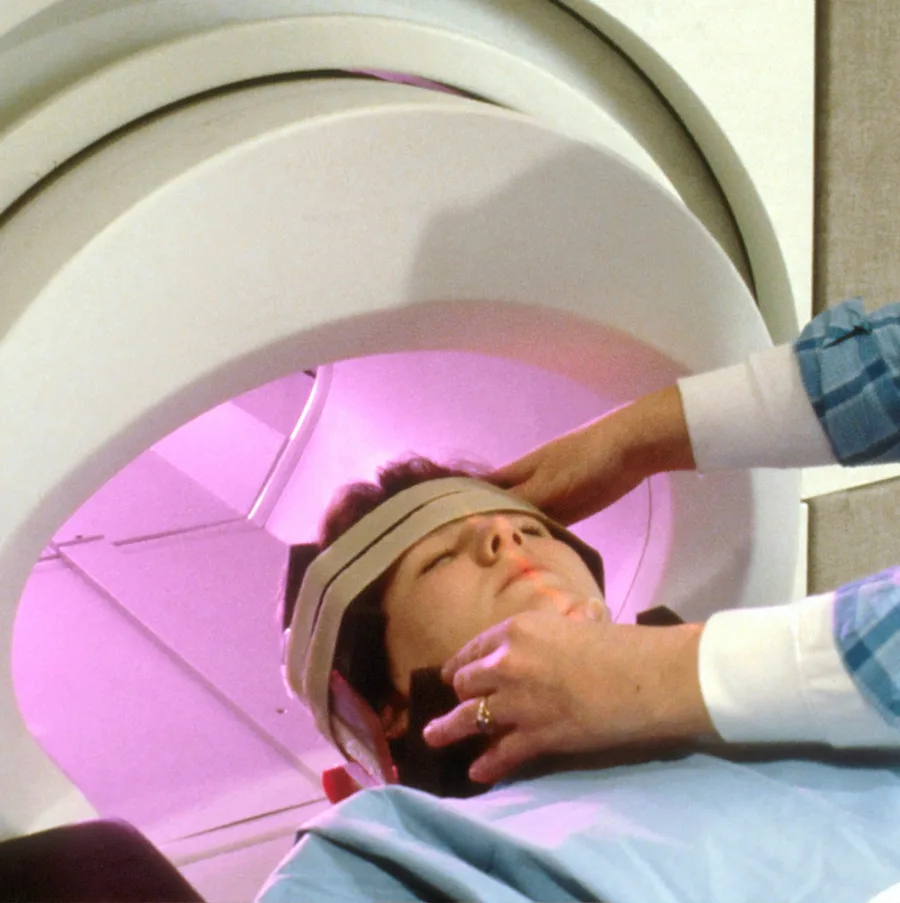
This is the most frequent request on this subject, and the most useful to address, because it has a date. An imaging scan brings together everything that sets off a claustrophobic reaction: a narrow space, the obligation not to move, the noise, the solitude, and the impossibility of getting out by yourself. To this is often added worry about the result, which has nothing to do with enclosed space and weighs just as much.
Preparation work is very concrete. It starts with the practical information: the exact duration, what you will hear, the fact that you will be speaking to the radiographer throughout, the call bulb in your hand. A great deal of anxiety falls away simply when the scene is known.
Then comes the mental rehearsal of the scan, step by step, exactly as it will unfold, until the day itself is no longer a discovery. Then the learning of a self-hypnosis exercise usable lying down, still and with eyes closed, which is exactly the position of the scan. Some practitioners hand over a recording to listen to the evening before and on the morning itself.
If panic rises during the scan, you are not trapped. The call bulb is in your hand, the team can see and hear you throughout, and pressing it does not mean stopping everything: the table comes out, you get your breath back, and very often the scan resumes and finishes. Many sequences last only a few minutes, with pauses between them, and asking the radiographer to announce each one is a marker that changes a great deal.
Two precautions. If your doctor has prescribed something for the scan, take it as planned: that decision is between you and them. An imaging scan is a one-off act, often needed for a diagnosis, and the aim is simply that it happens; it is repeated recourse, in a situation that recurs, that keeps a phobia going rather than reducing it. And tell the imaging department about your apprehension, whatever preparation you have done.
The use of hypnosis in supporting care and procedures is one of its best-established applications in hospital settings. See Hypnosis for Pain Management.
An example of support
*An illustrative example. The name is changed and the path described belongs only to the person who lived it.*
Hélène had an MRI booked three weeks later. She had already interrupted one, two years earlier, asking to come out after a few minutes, and had never gone back. The first conversation served to describe the scan in detail, which nobody had taken the time to do: the real length of each sequence, the noises, the presence of the radiographer she could speak to, the call bulb. We also advised her to ring the department to flag her apprehension, which she did, and the team offered her a quieter slot.
The work then bore on her breathing, which she monitored constantly, then on the mental rehearsal of the scan, sequence by sequence, with an exercise to listen to the evening before.
> "What helped me most was not being relaxed. It was knowing exactly what was going to happen, minute by minute." > Hélène, name changed
She completed the scan. She points out that she did not find it pleasant. Every situation is different, and Hélène's path says nothing about what you will experience.
How a Hypnosis session on this subject unfolds
The conversation. Which situations are a problem, since when, what you avoid today, and whether there is a deadline. If there is a scan date, all the work is organised around it. We will also ask whether medical care is under way and whether anything has been prescribed.
The aim. Framed together and concrete. For example: taking the lift to the third floor this week, or getting through the scan on the 14th without interrupting it.
The induction. A natural state of focused attention you already know without naming it. You stay conscious, you hear everything, you can speak and you can stop whenever you wish. On this subject, the practitioner stays in spoken contact with you from beginning to end, which matters when the fear is about being shut in.
The work. It bears most often on breathing and on how to stop monitoring it, on the mental rehearsal of a specific situation, on the relationship to duration, and sometimes on an old memory of being shut in. An honest point about breathing: breathing exercises are debated, some authors objecting that they become a support you can no longer do without. A trial published in 2000 compared behavioural therapy with and without breathing work, and found no difference. So it is not the technique that does the work, it is ceasing to monitor.
The return and the exercise. A conversation about what you experienced, a self-hypnosis exercise to take away, designed to be usable lying down and still, and a step to take before the next session.
The number of sessions is settled at the first conversation. For preparing a scan, the calendar obviously follows the date. Sessions work in person as well as by video.
Book an appointment
If you have a scan booked, mention the date when you book the appointment: it determines everything else, the number of sessions as well as their content, and preparation is better begun two weeks ahead than two days. The first conversation also serves to check what belongs elsewhere: if physical symptoms are involved, it is a doctor you need to see first, and if something has been prescribed for the scan, it is taken as planned.
In person, our practitioners see English-speaking clients in Quebec, in Montreal, Sherbrooke and Gatineau, and in France in Paris and Lille. By video, wherever you are in the world: on this subject the work rests largely on an exercise to repeat at home, which is learned just as well at a distance. Here is how it works.
A question before you decide? Write to us describing your situation.
Where would you like to consult?
All areas
 Annie Mayrand
Gatineau - Cumberland (ON)
👤
🧑🎓
🚭
❤️
💻
Annie Mayrand
Gatineau - Cumberland (ON)
👤
🧑🎓
🚭
❤️
💻
 Christian Rocher
Beloeil
👤
🧑🎓
👶
🚭
❤️
💻
Christian Rocher
Beloeil
👤
🧑🎓
👶
🚭
❤️
💻
 David Veilleux
Montréal - Anjou
👤
🧑🎓
🚭
❤️
🤰
💻
David Veilleux
Montréal - Anjou
👤
🧑🎓
🚭
❤️
🤰
💻
 Florence Aton
Sutton
👤
🚭
❤️
💻
Florence Aton
Sutton
👤
🚭
❤️
💻
 Jessica Reid
Sherbrooke
👤
🚭
💻
Jessica Reid
Sherbrooke
👤
🚭
💻
 Julie Rocque
Montréal - Jean-Talon
👤
🧑🎓
👶
🚭
❤️
🤰
💻
Julie Rocque
Montréal - Jean-Talon
👤
🧑🎓
👶
🚭
❤️
🤰
💻
 Nuria Pérez de León
Montréal - Rosemont - Saint-Lambert
👤
🧑🎓
💻
Nuria Pérez de León
Montréal - Rosemont - Saint-Lambert
👤
🧑🎓
💻
 Romain Rastoin
Bromont
👤
🧑🎓
🚭
❤️
💻
Romain Rastoin
Bromont
👤
🧑🎓
🚭
❤️
💻
 Réjeanne LeBlanc
La Prairie
👤
🧑🎓
👶
💻
Réjeanne LeBlanc
La Prairie
👤
🧑🎓
👶
💻


Frequently asked questions about Hypnosis for Claustrophobia (Fear of Enclosed Spaces)
A fortnight is short, but it is not nothing, and there is work to be done in that time. What we cannot do is promise you a result: nobody can, without having met you. What we can do is work on what happens before and during the scan. And in any case, tell the imaging department now, and speak to your doctor, who can prescribe something for the scan if that is indicated. Those are the two most useful steps, and neither depends on us.
It is not oxygen that runs out. A lift car is not airtight, and the shaft it travels in is a large volume of air: people have been trapped for days and come out dehydrated, not asphyxiated. An MRI tunnel is not even an enclosed space: it is open at both ends, about two metres long, lit and ventilated. What does change is comfort. It can be warm, the air can feel heavy and still, and that sensation is real. It is the one fear seizes on, by making you monitor every breath. The problem is not the quantity of air, it is what attention does with it. If you have a known breathing difficulty, speak to your doctor: that is a different question, and it is theirs.
You are not trapped. You keep a call bulb in your hand, and the team can see and hear you throughout. Pressing it does not mean stopping everything: the table comes out, you get your breath back, and very often the scan resumes and finishes. Many sequences last only a few minutes, with pauses between them. Ask the radiographer to announce each one: it is a marker that changes a great deal.
No, it is not a contraindication. Other things are, and they have nothing to do with fear: a pacemaker, a heart valve, a metal fragment near the eye, certain previous operations. Your imaging department decides, on the basis of a safety questionnaire. If that applies to you, say so: it is a question of safety, not of comfort. Worth noting too: a CT scan is not an MRI. It takes a few minutes and its ring is very short.
No, and the question comes up often among people who dread being shut in. The hypnotic state is a state of focused attention, not sleep and not being placed under someone's influence. You keep your eyes open if you prefer, you hear everything, and you can speak, move and stop the session at any moment.
No. Your medication is not our business: it is between you and your doctor, and nobody else has any say over it, neither to start it, nor to stop it, nor to adjust it. Our work happens alongside, not instead. One practical point: if medication is planned, the department usually asks that someone accompany you home, which is worth arranging in advance.
Psychotherapy is a regulated framework, practised by professionals whose title is protected. For a specific phobia, exposure therapy delivered by a psychologist is the reference approach, and that is what should be considered first. Hypnosis is a more circumscribed form of support, particularly suited to preparing for a dated appointment.
The two resemble each other and overlap, and it is not the place that separates them but what is feared there. In claustrophobia, the fear is about the enclosed space itself: suffocating, being stuck. In agoraphobia, the place matters less than the idea of feeling unwell with no way out and no help, which is why the classifications also list enclosed places among agoraphobic situations, alongside transport, queues and open spaces. One situation feared for what it is, is a specific phobia; several situations feared for what might happen there, is something else. That distinction belongs to a health professional, not to a page on a website.
It overlaps with claustrophobia without being reducible to it: the fear of crashing, of heights, and of not being in control are added to it. The work is partly different, and a good deal of it bears on understanding what actually happens in flight. We devote a whole page to it, Hypnosis for the Fear of Flying.
That is common, and it is just as common to find no episode at all. The absence of a triggering memory makes the fear neither less real nor harder to work with. A vague memory can be worked on without needing to reconstruct it, and we will not go looking for details, which would have no value. If the episode was violent, a psychologist trained in the specific approaches is the person to see first.
The number of sessions is settled at the first conversation. To prepare for a dated scan it is generally very short; for a long-standing claustrophobia that limits daily life, it depends on the pace at which you take the steps.
Sources and references
Specific phobias
- Specific phobia. Gouvernement du Québec, which explicitly lists enclosed spaces.
- Öst, L. G., Alm, T., Brandberg, M., & Breitholtz, E. (2001). One vs five sessions of exposure and five sessions of cognitive therapy in the treatment of claustrophobia. Behaviour Research and Therapy, 39(2), 167-183 (PMID 11153971).
- Radomsky, A. S., Rachman, S., Thordarson, D. S., McIsaac, H. K., & Teachman, B. A. (2001). The Claustrophobia Questionnaire. Journal of Anxiety Disorders, 15(4), 287-297 (PMID 11474815): the two components, suffocation and restriction.
The imaging scan
- MRI scan. National Health Service: "Talk to a healthcare professional at the hospital before your appointment if you're feeling anxious about having an MRI scan or have a fear of small spaces."
- Fiches d'information destinées aux patients. Société française de radiologie, in French: a feeling of unease from fear of being shut in is a common problem that departments know well.
- Reducing patient anxiety during MR imaging. Enders, J. et al. (2011). BMC Medical Imaging, 11, 4: claustrophobia prevents the scan or requires sedation in 2.3% of cases.
On hypnosis
- Audio-guided self-hypnosis for reduction of claustrophobia during MR imaging. Napp, A. E. et al. (2021). European Radiology, 31(7), 4483-4491. Fifty-five people against eighty-nine, without randomisation.
- Rizzo, S. et al. (2021). Is hypnosis a valid alternative to spontaneous breathing general anesthesia for claustrophobic patients undergoing MR exams? Insights into Imaging (PMID 34170425). Eighty people, retrospective series.
- The Efficacy of Hypnosis as a Treatment for Anxiety: A Meta-Analysis. Valentine, K. E. et al. (2019). International Journal of Clinical and Experimental Hypnosis, 67(3), 336-363. On anxiety in general.
And the neighbouring articles
- If the fear is about feeling unwell rather than about the enclosed space, see Hypnosis for Agoraphobia and Panic Attacks.
- If it is flying, see Hypnosis for the Fear of Flying.
- For the general subject, see Hypnosis for Fears and Phobias.
Hypnosis as practised by the members of Solutions Hypnose is a complementary support approach. It is neither a medical act, nor a diagnosis, nor psychotherapy in the regulatory sense, and it in no way replaces a consultation, follow-up or treatment prescribed by a health professional.
Our practitioners do not assess and do not treat mental disorders or illnesses. They never ask for an ongoing treatment to be stopped or changed: that decision rests exclusively with your doctor.
No result can be guaranteed. The testimonials and examples presented on this page describe individual experiences and do not predict what you will experience.
In case of significant distress, unexplained physical symptoms or suicidal thoughts, contact a doctor, emergency services or a helpline without delay.
Page written by David Veilleux
hypnotherapist and NLP coach
partner at Solutions Hypnose.
Updated .