
Hypnosis and Anxiety: easing the symptoms, quieting the mind
Anxiety has one cruel particularity: it does not need anything to actually happen (whereas stress answers a real pressure, and leaves when that pressure passes).
Anxiety runs on empty — it anticipates, it imagines, it prepares for the worst of a danger that is not there.
You can be anxious on a quiet Sunday afternoon, and that is exactly what makes it so exhausting, and so poorly understood by the people around you.
This page sets out what anxiety is, and what hypnosis can ease.
And, just as importantly, where the border with medicine runs.


What is Anxiety?
One essential distinction, before anything else
This difference has to be stated plainly, because everything else follows from it.
- Anxiety as an emotion is normal and universal. It is an anticipation system, useful by design: to prepare for an exam, to check the door is locked, to foresee problems. Everyone feels it, and a life without any anxiety at all would be a reckless one.
- Anxiety disorders are something else. When anxiety becomes invasive, persistent, out of proportion and gets in the way of daily life (work, relationships, going out…), you are in medical territory, with recognised forms described by health institutions such as INSERM and Ameli. These situations are a matter for a doctor or a psychologist: they can be looked after, often very effectively, and asking the question is nothing dramatic — it is simply the right move.
Well-being hypnotherapy supports the symptoms and the lived experience of anxiety: the tension, the rumination, the sleep, the anticipation. It diagnoses nothing, treats no disorder and never replaces follow-up.
Anxiety or Stress?
The two words often get used as synonyms, wrongly so.
Stress answers a real, present pressure: a deadline, an overload, a conflict… and settles once the situation is resolved.
Anxiety anticipates a vague danger and carries on spinning even when everything is fine: it is the mind manufacturing scenarios, the familiar "what if…".
"What if I fell ill,
what if I lost my job,
what if something happened to the people I love…"
Each one feeds the other: prolonged stress tires the nervous system, which becomes more reactive and therefore more anxious; and anxiety creates stress in its turn. Many people live with both, and the hypnosis work then covers the two dimensions.
How Anxiety shows itself
Anxiety is not just "worrying"

And that matters, because plenty of people do not recognise themselves in the word while living it in full. Here are the main symptoms of anxiety:
- In the head: rumination going round in loops, systematically expecting the worst, an inability to look ahead calmly, hypervigilance (scanning everything, watching for danger), difficulty deciding, the need to control everything, and that familiar mind that restarts the moment your head hits the pillow.
- In the body: a knot in the stomach, a tight throat, chest tightness, a racing heart, short breath, muscle tension, clammy hands, digestive trouble, permanent tiredness. These are real — anxiety is not "all in your head" (MedlinePlus, NIH).
One absolute rule, however: never put a physical symptom down to anxiety without medical advice. Palpitations or tightness deserve a check-up — often reassuring, sometimes revealing something else that can be treated.
- In behaviour: avoidance, above all. You turn down an invitation, you do not take that train, you put off that call. Every avoidance brings relief in the moment and strengthens the anxiety in the long run: it is the central mechanism that makes the problem grow — and one of the most useful levers in the work.
Moments of panic
Some people go through sharp surges of anguish: a racing heart, the breath cut short, the feeling of losing control or that something serious is happening. It is striking, often terrifying — and these episodes, uncomfortable as they are, are not dangerous in themselves; they do subside.
A first anguish attack calls for a medical consultation (to rule out other causes and set the right frame).
After that, learning to stop being afraid of the fear changes a great deal.
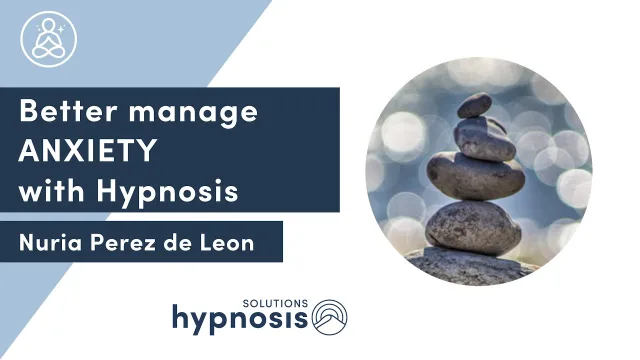
Video transcript
Hi, Anxiety is one of the most frequent reasons for consultation in therapeutic hypnosis. In fact, it is a word that covers quite different realities depending on our clients: - For some, it means intense mental stress, the hamster that keeps spinning, and is often associated with sleep disorders, as well as great mental and physical fatigue. - For others, it’s closer to the classic definition of anxiety. It’s about fears about the future, the imagination that takes over with negative "what ifs", and sometimes even disaster scenarios. - And then for some, the experience of panic attacks where the body and mind go haywire. The symptoms described by our clients are impressive, and I feel for you if you experience this at times.
And of course, if your situation is difficult to bear, or is getting worse, please consult a doctor or a psychologist. Depending on the intensity of the stress, the fears, and the associated symptoms, the hypnosis techniques will be different. The very first thing you need to know, and this may be a disappointment for you: hypnosis is not magic. To help you better manage your anxiety, you will probably need several sessions, and a combination of different approaches. But again, if you are suffering, your doctor will be able to guide you. Having said that, the first hypnosis session is often very impacting for our clients, because the state of hypnosis is one of great physical and mental relaxation.
They rediscover a state of relaxation that they had not experienced for a long time, and they also gain the confidence that their situation can improve. Depending on your symptoms and your goals, you’ll work with your hypnotherapist on how to: - Lighten your life when you feel overwhelmed, physically, or emotionally - Change your perspective - Identify your inner dialogues and scenarios that are making you feel stuck, as well as the limiting beliefs that are associated with them, to undo your negative thought spirals - Practicing breathing techniques, to help you focus on the present moment and regain calm when stress increases. Each person is unique, and we will work together to find the right keys for you.
If you want to better manage your stress and anxiety, the Solutions Hypnose team of hypnotherapists is here to help you. Either in person, near you, or on video, which also works very well. Make an appointment now to create the life you desire with hypnosis! See you soon.
Hypnotherapy is a complementary form of support and does not replace medical advice, diagnosis, or treatment. If you have any concerns about your health, please consult a physician first.
What Hypnosis offers for Anxiety
What Hypnosis eases, in practice
- Bringing the body back to calm. The hypnotic state activates the nervous system of relaxation — the one anxiety keeps at arm's length. In an anxious person that mode has become hard to reach: every session is practice at returning to it, and the capacity strengthens like a muscle.
- Making you self-sufficient through self-hypnosis. This is the heart of the approach: finding that state on your own, in a few minutes, on the underground, before a meeting, at bedtime. Support for anxiety that did not leave you self-sufficient would be missing its target.
- Quieting the spinning mind. Rumination is a mental habit, and habits can be reworked: learning to step out of a loop, to come back to the present, to switch off the projector running the scenarios. It is not about "not thinking" — that does not work — but about no longer being carried away.
- Defusing anticipation. Anxiety lives in the future: hypnotic work takes the charge out of the dreaded scenarios and restores the ability to look ahead without dread.
- Stepping out of avoidance, gradually. In imagination first, you approach what you avoid, in small steps, until the body stops reacting. It is gentle, it happens at your pace, and it is often what makes life larger again.
- Restoring sleep. Anxiety and insomnia feed one another — a circle to break at both ends, as our page on sleep and insomnia sets out.
What Hypnosis does not do
Hypnosis does not remove anxiety — and that would not even be desirable: the aim is for it to become proportionate again and to stop running your life.
It diagnoses nothing and replaces no treatment: if you are on medication, you never stop it without the prescriber — never.
Finally, some situations call for other approaches first: a diagnosed anxiety disorder, a trauma, or significant psychological distress belong with trained professionals, and we will say so plainly.
When to see a doctor without waiting
A few clear markers:
- if anxiety gets in the way of your daily life (work, relationships, going out);
- if physical symptoms persist (palpitations, tightness, digestive trouble);
- after a first panic episode;
- if anxiety comes with a low mood or a loss of drive that lasts;
- if you are using alcohol or other substances to keep going;
- and if dark thoughts appear, speak to a doctor immediately or go to emergency.
What our clients say

« My experience with hypnosis with Sanae was truly transformative. I started the session with deep anxiety, particularly tied to the fear of fainting in public. During the hypnosis session, something incredible happened. My mind, in that altered state of consciousness, became much more receptive to new suggestions and perspectives. It was as if, thanks to hypnosis, my brain had been able to reprogram some of its automatic reactions, the ones that made me fear and avoid things... »
Amer, client of Sanae Belgarch
« A very attentive professional. I felt at ease with Florence right away, and my anxiety symptoms eased from the very first session. As a first experience with hypnosis, it was a success! Thank you! »
Marie, client of Florence Aton
« I met Mr. Jean-Marie Balestrat only once. Even so, he managed to help me. First, he asked me questions to really understand my anxiety problem. He gave me an honest answer about what he could and couldn't do. During our single meeting, he still managed to give me tools (visualization, and how to recognize and respond to signs of anxiety) that not only reassured me, but really helped me react during a crisis. »
Stephen, client of Jean-Marie Balestrat
« Florence takes the time to understand what's wrong, she's very attentive. The first session already did me good in calming my anxiety, I can't wait for the second one! I recommend her 100% »
Tatya, client of Florence Aton
« SHE IS AMAZING MY ANXIETY HAS DECREASED SO MUCH IT TAKES A HUGE WEIGHT OFF MY SHOULDERS. THANK YOU ANNIE 🌞🤗 »
Michelle, client of Annie Mayrand
« During a period of great vulnerability, when I experienced capital-A Anxiety for the first time, hypnotherapy was a huge support in helping me find peace again... You have to live it to believe it! Thank you Marjorie! »
Karine, client of Marjorie Gilbert
« My visit with Nuria Pérez de León was excellent! She has a very calming voice and put me at ease right away — I was a little nervous at first, as I'd never tried hypnosis! My experience with hypnosis brought great results, and thanks to her, I no longer suffer from anxiety! I would highly recommend her to my family and friends! »
Mark, client of Nuria Perez de Leon
More on some anxiety-related subjects
Consult a Hypnotherapist for Anxiety near you
All areas
 Annie Mayrand
Gatineau - Cumberland (ON)
👤
🧑🎓
🚭
❤️
💻
Annie Mayrand
Gatineau - Cumberland (ON)
👤
🧑🎓
🚭
❤️
💻
 Christian Rocher
Beloeil
👤
🧑🎓
👶
🚭
❤️
💻
Christian Rocher
Beloeil
👤
🧑🎓
👶
🚭
❤️
💻
 David Veilleux
Montréal - Anjou
👤
🧑🎓
🚭
❤️
🤰
💻
David Veilleux
Montréal - Anjou
👤
🧑🎓
🚭
❤️
🤰
💻
 Florence Aton
Sutton
👤
🚭
❤️
💻
Florence Aton
Sutton
👤
🚭
❤️
💻
 Jessica Reid
Sherbrooke
👤
🚭
💻
Jessica Reid
Sherbrooke
👤
🚭
💻
 Julie Rocque
Montréal - Jean-Talon
👤
🧑🎓
👶
🚭
❤️
🤰
💻
Julie Rocque
Montréal - Jean-Talon
👤
🧑🎓
👶
🚭
❤️
🤰
💻
 Nuria Pérez de León
Montréal - Rosemont - Saint-Lambert
👤
🧑🎓
💻
Nuria Pérez de León
Montréal - Rosemont - Saint-Lambert
👤
🧑🎓
💻
 Romain Rastoin
Bromont
👤
🧑🎓
🚭
❤️
💻
Romain Rastoin
Bromont
👤
🧑🎓
🚭
❤️
💻
 Réjeanne LeBlanc
La Prairie
👤
🧑🎓
👶
💻
Réjeanne LeBlanc
La Prairie
👤
🧑🎓
👶
💻


Frequently asked questions about Hypnosis and Anxiety
No — and be wary of anyone who says otherwise.
First because anxiety is a normal emotion that is not "cured": the aim is for it to become proportionate again.
Second because a diagnosed anxiety disorder is a matter for medical or psychological care.
What hypnosis does well: easing the symptoms, quieting the mind, restoring sleep, and making you self-sufficient — alongside follow-up if you have any.
Stress answers a real, present pressure and settles once it passes; anxiety anticipates a vague danger and carries on even when everything is fine.
Put simply: stress has an object, anxiety runs on empty.
Each feeds the other, and many people live with both — the first conversation is there precisely to work out which one dominates for you.
Maybe — but that is not for us, or for you, to decide: see a doctor.
It is an absolute rule in our practice: a physical symptom deserves a check-up before being put down to anxiety.
Most of the time the check-up reassures — and that relief already brings the anxiety down. Sometimes it reveals something else, which can be treated. Either way, you come out ahead.
Yes, alongside it — it is even a common and often helpful combination.
Two rules: tell us about your follow-up, and never stop or change a treatment without your prescriber.
Our work is about daily life (tension, rumination, sleep, avoidance); medical decisions belong to your doctor, who is worth telling about your approach.
A first episode calls for a medical consultation.
After that, hypnosis can help a great deal, because what keeps these episodes going is often the fear of them coming back.
Therapeutic hypnosis works on that circle: learning to recognise the build-up, having concrete tools (self-hypnosis, breathing, anchoring) to go with it rather than fight it, and taking the charge out of the anticipation.
Many people describe real relief as soon as they stop being afraid of the fear.
Plan on at least four to eight sessions for anxiety, since it is often a pattern that has been in place for a long time.
Relief is frequently felt in the first sessions, but stability comes with practising self-hypnosis between appointments.
Your practitioner will give you a rough idea from the first conversation, and self-sufficiency stays the goal.
No, and this matters: our well-being support does not dig through your past, and you share only what you choose to. The work is turned towards the present and towards resources.
If your anxiety is tied to a traumatic event, that is not our ground: we will point you to professionals trained in psychological trauma, and our work can come afterwards, in support.
Anxiety is part of being human, so yes, it will show up again — facing a deadline, a change, bad news.
The difference is what you will do with it: with self-hypnosis and the tools you have gained, a surge becomes a passing episode rather than a spiral.
That is exactly why we insist so much on self-sufficiency rather than on dependence on sessions.
Going further
- Stress Management: when the pressure is real and present.
- Performance Anxiety: when the apprehension comes up against a specific stake — an exam, speaking in public, an interview, the stage.
- Sleep & Insomnia: breaking the anxiety/sleepless-nights circle.
- Fears & Phobias: when the fear settles on one specific object or situation.
Hypnotherapy is complementary well-being support: it is neither a diagnosis nor a treatment, and it replaces neither advice nor medical or psychological follow-up. Anxiety disorders are a matter for health professionals; never stop a treatment without your prescriber's advice.

Page written by Jean-Marie Balestrat
hypnotherapist and NLP coach
partner at Solutions Hypnose.
English version reviewed by David Veilleux
Published .