
Hypnosis and the Fear of Water in Children
It is Thursday. Swimming day. And since Wednesday evening your child has had a stomach ache.
In the morning they cling, they cry, they invent. You hesitate between insisting and giving in, and you feel bad either way. Or it is bath time, which should last ten minutes and turns into a negotiation. Or the holidays, where the whole family is in the water except them, and except you, staying alongside.
Before anything else, a safety rule. A child who is no longer afraid of water but still cannot swim is in greater danger than a child who is afraid. Work on the fear only makes sense alongside genuinely learning to swim, never instead of it.
Is it you who is afraid of water? See the page for adults instead.
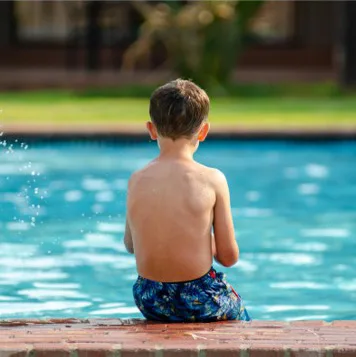

The rule that comes before everything else
In a child who cannot swim, fear of water is a protection. That is an uncomfortable thing to read when you have come looking for help, and it is nonetheless where this page starts.
A child who is no longer afraid but still cannot swim is in greater danger than before, because they go towards the water more readily. Work on the fear therefore only makes sense alongside genuinely learning to swim, and never instead of it.
No session replaces a swimming instructor, an approved flotation vest and constant supervision. And if your child becomes more comfortable in the water, they need watching as much as before, if not more.
Knowing how to swim does not put a child out of reach either. The Canadian Paediatric Society puts it plainly about swimming lessons: on their own, they "do not protect children from drowning". They remain essential. They are not enough.
Why we insist on this. In Quebec, drowning is the leading cause of injury death among children aged 1 to 4, and most of those drownings happen in a residential pool. In France it is the leading cause of death from everyday accidents among under-25s. And it does not look the way people imagine: it can happen with no cry and no sudden movement, in 20 cm of water and in under three minutes. One figure sums up all the rest: in fatal child drownings in Quebec, there was no adult nearby in 69 % of cases. That is why an adult should stay within arm's reach of a young child in the water, without stepping away even for a few seconds. And why inflatable armbands and rings are not safety equipment — that is the settled position of Canadian injury-prevention bodies. What protects is an approved flotation vest, correctly sized, with a large collar and a crotch strap. Which still does not replace your presence.
Understanding fear of water in children
It can appear very early, sometimes from the bathtub onwards, and shows up as intense reactions: shouting, crying, agitation, a flat refusal to go near a pool.
The origins vary. An experience felt as a shock — a fall, an unintended dunking, water in the eyes. A first swimming lesson that went badly, with the noise, the smell, the group. Or simply watching a parent who is uneasy in water themselves: children learn an enormous amount by looking.
Water covers the body, changes the reference points, removes the floor underfoot. For a child that is a lot at once. It is a fear like any other in how it works, but it bears on something they cannot avoid for long.
The sea is a different matter
It moves on its own, you cannot see the bottom, waves take you by surprise and push. Add the stories they have heard and the films they have seen.
A child who is fine in a pool can be terrified at the sea, and that is not a step backwards: it is simply not the same environment.
When this is not for us. After a serious event — a near-drowning, a drowning among people they know, an accident — the right resource is a child psychologist, ideally trained in psychological trauma. Tell us and we will point you there. And if the fear spreads to other situations, if it comes with settled sleep problems or a general withdrawal, speak to your paediatrician — see also our page on anxiety in children. Our hypnotherapists make no diagnosis and assess no disorder.
What it costs the child

Learning to swim, first of all, and that is the real issue. Knowing how to swim is a safety skill, not a hobby: a child stuck for two years misses stages that are harder to catch up on afterwards. Then school, where swimming days become days of dread, sometimes of absence. The group: staying at the edge while the others play, being noticed, sometimes being laughed at. Holidays and family life, with parents feeling guilty and no longer knowing whether to push or not.
And self-esteem, as always. A child who cannot do what the others can draws a conclusion about themselves, and that is often what lasts longest.
What parents can do, and it is a great deal
Take it seriously without playing it down or dramatising it. "I can see that water frightens you, let's talk about it" opens a door. "Don't be silly, there's nothing to it" closes one.
Never force, never throw a child in. It is the oldest and most reliable method for manufacturing a lasting phobia. Many aquaphobic adults date their fear from precisely that moment.
Rebuild at home, step by step. Playing with figurines in a basin, blowing bubbles through a straw, gently pouring water over an arm with a cup. Every small success counts, and what matters is not performance but enjoyment.
Talk to the swimming instructor. Many are willing to adapt, and some are specifically trained for fearful children. It is asked for far too rarely.
Look at your own relationship with water. If you are uneasy, your child knows, even if you say nothing — and our page on fear of water in adults may concern you as much as this one.
And the equipment. An approved flotation vest rather than inflatable armbands, and no equipment in place of your supervision.
Video available in French
Video transcript
Et si la peur de l'eau n'était pas seulement une question d'apprentissage, mais aussi une question d'émotion. En France, les séances de piscine commencent tôt, dès 5 ans. Et à cet âge-là, le corps et les émotions sont encore en plein apprentissage. Je pratique l'hypnose, la sophrologie et la programmation neurolinguistique. Et quand j'interviens notamment dans les classes de grande section de maternelle, je le vois très clairement.
C'est deux façons de vivre l'eau. Pour certains enfants, l'eau est un jeu, un endroit où on s'amuse, on explore, on essaie. Et pour d'autres, l'eau est froide, profonde et autour les sons de la piscine raisonnent. Et ça peut faire beaucoup d'un coup. Dans ces moments-là, le corps ne sait pas encore comment se sentir en sécurité. On parle parfois d'aquaphobie, la peur de l'eau. Et cette peur peut avoir des origines très différentes.
Il peut y avoir eu un moment précis, une surprise, une chute, une vague. J'ai accompagné une femme qui était complètement figée à l'idée d'aller dans la partie profonde du grand bassin, même après avoir pris des cours de natation. Elle savait nager. Techniquement, tout allait bien, mais dès qu'elle ne touchait plus le fond, son corps se tendait comme si quelque chose revenait. Et quand elle avait 8 ans, une vague l'avait renversée à la mer et son corps s'en souvenait encore, même 20 ans plus tard.
D'autrefois, la peur vient d'une émotion liée à quelqu'un d'autre, comme cette petite fille que j'ai accompagnée. Ce n'est pas elle qui avait eu peur dans l'eau, c'était son petit frère qui était tombé dans la piscine et elle avait eu peur pour lui. Son corps lui, avait gardé cette alerte. L'eau, c'est dangereux. Et puis il existe aussi des peurs où il n'y a pas vraiment d'événements précis. L'eau prend de la place, l'environnement est stimulant et le corps ne se sent pas encore prêt.
C'est ce que j'ai vécu avec mon fils. En grande section, il avait une peur de couler. Le grand bassin lui paraissait immense, profond, impressionnant. Il pleurait avant chaque séance. Il n'y avait rien de grave dans son histoire. C'était juste un corps qui ne se sentait pas encore en sécurité. Alors, comment l'hypnose peut aider un enfant à retrouver la sécurité dans l'eau ? On va grâce à l'hypnose ne jamais forcer un enfant à dépasser sa peur.
On passe par l'imaginaire qui est son langage naturel. Quand un enfant joue, rêve, invente, il est déjà dans un état très proche de l'hypnose. Et dans cet état, le corps peut se relâcher, la respiration s'allonger et la peur perdre de son intensité. On vient réassocier l'eau non plus à la panique mais à l'idée que l'eau peut aussi porter et accompagner le corps. Et c'est exactement ce que j'ai accompagné chez mon fils.
On a dessiné ses peurs, on les a chiffonnées puis on les a laisser partir. On a créé des images où il se voyait capable, curieux, soutenu par l'eau. Puis nous sommes allés ensemble plusieurs fois à la piscine juste pour être là, jouer et petit à petit son corps a compris que l'eau peut porter. Et aujourd'hui, la piscine est devenue un moment où il s'amuse et il apprend. Et c'est ça l'hypnose, transformer l'émotion en douceur au rythme de l'enfant.
Et en tant que parent, que peut-on faire ? La première étape, c'est vraiment d'accueillir l'émotion. Pas de rassurer à tout prix, pas de dire ce n'est rien, mais juste reconnaître que l'enfant traverse quelque chose, voir que c'est difficile et qu'il peuvent, vous pouvez y arriver ensemble. Et rien que ça, sentir alors que l'enfant n'est plus face à ce qu'il ressent. Et ensuite ce qui aide c'est d'ancrer le corps. Par exemple, poser une main sur le cœur, une autre sur le ventre et allonger l'expiration.
Ce n'est pas pour calmer l'enfant dans ce cas-là, mais vraiment pour lui montrer dans son corps, tu peux respirer ici, tu es en sécurité et revenir à ça quand il est dans l'eau. Et on peut aussi recréer du lien positif avec l'eau, hors de la piscine dans un cadre simple, jouer avec une bassine, des figurines, des bateaux, faire des bulles avec une paille. L'idée ce n'est pas d'entraîner l'enfant mais d'apprivoiser la sensation, de redonner au corps des expériences douces, maîtrisables.
Et si l'enfant est d'accord, revenir alors à la piscine mais sans objectif. Pas aujourd'hui, on met la tête sous l'eau, juste on y va pour regarder, pour être là, pour voir comment l'eau accueille le corps et on célèbre chaque petit pas, même minuscule. parce qu'il ne s'agit pas de courage, il s'agit de sécurité intérieure et ça ça se construit ensemble. Donc la peur de l'eau n'est pas une fatalité et avec l'hypnose, l'enfant peut apaiser l'émotion, retrouver un corps qui respire et renouer avec la curiosité et surtout le plaisir dans l'eau.
Si vous souhaitez accompagner votre enfant dans cette démarche, vous pouvez contacter Solutions Hypnose autant en cabinet que en visio, ca marche très bien aussi. Merci de nous avoir regardé et à très bientôt.
Hypnotherapy is a complementary form of support and does not replace medical advice, diagnosis, or treatment. If you have any concerns about your health, please consult a physician first.
What Hypnosis can offer
It replaces neither swimming lessons, nor supervision, nor a psychologist when the situation calls for one. It guarantees no result.
What a course of work aims at:
- Working without a pool. That is the main point: a child can approach water in imagination, at their own pace, without getting wet or being judged.
- Progressing in stages — feet, knees, shoulders — with the child deciding the speed.
- Setting up an anchor of calm they can use at the poolside.
- Defusing one specific memory, when there is one.
- Preparing for Thursday, concretely: the changing room, the smell, the noise, the moment of going in.
- Making the child an agent. That is often the biggest change: they stop simply enduring it.
An absolute limit on the images used in session
Metaphors are useful and children take to them very well. But some must never be used with a child who cannot swim.
Concretely: no suggestion of breathing underwater, of swimming like a fish or a dolphin, of being protected by a magic object in the water, and no image of aquatic invulnerability whatsoever.
The reason is the very one put forward to explain why hypnosis is of interest: an experience lived intensely in imagination leaves a trace. A six-year-old who has taken in that they breathe underwater like a dolphin, and who then finds themselves near a pool unsupervised, is in real danger.
The useful images run the other way: being calm *at the edge*, knowing how to come back, knowing how to call out, feeling safe *because an adult is there*. The aim is not invulnerability, it is calm.
What the research says
There is no study specifically on hypnosis and fear of water in children. We would rather write that than let you guess it.
And honesty requires going further. A review of the clinical studies published in *La Presse Médicale* concludes that the evidence is negative or insufficient to establish the efficacy of hypnosis in chronic anxiety disorders, phobias included. What we offer here is support, not a treatment whose effect has been demonstrated.
The best documented approach for specific phobias remains gradual exposure — a form of cognitive behavioural therapy in which you climb a ladder step by step, starting from whatever causes the least anxiety. That is exactly what a good swimming course with a patient instructor does. Hypnosis can prepare and accompany that path; it does not replace it, and it replaces none of the safety measures on this page.
An example: Lucas's case
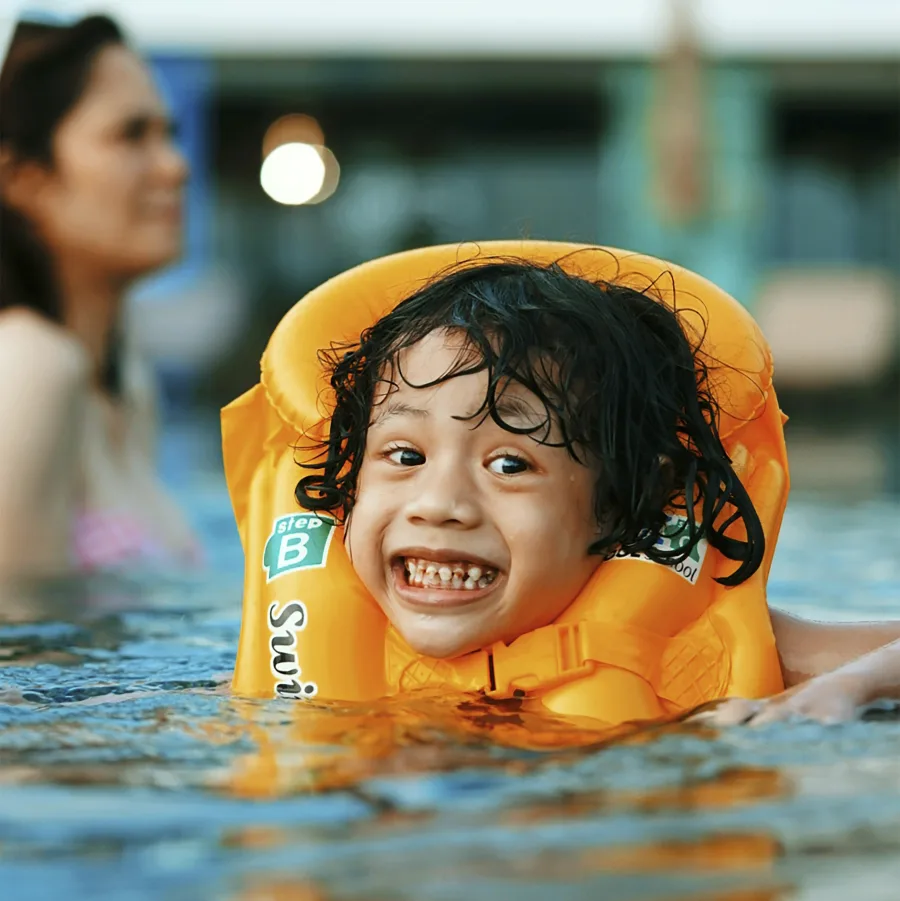
Lucas (name changed), aged 6, had been refusing school swimming for two years. Thursday was an ordeal for the whole family: tears on leaving, clinging to his mother, then a child who stays at the edge of the group. In session he described in his own words what bothered him — the cold water, the smell, and the fear of sinking as soon as the water reached his neck. The work was about Thursday rather than about swimming: the changing room, the smell, the noise, the moment of going in. He built a story in which he was the hero, moving at his own pace, with a trusted adult always present. Alongside that, his parents took up water games at home again, and his mother spoke to the swimming instructor, who agreed to let him start sitting on the edge.
This case describes one possible path. It does not predict your child's. Pace and results vary from one child to another, and no course of work can guarantee a result. *Published with the parents' written consent, kept on file.*
How a session unfolds
The first contact is with you. Your child's history with water, the family's too, what has already been tried, and where they have got to with learning to swim.
Your child has to be willing. Show them the practitioner's profile and let them decide: it is their call.
A concrete and cautious goal is set. Going into the changing room without crying, sitting at the edge, accepting water up to the knees. No swimming, no going under, no jumping in as a session goal: those stages belong to the swimming instructor.
The session itself. Stories, play, characters, with the child keeping control of the pace. Thirty to forty-five minutes depending on age.
What you take away. Some pointers for home, and the idea of speaking to the swimming instructor.
From what age? Around 5 or 6, depending on maturity — and that says nothing about the age for swimming lessons, which is an entirely separate question: those start much earlier, with a parent in the water while the child is small. Do not wait for our sessions to begin theirs.
And how many sessions? That is discussed at the first contact: we do not give a figure in advance.
Book an appointment
Tell us whether your child has already started learning to swim: it changes how the work is organised. Ask us a question or book an appointment. Wherever you are in the world, video consultations work well with children, often from their own bedroom with a parent beside them — here is how it works, and our page on hypnosis for children explains how a session goes at that age. If swimming days are part of a wider difficulty at school, see also school stress.
Where would you like to consult?
All areas
 Annie Mayrand
Gatineau - Cumberland (ON)
👤
🧑🎓
🚭
❤️
💻
Annie Mayrand
Gatineau - Cumberland (ON)
👤
🧑🎓
🚭
❤️
💻
 Christian Rocher
Beloeil
👤
🧑🎓
👶
🚭
❤️
💻
Christian Rocher
Beloeil
👤
🧑🎓
👶
🚭
❤️
💻
 David Veilleux
Montréal - Anjou
👤
🧑🎓
🚭
❤️
🤰
💻
David Veilleux
Montréal - Anjou
👤
🧑🎓
🚭
❤️
🤰
💻
 Florence Aton
Sutton
👤
🚭
❤️
💻
Florence Aton
Sutton
👤
🚭
❤️
💻
 Jessica Reid
Sherbrooke
👤
🚭
💻
Jessica Reid
Sherbrooke
👤
🚭
💻
 Julie Rocque
Montréal - Jean-Talon
👤
🧑🎓
👶
🚭
❤️
🤰
💻
Julie Rocque
Montréal - Jean-Talon
👤
🧑🎓
👶
🚭
❤️
🤰
💻
 Nuria Pérez de León
Montréal - Rosemont - Saint-Lambert
👤
🧑🎓
💻
Nuria Pérez de León
Montréal - Rosemont - Saint-Lambert
👤
🧑🎓
💻
 Romain Rastoin
Bromont
👤
🧑🎓
🚭
❤️
💻
Romain Rastoin
Bromont
👤
🧑🎓
🚭
❤️
💻
 Réjeanne LeBlanc
La Prairie
👤
🧑🎓
👶
💻
Réjeanne LeBlanc
La Prairie
👤
🧑🎓
👶
💻


Frequently asked questions about Hypnosis and the Fear of Water in Children
No, never, and it is the most important point on this page. It prepares a child to get through them. Knowing how to swim is a safety skill, learned in the water, with a professional.
No, no safer than before, and that is precisely why supervision stays complete. A child who is more comfortable goes towards the water more readily: they need watching as much as before, if not more.
Yes, and that is the point of the approach. Imagination can start the change, but the rest happens in the water, step by step, with a competent adult.
As soon as the fear stops your child from having experiences that matter: swimming lessons, holidays, sometimes bath time. After a serious water-related event, see a child psychologist instead.
That is discussed at the first contact, once the situation is understood. We do not give a figure in advance.
That is common and not contradictory: the reference points are not the same. The sea moves, you cannot see the bottom, waves take you by surprise and push.
Your child senses it, even unspoken. Many parents work on their own fear in parallel, and that is often what unlocks things fastest.
Sources and references
On drowning and supervision
- Drowning Facts — Centers for Disease Control and Prevention. More children aged 1 to 4 die from drowning than from any other cause.
- Drowning — World Health Organization. Around 300,000 drowning deaths a year worldwide; risk rises whenever children are around water without active adult supervision.
- Water Safety and Young Children — American Academy of Pediatrics. On "touch supervision", and on the fact that no swimming lesson can drown-proof a child.
- Water safety — Canadian Paediatric Society. On swimming lessons that "do not protect children from drowning" on their own, on arm's reach, and on floats that are not safety devices.
- Preventing drowning in children — Institut national de santé publique du Québec, 2017-2021 data (in French). Leading cause of injury death among 1 to 4-year-olds; no adult nearby in 69 % of cases.
On flotation equipment
- Lifejackets and personal flotation devices — Parachute, Canada's injury-prevention organisation. Inflatable toys such as armbands and rings are not safety devices.
On phobias and Hypnosis
- Specific Phobias — MSD Manual, professional edition. On gradual exposure therapy as the reference approach.
- Pelissolo, A. (2016). *Hypnosis for anxiety and phobic disorders: A review of clinical studies*. La Presse Médicale, 45(3), 284-290. The review concluding that the evidence is negative or insufficient in chronic anxiety disorders, phobias included.
Hypnosis as practised by the members of Solutions Hypnose is a complementary support approach. It is neither a medical act, nor a diagnosis, nor psychotherapy in the regulatory sense, and it in no way replaces a consultation, follow-up or treatment prescribed by a health professional.
Our practitioners do not assess and do not treat mental disorders or illnesses. They never ask for an ongoing treatment to be stopped or changed: that decision rests exclusively with your doctor.
No result can be guaranteed. The testimonials and examples presented on this page describe individual experiences and do not predict what you will experience.
In case of significant distress, unexplained physical symptoms or suicidal thoughts, contact a doctor, emergency services or a helpline without delay.

Page written by Charlotte de Joybert
hypnotherapist and sophrologist
partner at Solutions Hypnose.
English version reviewed by David Veilleux
Updated .