
Hypnosis for the Fear of Death (Thanatophobia)
The house is quiet. You were almost asleep. And the thought arrives, always the same one, through the same door: one day, it stops.
Your heart speeds up. You try to think about something else, which amounts to thinking about it again. You reason with yourself, you tell yourself everyone dies, that it's absurd at your age, that you are in good health. It changes nothing, because fear is not settled by argument.
The next day, you are exhausted. You avoid the conversation about a colleague's illness. You switch channels when the TV report comes on. You book a doctor's appointment for the third time this year, or on the contrary you stop going altogether, for fear of hearing something.
What wears you down with this particular fear is that it bears on something true. You cannot tell yourself the danger does not exist. So you look for something else.


What is Thanatophobia?
Thanatophobia is the name for an intense, pervasive fear of death or of dying. It is not an official diagnosis appearing as such in the medical classifications. It is a descriptive term, and that matters, because the same fear can cover very different situations.
It can belong to a specific phobia, where anxiety fires at the mere prospect of facing what you dread. The Government of Quebec notes that this kind of fear often comes with palpitations and other physical signs — that is the ground of our page on fears and phobias.
It can be the content of a panic attack, where the conviction of dying on the spot is part of the attack itself.
It can stem from health anxiety, when the fear bears less on death itself than on the illness that might announce it — the fear of being ill has its own page.
It can follow a bereavement, a parent's in particular, the moment when many people meet their own finitude concretely for the first time.
It can accompany a depressive state or a generalised anxiety disorder.
And it can be an existential concern, with nothing pathological about it: a question humans have always asked themselves, which sometimes grows louder at certain ages or after certain events.
What we do not do. Determining which of these categories you fall into is a medical act. Our hypnotherapists make no diagnosis and assess no mental disorder. This distinction is not a formality: it completely changes what you need. Speak to your doctor if this fear has been disturbing your sleep or your daily life for several weeks, if it appeared after a bereavement or a difficult event, if it comes with a loss of drive or a low mood, or if it arises in the context of a real illness, yours or a loved one's. In Quebec: Info-Social 811, option 2. In France: your family doctor.
The impact of the Fear of Death on daily life
Sleep goes first. The fear of dying is an evening fear: the day keeps you busy, the night leaves the field open.
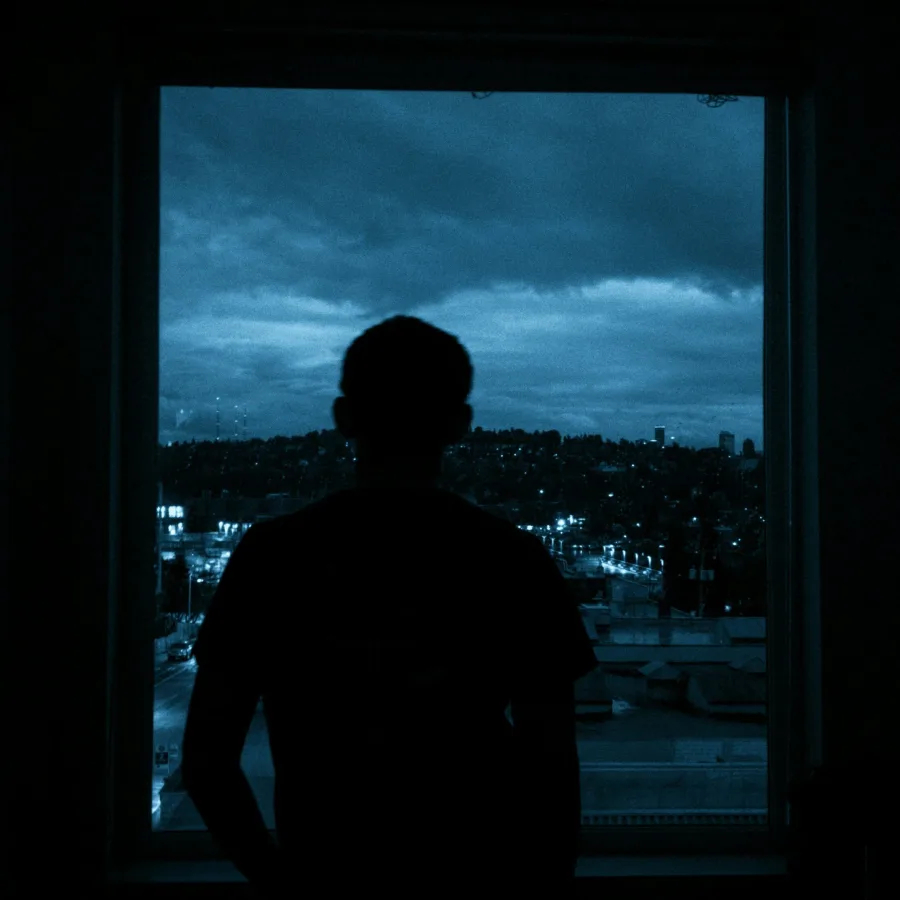
Many people put off going to bed to avoid the moment when the thought returns, which worsens the fatigue, which weakens the next day's mood further — we cover this on the page devoted to sleep problems. Then comes avoidance, discreet at first: you stop watching certain films, you change the subject when someone mentions their operation, you skip the obituaries. Some people avoid medical check-ups for fear of the result, others multiply them for a week's reassurance, and both lead to the same place.
There is also control. Checking that the children are breathing. Refusing to fly. Forbidding a motorbike ride. These are acts of love that become heavy for everyone, including the person performing them.
And there is the paradox that hurts most: by dint of fearing the loss of life, you stop enjoying it.
Recognised approaches outside Hypnosis
Your doctor remains the way in, not least to situate the nature of what you are living through. Here is what they can draw on:
- Cognitive behavioural therapy, the best-documented approach for phobias and anxiety disorders. In Quebec it is framed by the Programme québécois pour les troubles mentaux.
- Psychological follow-up, particularly indicated when the fear follows a bereavement, a trauma or a medical diagnosis.
- Medication, if your doctor judges it appropriate.
- Work on sleep, often neglected even though fatigue amplifies everything else.
- Mindfulness approaches, which teach you to let a thought pass without fighting it.
- Peer support groups. In Quebec, Phobies-Zéro documents anxiety disorders and runs peer support groups, in French. Its phone line is for members and open during office hours: for an urgent need, see the numbers below.
- Spiritual or philosophical support, which some people find truer than any psychological approach, and which remains a perfectly valid answer.
Hypnosis adds itself to this list. It does not replace it.
Hypnosis for the Fear of Death: aims and benefits
It is not going to convince you that death does not exist, and no honest practitioner will claim to erase a reality. It does not replace follow-up if the fear is rooted in a bereavement or a depressive state.
It does not put you to sleep, does not make you lose control, and you stay conscious from beginning to end — the principle is explained in detail on our page what is therapeutic hypnosis.
What the work aims at, concretely:
- Taking the night back. It is almost always the most urgent request, and often the first change people notice. The work deals with bedtime and with what fires on waking in the night.
- Installing an anchor, a gesture or a breath associated in session with a state of calm, available when the thought returns at three in the morning.
- Changing your relationship with the thought rather than chasing it away. Wanting not to think about something is the surest way of thinking about it. A good part of the work is about letting the thought pass through without it setting off the physical cascade.
- Undoing the silent rules of the "if I think about it, it happens" or "I have to control everything to protect my family" kind. They reason badly and work well.
- Taking back the avoided situations, gradually, starting with the smallest.
- Bringing attention back to the present, which is not a slogan but a practice.
What the research says
There is no solid study dealing specifically with hypnosis and the fear of death. Better to say so than to let it be inferred.
What is better documented is the effect of hypnosis on anxiety. A meta-analysis published in 2019 in the International Journal of Clinical and Experimental Hypnosis brought together fifteen studies and reports a large mean effect at the end of the sessions. The authors note a point that matches the way we work: hypnosis obtained better results as a complement to other psychological interventions than when used on its own.
That is also why we encourage you to have medical follow-up alongside, rather than instead.
An example of support: Marc's case
Marc (name changed), 45, was waking almost every night since his father's death two years earlier.

He dreaded bedtime and cut short any conversation touching on health or illness. His doctor, whom he had consulted first, had ruled out a physical cause for the waking and had supported him on the question of grief. In session, the work dealt with bedtime rather than with death in general, and Marc built an anchor of calm associated with a walk in the forest, a place that mattered to him. Then with what happened precisely on waking in the night, when the thought arrived. He later described being able to let it pass without everything firing behind it.
This case describes one possible course. It does not predict yours. The pace and the outcomes vary from one person to another, and no support can guarantee a result.
How a Hypnosis session on this subject unfolds
The interview. Twenty to thirty minutes. How long, at what moments, what happened before it started, what you avoid today, what treatment you are on. This step also serves to check that hypnosis is relevant for you. If the fear is rooted in a recent bereavement, an ongoing illness or significant distress, we will say so and guide you elsewhere.
We set a concrete objective. Not "no longer being afraid of death", which is neither realistic nor desirable. Rather: getting back to sleep in under twenty minutes, being able to listen to someone talk about their health, flying again this summer.
The induction. The practitioner guides you towards a state of relaxation and focused attention. You are seated or lying down, fully dressed, eyes usually closed.
The work itself. On this subject it frequently involves a safe mental place, an anchor you can reuse at night, the mental images that accompany the thought, and the gradual return to what is avoided.
The return and what follows. A conversation about what happened, then an exercise to practise at home, often a breathing or self-hypnosis routine at bedtime. Some practitioners record part of the session so you can listen to it again at night. The full sequence is described on our page what to expect in a hypnosis session.
How many sessions? That is discussed at the first interview. Anyone who quotes you a number before having met you is selling you something.
Booking an appointment

This fear fares better said than avoided. Our hypnotherapists practise in Montreal, Sherbrooke, Gatineau, Paris, Lille and by video anywhere in the world. Hesitating? Write to us describing your situation. We will tell you frankly whether hypnosis seems suited to you, and where to turn if it is not. The first interview is there for exactly that.
Where would you like to consult?
All areas
 Annie Mayrand
Gatineau - Cumberland (ON)
👤
🧑🎓
🚭
❤️
💻
Annie Mayrand
Gatineau - Cumberland (ON)
👤
🧑🎓
🚭
❤️
💻
 Christian Rocher
Beloeil
👤
🧑🎓
👶
🚭
❤️
💻
Christian Rocher
Beloeil
👤
🧑🎓
👶
🚭
❤️
💻
 David Veilleux
Montréal - Anjou
👤
🧑🎓
🚭
❤️
🤰
💻
David Veilleux
Montréal - Anjou
👤
🧑🎓
🚭
❤️
🤰
💻
 Florence Aton
Sutton
👤
🚭
❤️
💻
Florence Aton
Sutton
👤
🚭
❤️
💻
 Jessica Reid
Sherbrooke
👤
🚭
💻
Jessica Reid
Sherbrooke
👤
🚭
💻
 Julie Rocque
Montréal - Jean-Talon
👤
🧑🎓
👶
🚭
❤️
🤰
💻
Julie Rocque
Montréal - Jean-Talon
👤
🧑🎓
👶
🚭
❤️
🤰
💻
 Nuria Pérez de León
Montréal - Rosemont - Saint-Lambert
👤
🧑🎓
💻
Nuria Pérez de León
Montréal - Rosemont - Saint-Lambert
👤
🧑🎓
💻
 Romain Rastoin
Bromont
👤
🧑🎓
🚭
❤️
💻
Romain Rastoin
Bromont
👤
🧑🎓
🚭
❤️
💻
 Réjeanne LeBlanc
La Prairie
👤
🧑🎓
👶
💻
Réjeanne LeBlanc
La Prairie
👤
🧑🎓
👶
💻


Frequently asked questions about Hypnosis for the Fear of Death (Thanatophobia)
Not necessarily. Wondering about your own finitude is part of human life and is not an illness. What deserves attention is the moment when the thought takes over your nights, narrows what you do, or stops you enjoying your days.
No, and that would not be desirable. A quiet awareness of your own finitude is part of adult life. What can be worked on is the difference between thinking about it and being overwhelmed by it.
It depends on your situation and is discussed at the first interview. Nobody can know before having met you.
Yes, and it should be said at the very first contact. Grief that still weighs heavily months or years later calls first for appropriate care, medical or psychological. Hypnosis can come alongside it, not instead of it.
Yes, and it is common. Mention it at the interview. We will never ask you to stop or change it: that decision belongs exclusively to the doctor who prescribed it.
No. The work most often deals with very concrete things: bedtime, an avoided situation, a specific thought. You decide what you share.
No, that is a different situation and it deserves better than a blog page. Distress in the face of a real illness calls for specialised support, in psycho-oncology or palliative care depending on the context. Speak to your care team, who can guide you.
No. That is neither its object nor its competence. Those questions belong to philosophy, to spirituality or to your own conviction, and it is not the practitioner's role to answer them on your behalf.
Sources and references
In French
- Phobie spécifique — Government of Quebec
- Phobies spécifiques — Merck Manuals, consumer version
In English
- Thanatophobia (Fear of Death) — Cleveland Clinic
Study cited
- Valentine, K. E., Milling, L. S., Clark, L. J., & Moriarty, C. L. (2019). The Efficacy of Hypnosis as a Treatment for Anxiety: A Meta-Analysis. International Journal of Clinical and Experimental Hypnosis, 67(3), 336-363. doi.org/10.1080/00207144.2019.1613863 — on anxiety in general, not on the fear of death.
Need to talk? Quebec: Info-Social 811 option 2 · Crisis line 1 866 APPELLE (277-3553). France: 3114, the national suicide prevention number, free and available 24/7.
Hypnosis as practised by the members of Solutions Hypnose is a complementary support approach. It is neither a medical act, nor a diagnosis, nor psychotherapy in the regulatory sense, and it in no way replaces a consultation, follow-up or treatment prescribed by a health professional.
Our practitioners do not assess and do not treat mental disorders or illnesses. They never ask for an ongoing treatment to be stopped or changed: that decision rests exclusively with your doctor.
No result can be guaranteed. The testimonials and examples presented on this page describe individual experiences and do not predict what you will experience.
In case of significant distress, unexplained physical symptoms or suicidal thoughts, contact a doctor, emergency services or a helpline without delay.
Page written by Florence Aton
hypnotherapist and NLP coach
partner at Solutions Hypnose.
English version reviewed by David Veilleux
Updated .