
Hypnosis and Depression
If you're having dark thoughts right now, stop reading and call. Quebec: 1 866 APPELLE (277-3553) or 811 option 2. Elsewhere in Canada: 988, call or text. France: 3114. Free, around the clock, and you don't need to be "bad enough" to call.
Depression is an illness, it is treatable, and that starts with a doctor. It is not weakness, not a failure of will, not something you get over by pulling yourself together.
Hypnosis does not treat depression. It can support certain symptoms — sleep, rumination, anxiety — alongside proper care, and never instead of it. This page sets out what it can do, at what point, and what it will never do.


If you're having dark thoughts right now, stop reading and call.
Quebec: 1 866 APPELLE (277-3553), around the clock · text 535353 · chat at suicide.ca · Info-Social 811 option 2.
Elsewhere in Canada: 988, call or text, around the clock, in English or French — dialled from Quebec it redirects you to 1 866 APPELLE.
France: 3114, the national suicide prevention line, free, around the clock; 114 by text if you are deaf, hard of hearing or have aphasia.
Immediate emergency: 911 in Quebec, 15 or 112 in France.
These lines are staffed by professionals, and you don't need to be "bad enough" to call.
What it's like
Waking is the worst moment. Before you even open your eyes, the weight is already there.
What used to give you pleasure does nothing now. Not "less": nothing. You know it, and knowing changes nothing.
People around you say you should get out, see friends, exercise. They're right, and it is exactly what you are unable to do at the moment. It adds guilt to the exhaustion.
This is not a character flaw. The loss of drive and the slowing down are part of the illness, the way fever is part of the flu.
Three things to know before reading on.
Depression is an illness, and it is treatable — not a weakness, not a failure of will.
Only a doctor can make the diagnosis and put the right care in place: that is where to start, and it is an approach that works.
Hypnosis does not treat depression; it can support certain symptoms alongside proper care, and never in its place.
If you are on medication, never stop or reduce it on your own: coming off an antidepressant is prepared with the doctor who prescribed it.
Understanding depressive states
Intensity varies, from a passing low to a major depressive episode, and the symptoms combine:
- sadness, and above all loss of interest in what used to appeal;
- fatigue and disturbed sleep, in one direction or the other;
- trouble concentrating, a sense of mental fog;
- falling self-esteem, guilt, the feeling of being a burden;
- changes in appetite;
- dark thoughts.
Symptoms often settle in gradually, which makes them hard to recognise. Many people first consult about something else: sleep, a knot in the stomach, a loss of confidence.
Some periods carry more exposure: a break-up, a bereavement, burnout, the arrival of a child, adolescence, growing older, retirement. Transitions, where something has to be left behind, are particularly fertile ground.
When to consult without waiting. If these symptoms have lasted more than two weeks, if they stop you working or caring for the people around you, if you're withdrawing, if your use of alcohol or medication is rising, or if you're having suicidal thoughts. Your family doctor is the right starting point: they will assess and refer. Depression is treatable, and the earlier care begins, the better.
Two particular situations.
After a birth, a postpartum depressive episode is common, it is treatable, and it takes nothing away from you as a parent — talk to your doctor, your midwife or your care team, they are prepared for it.
In a teenager, irritability, withdrawal and falling grades are often the signs, rather than expressed sadness: faced with a lasting change, seek advice.
What depression takes

Drive. It's the symptom least understood from the outside. It isn't about not wanting to: it's about not being able to. Sleep goes too, in one direction or the other, with a very characteristic early waking. Connection with others frays: you cancel, you stop replying, you apologise, then you judge yourself for having withdrawn. Work and study become difficult, with the concentration and memory problems that make people fear they're becoming incompetent.
And the way you see yourself. This is the most deceptive part: depression doesn't only distort mood, it distorts the judgement you pass on yourself, on your past and on your future. What you think of yourself right now is not the truth, it's the symptom.
What exists, and in what order
- Your family doctor, first. They assess, refer, and prescribe if needed.
- Psychotherapy, central to the treatment of depression, and more accessible than people think on both sides of the Atlantic. In Quebec, every public establishment provides mental health care free of charge, from self-care to psychotherapy, under the Programme québécois pour les troubles mentaux; the ways in are 811 option 2, your doctor, a family medicine group or a CLSC. The Ordre des psychologues also runs a directory, "Trouver de l'aide", which leads to private, paid services. In France, the Mon soutien psy scheme covers 12 sessions per calendar year with a participating psychologist at €50 a session, 60 % reimbursed by the health insurance system and the rest by your complementary insurer if you have one; access has been direct since 15 June 2024, with no letter from a doctor, and the scheme is open to everyone from age 3.
- Medication, if the doctor judges it appropriate. It isn't judged on a few days and is never stopped alone: the French health insurance system notes that coming off is gradual, decided with the doctor, and that stopping early exposes you to relapse.
- Behavioural activation, which means gradually reintroducing activities, before the desire to do them returns. It's counter-intuitive, and it's one of the better documented levers: a meta-analysis of 105 trials establishes its effectiveness in adults, and Canadian guidelines place it as a first-line option. It is a component of psychotherapy: it is practised with an authorised professional, and we do not offer it. It is done in very small steps and with support, never by forcing yourself alone.
- Physical activity, whose effect is real, dosed to what you can manage.
- Light therapy, for seasonal forms, on medical advice.
- Charities and helplines, including for relatives.
One point about Mon soutien psy, because it concerns the readers of this page. The scheme is aimed at depressive and anxiety disorders of mild to moderate intensity. The French health insurance system explicitly excludes people who need specialist psychiatric input from the outset, including anyone at risk of suicide or with a severe form — and directs them to 15 or 3114 instead. If that describes you, don't spend weeks looking for a participating psychologist: your doctor, or those numbers, first.
Hypnosis is added to that list, as a complement. If your episode is rooted in a loss, see our page on grief and sadness; if it comes from work, those on burnout and brown-out.
Video available in French
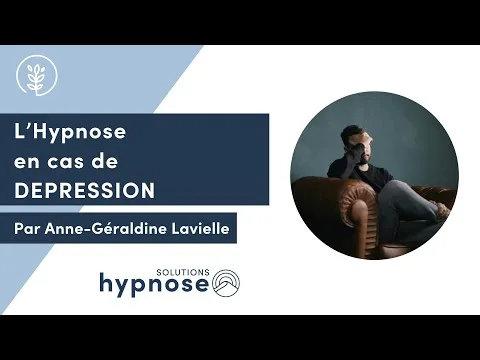
Video transcript
Bonjour, je suis Anne Géraldine Lavielle, coach professionnelle, coach holistique et hypnothérapeute. J'accompagne les personnes à oser être qui elles sont et à créer la vie qui leur plaît. Alors aujourd'hui, je voudrais vous parler de la dépression. Et bien la dépression, en fait c'est une fatigue émotionnelle, une souffrance silencieuse qui touche des millions de personnes dans le monde. Elle se caractérise par une perte de motivation et par un repli sur soi.
C’est un état qui est mal aimé et qui est souvent encore tabou. Si les traitements médicaux et thérapeutiques, évidemment sont essentiels, l'hypnose thérapeutique est un outil complémentaire qui peut vraiment aider les personnes à traverser cet état et à retrouver de la joie de vivre et de l'envie. Alors, à quoi se caractérise la dépression ? À quoi voit on qu'on est dans un état dépressif ? Eh bien, il y a différents symptômes qui se combinent souvent, qui peuvent à la fois toucher les côtés émotionnels, mais aussi mental et physique de la personne.
Déjà une tristesse intense, une perte d'intérêt pour les activités qui autrefois vous faisaient plaisir, une fatigue chronique, des troubles de sommeil qui peuvent conduire à l'insomnie, des difficultés à se concentrer et à faire des activités simples de la vie quotidienne. Du coup, cela conduit à une baisse d'estime de soi et une sorte de baisse de confiance en soi. Enfin, des pensées négatives qui peuvent conduire à de la rumination et qui font chuter l'énergie de la personne.
Alors n'importe qui peut passer par un état dépressif dans sa vie, en fait cela fait partie de la courbe du changement et la dépression est juste un passage pour aller vers quelque chose de nouveau dans sa vie. Il y a différentes étapes dans la vie où on peut passer par un état dépressif, déjà et bien le passage de l'adolescence à l'âge adulte, une rupture amoureuse, un décès dans sa famille, un licenciement professionnel.
Cela peut aussi arriver quand par exemple, les enfants quittent la maison quand ils sont à l'âge de l'autonomie, il y a aussi la dépression de la personne âgée. Je dirais toute situation qui conduit à un changement important et qui va vous obliger à revoir votre mode de vie et votre façon de fonctionner. Et derrière il y a toujours un nouveau projet, quelque chose qui viendra vers vous et qui sera plus lumineux, qui correspondra plus à vos envies et à la nouvelle personne que vous êtes.
Alors, comment se déroule une consultation en hypnose ? Eh bien, l'hypnose thérapeutique déjà, est une approche qui permet d'accéder à l'inconscient pour aider la personne à retrouver ses ressources. Je suis aussi formée en programmation neuro linguistique mais aussi en méditation de pleine conscience, je peux utiliser aussi l’EFT qui est une méthode de libération des émotions ainsi que des techniques créatives. Mais je dirais que la chose primordiale sera la qualité d'être de l'hypnothérapeute, sa capacité à écouter, à avoir de l'empathie, à comprendre ce que la personne traverse, à la rassurer aussi, à l'aider à accepter sa situation, car souvent les personnes sont dans le déni, elles vont avoir besoin d'un peu de temps pour accepter ce qu'elles vivent.
Aussi d'accepter que cette situation n'est qu'une étape sur la courbe du deuil et qu'il y aura après forcément quelque chose de positif pour elles. Alors l'hypnose thérapeutique, eh bien permet de libérer des émotions négatives, comme par exemple : le stress, l'anxiété, la tristesse, la culpabilité. Elle permet aussi d'accéder à ses ressources car nous avons tous des ressources et nous pouvons nous rappeler que dans certaines situations de notre vie, nous avons déjà su rebondir et cela permettra de retrouver une certaine confiance en soi.
Et puis aussi évidemment, d'aider la personne à retrouver des envies, des désirs, peut être des nouveaux besoins. Nous ne sommes plus la même personne que nous étions à 20 ans, à 40 ans, à 60 ans ou à 80 ans. Nous avons besoin d'autre chose. Je me souviens de ce monsieur, qui après plusieurs séances, m'a dit : “C'est vers le yoga que je veux aller.” Ou cette dame qui a pris conscience qu'elle avait besoin de se faire de nouvelles amies et de se sentir plus entourée.
Il y a forcément une solution pour sortir de la dépression. Alors eh bien, toute l'équipe de Solutions Hypnose se tient à votre disposition pour vous aider. Moi même, je suis basée en Alsace, à Strasbourg et à Saverne et je propose aussi des consultations en visioconférence, cela marche vraiment très bien. N'hésitez pas à me contacter, je vous aiderai à retrouver de la joie, de l'énergie positive, du bonheur pour oser créer la vie qui vous convient.
A bientôt.
Hypnotherapy is a complementary form of support and does not replace medical advice, diagnosis, or treatment. If you have any concerns about your health, please consult a physician first.
What Hypnosis can, and cannot, do
What it doesn't do
It does not treat depression and replaces neither a doctor, nor psychotherapy, nor medication.
It is no substitute for any medicine, and our practitioners give no opinion on your prescription.
And it won't ask you to make an effort. If you can't get out of the house, this is not the moment for someone to tell you again to go for a walk.
What it can support
- Sleep. Often the first thing worked on, and the one that changes the rest: slightly better sleep makes everything else more bearable. We have a whole page on sleep problems.
- Anxiety, which very frequently accompanies depressive states — see also our page on stress and anxiety.
- Rumination, those thoughts that turn without an exit, especially at night and on waking.
- Inner talk, that "I'm worthless" which sounds like an observation and is a symptom. That's the subject of our page on the inner critic.
- The link with what you've already come through. Not to tell you that you're strong, but to make accessible again the memory that other hard periods came to an end. In depression that memory becomes unreachable, and recovering it counts.
- A gradual return, when the moment has come and in agreement with your care. Not "acting without the courage to act", but steps small enough to be sustainable.
- Life transitions, when the episode is rooted in a difficult passage: a separation, a bereavement, retirement.
The question of timing
This is what determines everything, and it's rarely said.
In the acute phase, when getting up is already an effort, the priority is medical. Hypnosis has little place at that stage, except on sleep. A serious practitioner will tell you to start elsewhere.
Once care is in place and things are slowly rising, it finds a real place: sleep, rumination, anxiety, inner talk.
Later, on what precipitated the episode and on what you want to build afterwards.
What the research says
The data on hypnosis and depression are limited, and we won't pretend otherwise. The most recent systematic review to include randomised trials only, with a formal assessment of the quality of the evidence, concludes that the available data do not yet support recommending hypnosis in this context — while finding no evidence of significant adverse effects. Hypnosis appears in none of the major depression guidelines, Canadian, British or French: neither for nor against, it simply isn't there.
The recognised approaches for a depressive state are psychotherapy and, depending on the situation, medical care. What is best documented on the hypnosis side concerns other areas — pain, the course of certain medical procedures and the anxiety that accompanies them — and more often alongside other approaches than used alone. That is exactly the position we hold here. Our page on what science says about hypnosis goes through it subject by subject.
An example: Hélène's case
*An illustrative example, built from situations we meet often. It is not one real person's account.*

Hélène (name changed), 52, came six months after a separation. Her doctor had made the diagnosis and put care and medication in place. She wasn't coming about the depression: she was coming because she no longer slept, and because her nights were filled with the same phrases on a loop. The work began with sleep, and with sleep only for several sessions — it was her own objective, and modest enough to be sustainable on an evening when nothing else was.
Only afterwards did it move to what she said to herself on waking, and then to regaining access to periods of her life when she had come through other things — a memory that had become unreachable to her. Her medication and her medical follow-up were at no point discussed in session.
This example describes one possible course of work. It predicts nobody's. The pace and the results vary from one person to another, and no support can guarantee an outcome.
How a session on this subject unfolds
The conversation starts with your care. Have you seen a doctor, do you have support, are you on medication. If the answer is no, we'll point you there before going further, and that isn't a refusal: it's the right sequence.
A very modest objective, deliberately. Not "feel better", but: sleep four hours in a row, get out once this week, keep an appointment.
Sessions matched to your energy. Shorter if needed, with no long exercise to do at home. Handing a programme to someone with no drive left is adding one more possible failure to an already heavy list.
A spaced-out rhythm, as a rule. And we work on the understanding that your doctor remains the pilot.
How many sessions? That's discussed at the first meeting. Nobody can know in advance, and a recovery isn't something you schedule.
Book an appointment
Write to us if you're hesitating. And if your situation calls for a doctor first, we'll tell you plainly — it happens often, and it is never a refusal. Ask us a question or book an appointment. If you don't have the energy to travel, say so: sessions can be shorter, and a video consultation removes the journey. Nobody here will ask you to be in good shape before you come, and cancelling because today isn't the day costs you nothing with us.
Our practitioners see people in Montreal, Sherbrooke, Gatineau, Paris and Lille, and by video wherever you are in the world.
Where would you like to consult?
All areas
 Annie Mayrand
Gatineau - Cumberland (ON)
👤
🧑🎓
🚭
❤️
💻
Annie Mayrand
Gatineau - Cumberland (ON)
👤
🧑🎓
🚭
❤️
💻
 Christian Rocher
Beloeil
👤
🧑🎓
👶
🚭
❤️
💻
Christian Rocher
Beloeil
👤
🧑🎓
👶
🚭
❤️
💻
 David Veilleux
Montréal - Anjou
👤
🧑🎓
🚭
❤️
🤰
💻
David Veilleux
Montréal - Anjou
👤
🧑🎓
🚭
❤️
🤰
💻
 Florence Aton
Sutton
👤
🚭
❤️
💻
Florence Aton
Sutton
👤
🚭
❤️
💻
 Jessica Reid
Sherbrooke
👤
🚭
💻
Jessica Reid
Sherbrooke
👤
🚭
💻
 Julie Rocque
Montréal - Jean-Talon
👤
🧑🎓
👶
🚭
❤️
🤰
💻
Julie Rocque
Montréal - Jean-Talon
👤
🧑🎓
👶
🚭
❤️
🤰
💻
 Nuria Pérez de León
Montréal - Rosemont - Saint-Lambert
👤
🧑🎓
💻
Nuria Pérez de León
Montréal - Rosemont - Saint-Lambert
👤
🧑🎓
💻
 Romain Rastoin
Bromont
👤
🧑🎓
🚭
❤️
💻
Romain Rastoin
Bromont
👤
🧑🎓
🚭
❤️
💻
 Réjeanne LeBlanc
La Prairie
👤
🧑🎓
👶
💻
Réjeanne LeBlanc
La Prairie
👤
🧑🎓
👶
💻


Frequently asked questions about Hypnosis and Depression
No. Depression is an illness that belongs to a doctor and, often, to psychotherapy. Hypnosis can support certain symptoms alongside that care, never in its place.
No, never on your own initiative. An antidepressant is neither stopped nor reduced alone: that is prepared with the doctor who prescribed it. We give no opinion on your medication.
That is a conversation to have with your doctor, not with us. The choice is yours, informed by the person who can actually assess your situation.
Find out before giving up. In Quebec, every public establishment provides mental health care free of charge: the ways in are 811 option 2, your doctor, a family medicine group or a CLSC. In France, the Mon soutien psy scheme covers 12 sessions per calendar year with a participating psychologist at €50 a session, 60 % reimbursed. One caveat: it is aimed only at mild to moderate forms, not at people at risk of suicide, who should call 15 or 3114.
Say so. Sessions adapt, they can be shorter, and video avoids the journey. And if this really isn't the moment, we'll tell you without making you feel you've failed.
No. Depression is neither a lack of willpower nor a weakness of character. The loss of drive is part of the illness.
That depends on a great many things. What is established is that depression is treatable and that most people come through it. That's information, not a promise.
That's discussed at the first meeting. Nobody can know in advance, and a recovery isn't something you schedule.
Stay present without demanding, offer without insisting, and avoid advice of the pull-yourself-together kind. Encourage them to see a doctor, and offer to go with them. Helplines take calls from relatives too.
Talk about it straight away, to a doctor, to emergency services, or to the numbers at the top of this page. It isn't an admission of weakness and you aren't bothering anyone.
Sources and references
In Quebec and Canada
- 1 866 APPELLE: 24/7 crisis line — Suicide.ca (Association québécoise de prévention du suicide), in French: "1 866 APPELLE (277-3553) […] 24 heures sur 24 et 7 jours sur 7".
- Dépression — Gouvernement du Québec (in French): symptoms present most of the time for at least two weeks.
- Ressources d'aide et de soutien en santé mentale — Gouvernement du Québec (in French): the directory of helplines, which "s'adressent également à la famille et aux proches".
- Étapes pour obtenir des soins et services en santé mentale — Gouvernement du Québec (in French): "Tous les établissements publics […] offrent gratuitement des soins et des services en santé mentale."
- Programme québécois pour les troubles mentaux — Quebec Ministry of Health (in French).
- Trouver de l'aide — Ordre des psychologues du Québec (in French). A directory of subscribing practitioners: "Leurs services sont payants."
- Mental health support: Get help — Government of Canada, the source for 988: "If you or someone you know is thinking about suicide, call or text 9-8-8. Support is available 24 hours a day, 7 days a week."
In France
- Numéro national de prévention du suicide — the 3114, "accessible 24h/24 et 7j/7, gratuitement, en France entière".
- Traitement de la dépression — Assurance Maladie (in French): antidepressants are prescribed "en association à la psychothérapie" and "en cas d'épisode dépressif modéré à sévère".
- Mon soutien psy — Assurance Maladie (in French): conditions, pathway and exclusions.
- Directory of participating psychologists — Assurance Maladie (in French).
On hypnosis and on the established approaches
- Souza, F. L. F., Moura, L. S., Vieira Almeida Silva, N., & Elkins, G. (2024). *Hypnosis-based interventions for depression: a systematic review*. Complementary Therapies in Clinical Practice. doi.org/10.1016/j.ctcp.2024.101913 — "There is not enough evidence to indicate that hypnosis-based interventions may reduce the severity of depression […] although no evidence of significant adverse effects was found."
- Valentine, K. E., Milling, L. S., Clark, L. J., & Moriarty, C. L. (2019). *The Efficacy of Hypnosis as a Treatment for Anxiety: A Meta-Analysis*. International Journal of Clinical and Experimental Hypnosis, 67(3), 336-363. doi.org/10.1080/00207144.2019.1613863 — "Hypnosis was more effective in reducing anxiety when combined with other psychological interventions than when used as a stand-alone treatment."
- Cuijpers, P. et al. (2026). *Behavioral activation for depression: a meta-analysis*. Clinical Psychology Review. doi.org/10.1016/j.cpr.2026.102783 — 105 trials, 13,933 people; the effect holds up to twelve months.
Need help right now? Quebec: 1 866 APPELLE (277-3553) · text 535353 · Info-Social 811 option 2. Elsewhere in Canada: 988, call or text. France: 3114, free and around the clock.
Hypnosis as practised by the members of Solutions Hypnose is a complementary support approach. It is neither a medical act, nor a diagnosis, nor psychotherapy in the regulatory sense, and it in no way replaces a consultation, follow-up or treatment prescribed by a health professional.
Our practitioners do not assess and do not treat mental disorders or illnesses. They never ask for an ongoing treatment to be stopped or changed: that decision rests exclusively with your doctor.
No result can be guaranteed. The testimonials and examples presented on this page describe individual experiences and do not predict what you will experience.
In case of significant distress, unexplained physical symptoms or suicidal thoughts, contact a doctor, emergency services or a helpline without delay.

Page written by Anne-Géraldine Lavielle
hypnotherapist and holistic coach
partner at Solutions Hypnose.
English version reviewed by David Veilleux
Published .