
Hypnosis for Golfers: mental preparation, performance
On the range, everything works. In competition, you do not recognise yourself.
Or it is more specific than that: it is the five-foot putt. The one you hole with your eyes shut on a Tuesday, and stand over four seconds too long on a Sunday. Or it is the hole where it all tips over — one bad shot, then a second trying to make it back, then a card that goes. You know perfectly well that the real problem is not the first shot, it is what you did afterwards.
Golf is unusual in one respect: you have a lot of time between shots. That is what makes it a magnificent game, and it is also what leaves all the room in the world for the inner commentary.


Why the mental side weighs so heavily in golf
This page is a specialist article. Mental preparation for sport as a whole — mental imagery, the zone of activation, bouncing back after a mistake, routines, sleep, returning after injury — is covered in our guide Hypnosis for Sports Performance. Read that first if the subject is new to you. Here we go into what is specific to golf: the dead time between shots, the short putt, the card, and a phenomenon golfers know well and that deserves to be explained properly, the *yips*.
The dead time. Four to five hours on the course, of which a few minutes are actual stroke. The rest is walking and thinking.
The stroke is self-initiated. Nobody serves you the ball, no opponent forces your hand. You decide when, which leaves all the latitude in the world to hesitate.
The gap between practice and competition is more visible here than anywhere else, because the stroke is identical and only the context changes.
And the bookkeeping. Every shot is recorded, compared, added up. It is hard to turn the page when the score keeps it open.
Golf is also a precision sport, which has a direct consequence: the optimal zone of activation is particularly narrow. A weightlifter can afford to be highly aroused; a golfer cannot. That notion is explained in our Sports Performance guide.
The attention paradox
Here is a point most players do not know, and it explains a great deal.
The more attention you pay to the mechanics of your stroke at the moment of making it, the worse it works. A movement made automatic by years of practice degrades when you put it back into manual control. That is exactly what happens under pressure: you start monitoring your wrists, your transfer, your tempo.
The idea has been studied for thirty years under the name external focus of attention: directing attention at the intended effect — the target, the ball flight, the movement of the club — rather than at your own body. A 2007 study measured exactly that in six expert golfers with an average handicap of 1.3: they struck markedly more accurately while thinking about the movement of the club than about the movement of their arms, and better even than when left to their usual habits.
The proposed explanation is simple: turning your attention to your own movement puts it back under conscious control, which disrupts the automatic patterns.
And now the honest part, because this file has changed recently. External focus is one of the most cited principles in motor learning, and you will read it everywhere as settled fact. It is currently contested. A reanalysis published in 2024 in the same journal as the landmark meta-analysis, using the same data, concludes that the effect is largely explained by publication bias: once corrected, it becomes negligible. The authors explicitly call for caution before recommending it in applied settings. We mention it anyway, because players' and teachers' experience points the same way and because the 2007 study on experts exists — but that study involved six players, and we will not present it as a demonstration.
What makes mental preparation relevant here does not hinge on that debate: it does not work on your swing, it works on where your attention goes while the swing happens. Whether the exact mechanism is that one or another, the experience of a player monitoring himself under pressure is not in dispute.
Something to know about: the yips
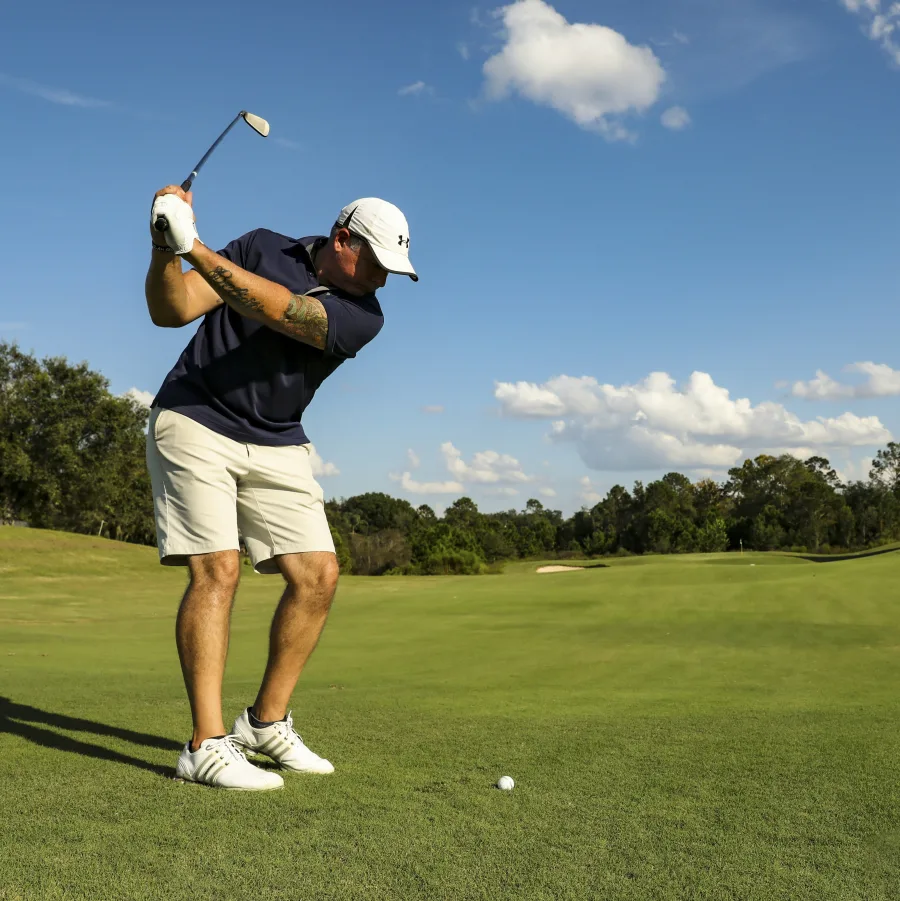
If you get jerks, freezes or involuntary contractions at the moment of the putt or the chip, only in that stroke and nowhere else, it is not necessarily a mental problem. The phenomenon, known as the *yips*, is well described in the medical literature — and it is common: in a survey of professional and amateur golfers, 28 % of respondents reported suffering from it. The figure should be read with care, since it covers only the golfers who took the trouble to reply, but a more recent Dutch study finds a comparable order of magnitude, around 22 %.
The yips belong to the same family as writer's cramp and musician's dystonia: focal dystonias, involuntary muscle contractions triggered by one precise, heavily repeated movement. The US National Library of Medicine explicitly lists golfers among those affected, and the MSD Manual names "musician's and golfer's dystonia" in the same breath. A 2005 study found, on electromyography, abnormal wrist co-contraction in half the affected golfers and in none of the unaffected ones — a later study by the same group, on a larger sample, found it only as a trend.
Two readings coexist, and we will not settle between them. A 2003 review proposes seeing the yips as a continuum between a neurological pole (focal dystonia) and a psychological one (collapse under pressure), based on the accounts of 72 affected golfers — the authors themselves call it preliminary support. Conversely, the National Library of Medicine writes that focal dystonia does not appear to be a form of performance anxiety. Both positions exist in the literature.
What is certain is that the two pictures look alike from the outside, and that it is not for us to tell them apart. If your symptoms are frankly involuntary, resist all technical work and persist in practice with nothing at stake, speak to your doctor before going any further: they will refer you to a neurologist if needed. Diagnosing a dystonia is a clinical matter, and it belongs to a doctor. Years are sometimes lost treating as a mental block something that is not one. It is the same vigilance we apply on musicians' inner hearing, where focal dystonia is also a trap. Our practitioners make no diagnosis.
And if the body is involved. Pain in the back, the elbow or the wrist, loss of strength: see a doctor. Pain changes both the movement and the apprehension, and no mental work replaces medical advice — see also our page on pain management.
What it costs
The cards. The gap between your actual level and the score you hand in, which wears you down in the end.
Competitions avoided. Many players stop entering, and that is often what prompts the call.
The enjoyment. It is what people mention least and what brings them most. A chosen pastime becomes a four-hour assessment.
And the body, because a tense player gets injured more.
What exists outside hypnosis
- A teaching pro. When a movement resists, it is not always mental. A pro can settle the question in one lesson.
- A doctor, in case of pain or involuntary symptoms.
- The pre-shot routine. It is the best studied mental preparation tool across all sports, and the most underused by amateurs: a short sequence, always identical, that occupies the attention and signals to the body that this is the moment. A meta-analysis pooling 112 effect sizes finds a moderate to large benefit in experimental conditions, including under pressure, and whatever the athlete's level. Your teaching pro can help you build one.
- Mental preparation and sport psychology, disciplines in their own right.
- A round journal, to spot where and when things actually tip over, rather than relying on the impression left by the last hole.
Hypnosis is added to that list. It does not replace it.
What Hypnosis can offer
It does not fix a swing, does not replace a teaching pro, and guarantees no score. It does not improve your technique: it works on what stops your technique coming out. The main lever is the switch to manual control — getting out of watching the stroke and back to the target. Then comes the pre-shot routine, to be installed and anchored so that it holds under pressure and not only on the range. Then the next shot: the ability to move on after a bad one is probably what most clearly separates two players of the same technical level.
That principle holds for every sport and it is set out in the Sports Performance guide; in golf it takes a particular form, since you have several minutes of walking in which to ruminate before the next shot.
What else a course of work aims at:
- The short putt, where what is at stake is out of all proportion to the difficulty.
- Consistency over eighteen holes, and the move from the ninth to the tenth.
- One specific memory: the hole where it went wrong, the competition that got away, the shot in front of an audience.
- The pleasure of playing, which is not a bonus: a player who is enjoying it plays better.
What the research says
There is no solid study showing that hypnosis improves golf performance. We are not going to claim otherwise.
What is documented is the effect of hypnosis on anxiety — a meta-analysis of seventeen trials finds a large average effect, better as a complement to other approaches than used alone. That bears on anxiety, not on sporting performance.
And the pre-shot routine does have a solid base, including under pressure.
The rest is reasoning, not proof. If pressure pushes you to monitor yourself and if monitoring yourself degrades an automatic movement, then working on what attention does under pressure makes sense. It is coherent. But the external focus advantage has been contested since 2024, no study covers hypnosis and golf, and coherent does not mean demonstrated. We will not write it as though it did.
An example: Marc's case
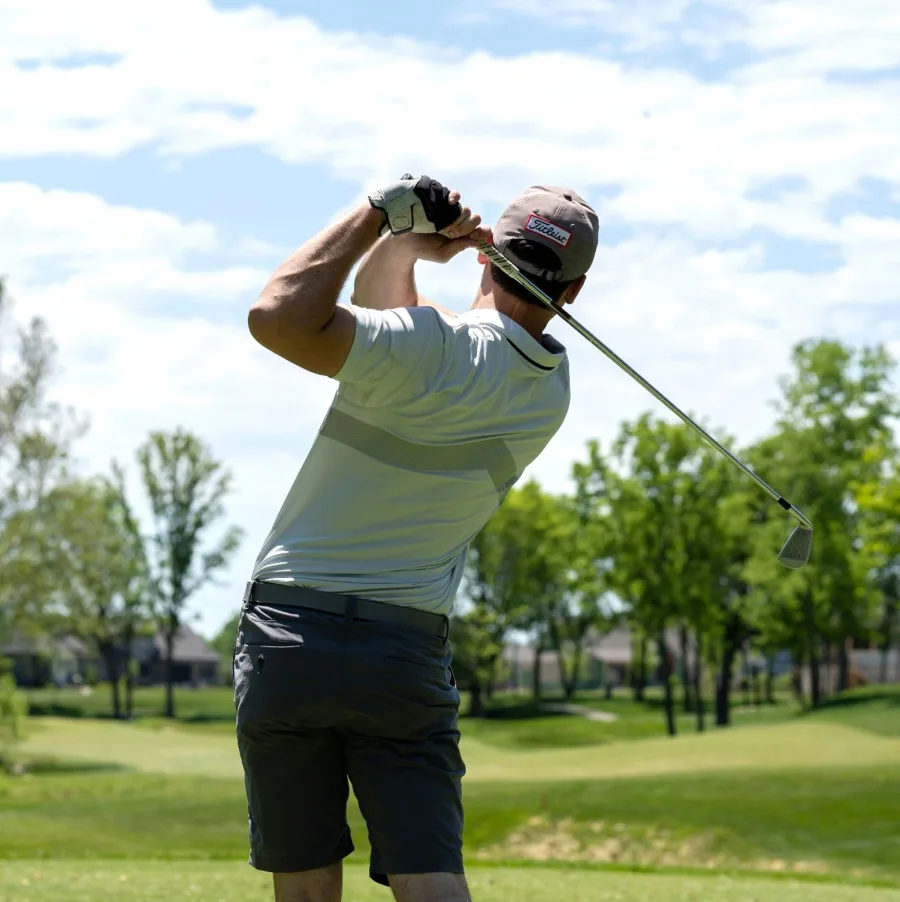
Marc (name changed) has played for fifteen years. Good level on the range, disappointing results in competition. He summed it up like this: "I fall apart as soon as anything is at stake, I feel like I no longer know how to play the moment it counts." The work was not about his swing, which was not the issue. It was about the seconds before the shot, about where his attention went at that moment, and about what he did after a bad one. He installed a short routine, anchored on one precise gesture, and learned a brief form of self-hypnosis he could use while walking between holes.
This case describes one possible path. It predicts nobody else's. Pace and results vary from one person to another, and no course of work can guarantee a result or an improvement in score.
How a course of work unfolds
The conversation. How long you have played, your level, and above all where exactly it sticks: a stroke, a moment in the round, a context. The practitioner will try to separate what is mental, what is technical, and what calls for medical advice.
A concrete goal. Not "be a better player", but: hand in a card that matches the level I practise at, approach short putts without standing over them for four seconds, stop losing three holes after a bad shot.
The induction, then the work itself: attention directed at the target, the pre-shot routine, an anchor, revisiting a memory, preparing for a dated competition.
The follow-through. A brief form of self-hypnosis, usable while walking. Some practitioners provide a recording to listen to before a competition.
The calendar. This kind of request often has a deadline. Say what it is: it organises everything else.
How many sessions? That is discussed at the first appointment. Nobody can know in advance.
Book an appointment
Tell us if you have a competition coming up: the deadline changes how the work is organised. And if what you describe belongs rather with your teaching pro or a doctor, we will say so. Ask us a question or book an appointment. Wherever you are in the world, video consultations suit this subject well, since it all happens in imagination — here is how it works. If it is the stage rather than the green that undoes you, see our page on stage fright and artistic performance.
Where would you like to consult?
All areas
 Annie Mayrand
Gatineau - Cumberland (ON)
👤
🧑🎓
🚭
❤️
💻
Annie Mayrand
Gatineau - Cumberland (ON)
👤
🧑🎓
🚭
❤️
💻
 Christian Rocher
Beloeil
👤
🧑🎓
👶
🚭
❤️
💻
Christian Rocher
Beloeil
👤
🧑🎓
👶
🚭
❤️
💻
 David Veilleux
Montréal - Anjou
👤
🧑🎓
🚭
❤️
🤰
💻
David Veilleux
Montréal - Anjou
👤
🧑🎓
🚭
❤️
🤰
💻
 Florence Aton
Sutton
👤
🚭
❤️
💻
Florence Aton
Sutton
👤
🚭
❤️
💻
 Jessica Reid
Sherbrooke
👤
🚭
💻
Jessica Reid
Sherbrooke
👤
🚭
💻
 Julie Rocque
Montréal - Jean-Talon
👤
🧑🎓
👶
🚭
❤️
🤰
💻
Julie Rocque
Montréal - Jean-Talon
👤
🧑🎓
👶
🚭
❤️
🤰
💻
 Nuria Pérez de León
Montréal - Rosemont - Saint-Lambert
👤
🧑🎓
💻
Nuria Pérez de León
Montréal - Rosemont - Saint-Lambert
👤
🧑🎓
💻
 Romain Rastoin
Bromont
👤
🧑🎓
🚭
❤️
💻
Romain Rastoin
Bromont
👤
🧑🎓
🚭
❤️
💻
 Réjeanne LeBlanc
La Prairie
👤
🧑🎓
👶
💻
Réjeanne LeBlanc
La Prairie
👤
🧑🎓
👶
💻


Frequently asked questions about Hypnosis for Golfers
We do not promise that. It works on what stops your actual level from showing up on the course. What happens on the card after that depends on a great many other things too.
The first thing is to tell anxious hesitation apart from involuntary movement. If the jerks are frankly involuntary, occur only on that stroke and persist with nothing at stake, see a neurologist: that picture suggests the yips in their neurological form.
That is the most common reason people come. The gap almost never comes from technique, but from switching over to watching the stroke.
No. Amateurs make up most of the enquiries, often with enjoyment rather than results at stake, which is an excellent reason.
That is discussed at the first appointment, depending on your deadline. Nobody can know in advance.
Yes, it all happens in imagination. No session takes place on a course.
That is workable and it is a good window. Say so at the first contact: the deadline organises everything else.
Sources and references
On the yips
- Smith, A. M., Adler, C. H., Crews, D. et al. (2003). *The "yips" in golf: a continuum between a focal dystonia and choking*. Sports Medicine, 33(1), 13-31. doi.org/10.2165/00007256-200333010-00002 — the Mayo Clinic paper behind the type I / type II distinction, on 72 golfers, described by its own authors as preliminary support.
- McDaniel, K. D., Cummings, J. L., & Shain, S. (1989). *The "yips": a focal dystonia of golfers*. Neurology, 39(2), 192-195. doi.org/10.1212/wnl.39.2.192 — source of the 28 % of respondents figure, and of the finding that affected golfers are older with more years of play.
- van Wensen, E., van der Zaag-Loonen, H. J., & van de Warrenburg, B. P. (2021). *The Dutch Yips Study: Results of a Survey Among Golfers*. Tremor and Other Hyperkinetic Movements, 11, 27. doi.org/10.5334/tohm.636 — 22 % prevalence among Dutch golfers.
- Adler, C. H., Crews, D., Hentz, J. G., Smith, A. M., & Caviness, J. N. (2005). *Abnormal co-contraction in yips-affected but not unaffected golfers: evidence for focal dystonia*. Neurology, 64(10), 1813-1814. And Adler, C. H. et al. (2011). *Are the yips a task-specific dystonia or "golfer's cramp"?* Movement Disorders, 26(11), 1993-1996, which finds the co-contraction only as a trend.
On focal dystonia
- Task-specific focal dystonia — MedlinePlus, US National Library of Medicine. Explicitly lists golfers, and states that focal dystonia does not appear to be a form of performance anxiety.
- Dystonias — MSD Manual, professional edition. On task-specific dystonia, which includes writer's cramp and musician's and golfer's dystonia, and on diagnosis being clinical.
- Dystonia — National Health Service, United Kingdom. On what to do: see a doctor, who refers on to a neurologist if needed.
On attention and routines
- Wulf, G., & Su, J. (2007). *An External Focus of Attention Enhances Golf Shot Accuracy in Beginners and Experts*. Research Quarterly for Exercise and Sport, 78(4), 384-389. open-access PDF — six expert golfers in experiment 2.
- Chua, L.-K., Jimenez-Diaz, J., Lewthwaite, R., Kim, T., & Wulf, G. (2021). *Superiority of external attentional focus for motor performance and learning: Systematic reviews and meta-analyses*. Psychological Bulletin, 147(6), 618-645. doi.org/10.1037/bul0000335
- McKay, B. et al. (2024). *Reporting Bias, Not External Focus: A Robust Bayesian Meta-Analysis and Systematic Review of the External Focus of Attention Literature*. Psychological Bulletin, 150(11), 1347-1362. doi.org/10.1037/bul0000451 — the reanalysis which, from the same data, finds a negligible effect once publication bias is corrected for.
- Rupprecht, A. S. A., Tran, U. S., & Gröpel, P. (2024). *The effectiveness of pre-performance routines in sports: a meta-analysis*. International Review of Sport and Exercise Psychology, 17(1), 39-64. doi.org/10.1080/1750984X.2021.1944271 — 112 effect sizes.
On Hypnosis and anxiety
- Valentine, K. E., Milling, L. S., Clark, L. J., & Moriarty, C. L. (2019). *The Efficacy of Hypnosis as a Treatment for Anxiety: A Meta-Analysis*. International Journal of Clinical and Experimental Hypnosis, 67(3), 336-363. doi.org/10.1080/00207144.2019.1613863 — on anxiety, not on sporting performance.
Hypnosis as practised by the members of Solutions Hypnose is a complementary support approach. It is neither a medical act, nor a diagnosis, nor psychotherapy in the regulatory sense, and it in no way replaces a consultation, follow-up or treatment prescribed by a health professional.
Our practitioners do not assess and do not treat mental disorders or illnesses. They never ask for an ongoing treatment to be stopped or changed: that decision rests exclusively with your doctor.
No result can be guaranteed. The testimonials and examples presented on this page describe individual experiences and do not predict what you will experience.
In case of significant distress, unexplained physical symptoms or suicidal thoughts, contact a doctor, emergency services or a helpline without delay.
Page written by Nuria Pérez de León
hypnotherapist and NLP coach
partner at Solutions Hypnose.
English version reviewed by David Veilleux
Updated .