
Hypnosis and Selective Mutism in Children
He talks non-stop at home. He tells you about his day, he sings, he argues with his brother. At school, nothing. Not a word to the teacher, not a word to the other children. He looks down, he freezes, he waits for it to pass.
And you may have been told he's shy, that he'll come out of his shell. Or the opposite: that he's being difficult, that he refuses to speak. It is neither.
Selective mutism is an anxiety disorder. This page sets out what it is, what you must not do — the part that costs nothing and changes everything —, where to start, and what hypnosis can offer alongside proper care, without ever delaying it.


What selective mutism is
Selective mutism is an anxiety disorder — that is the classification used both by the DSM-5 and by the ICD-11. It is characterised by a persistent inability to speak in certain social situations — school, with strangers — while the child speaks normally in other settings, at home or with close family. The diagnosis requires that the silence last at least one month, not counting the first month of school: the start of the year always deserves time.
The child is not intentionally refusing to speak. His silence is a response to intense anxiety. He feels paralysed by the fear of being judged, and in that moment he cannot do otherwise.
That difference is essential, and it changes how to support him: you don't respond the same way to a refusal and to a freeze.
A disorder often spotted too late
It frequently goes unnoticed, because it doesn't disturb anyone. The child is quiet, calm, he doesn't disrupt the class. It can take years to realise this isn't shyness.
Yet children affected risk social, academic and sometimes language delays if nobody supports them. The earlier the support, the simpler it is — and that isn't only intuition: in a follow-up published a year after support ended, 78 % of children aged 3 to 5 no longer had selective mutism, against 33 % of those aged 6 to 9. That's why this page insists so much on getting started.
Selective mutism most often appears between 3 and 6 years old, but it is frequently spotted later, when school starts and the contrast between home and classroom becomes visible. It affects fewer than 1 % of children — more among those schooled in a language that isn't spoken at home. And it rarely comes alone: eight children in ten also have another anxiety disorder, most often social anxiety.
The signs that often go with it
- Marked shyness, fear of being embarrassed in public, social withdrawal
- Strong attachment to the parents
- Repetitive behaviours
- And often tantrums at home — because the tension built up all day is released where the child feels safe
Some typical situations

Selective mutism doesn't look the same in every child, and you may well recognise yours in one of these. Silent at school, expressive at home: he talks freely with the family and freezes completely in class, avoids the teacher's eye, can seem absent or distracted, and sometimes cannot even manage a yes or a no. He speaks to only one or two classmates: he whispers to a friend he trusts, who often ends up answering on his behalf, but he never addresses an adult.
He doesn't speak at all outside the home — at school, with extended family, in public places. He seems blocked, tense, and may cry if told to speak. Or he speaks only in very precise conditions: alone with a parent in a closed room, for instance. As soon as something changes, as soon as someone comes in, he freezes.
What you must not do
This is the most important part of this page, and it costs nothing to apply from today.
Never force your child to speak. Not by insisting, not by the adult's silence waiting for it to come. Every specialist association says the same thing: the pressure has to be removed, not increased.
Don't promise a reward in exchange for speech. One clarification is needed here, because it is counter-intuitive: reinforcement systems genuinely are part of recognised behavioural approaches, but run by a professional. A reward promised in advance by a parent turns the exchange into a test and adds exactly the pressure you were trying to remove. The same goes for praising the child publicly when he finally speaks: it draws attention to him and often causes a setback.
Don't systematically speak for him, but don't leave him alone facing an impossible demand either. This is the best described maintaining mechanism of the disorder: the adult answers for the child, the discomfort drops away at once, and the silence is reinforced for next time. The balance is to leave him other ways of answering: a nod, a gesture, pointing at something, a written word. And to rephrase your questions: a closed question, answered yes or no or in a word, is infinitely easier than an open one.
Don't comment in front of him. "He never speaks", "he's very shy", said in front of the child, installs an identity he will then struggle to leave behind.
Don't present him as someone who refuses. It isn't opposition, and saying so at school changes how he'll be looked after.
And above all, don't let it drift. Selective mutism doesn't always resolve on its own, and it becomes entrenched with time.
Where to start
Talk to your doctor or paediatrician. That's the first step, and it also allows what needs checking to be checked: hearing, language development, and other possibilities a professional will rule out.
The best supported approach combines behavioural work with very gradual exposure, the parents' involvement and the school's cooperation. A meta-analysis of five controlled trials finds a large effect. It should be said, though, that no harmonised official guideline yet exists for this disorder, and that studies remain few: practice varies from one professional to another. Depending on the situation, a psychologist, a speech therapist or a child psychiatrist may be involved. Medication is not a first-line option; it is considered with a doctor when support alone isn't enough.
School is a partner, not a problem. Adjustments exist: not requiring a spoken answer at first, providing alternative means of communication, avoiding putting the child on the spot in front of the group. Teachers rarely know this disorder, and a clear explanation from you often changes a great deal.
In France, the ministry answered a parliamentary question on exactly this: an individualised reception plan (*projet d'accueil individualisé*) can be drawn up for a child with mutism, and depending on the situation other personalised plans can take over. The point that reassures families most: these adjustments are possible without a disability being recognised. In Quebec, there is no dedicated ministry document on selective mutism: the route goes through the school team, supported by your CIUSSS youth mental health services.
Two clarifications that prevent mistakes.
If your child is discovering a new language, he will often go through a period of speaking little. That's normal, and it isn't selective mutism: that period generally lasts less than six months. What matters isn't so much its length as the fact that it progresses — the child listens, repeats under his breath, then takes the plunge. If the silence doesn't shift, if it also affects the home language, or if it drags on, say something: selective mutism is in fact more common among children schooled in another language, and that's the group where delayed support costs the most.
And if you think the situation is linked to a traumatic event or to a difficult family or social context, turn to a child psychologist or a social worker.
What Hypnosis can offer
Let's be clear: hypnosis does not treat selective mutism, which is an anxiety disorder requiring specialist care. It replaces neither the doctor, nor the psychologist, nor the work with the school — and it must above all not delay any of that, because time matters here.
What it can do, alongside, is work on the anxiety at the heart of the problem. And it has a real advantage with children: it goes through imagination, play and relaxation, and it doesn't ask the child to speak. That is far from trivial when speaking is precisely what's impossible.
The work is built around four strands: reducing the anxiety and changing how the triggering situations are perceived; building confidence in social situations; encouraging very gradual communication — first sounds, whispers, then the voice, in settings chosen in order of difficulty, never straight to the whole class; and equipping the parents, so the work carries on at home and everyone knows what to do when the child freezes.
What it looks like in practice
Every child is different, but here is what your practitioner might use.
Relaxation, to bring down the background anxiety.
A safety anchor: a discreet gesture, pressing a finger against the palm for instance, paired with a feeling of calm, which the child can call up alone before trying to speak.
A progression in imagination, where he pictures increasingly demanding communication situations — speaking alone in his room, then to a friend, then to a small group.
Metaphors and stories, where a quiet character gradually finds their voice.
Role play with soft toys, puppets or drawings, which allow expression without the pressure landing on the child himself.
What the research says
The scientific literature contains only one published case on hypnosis and selective mutism: a 2016 report on a single child. One case allows no conclusion — it cannot separate the effect of the support from natural change, and selective mutism does improve spontaneously in some children. No practice guideline recommends hypnosis for this disorder, and we prefer to tell you.
The approach whose effectiveness is established is behavioural work with graded exposure, and that is what should be started first.
What is documented on the hypnosis side is its effect on anxiety, with better results alongside other approaches than used alone. That is exactly the place we claim here, and our page on what science says about hypnosis goes through it subject by subject.
An example: Félix's case
*Name changed, published with the parents' written consent held on file.*

Félix, 9, had spoken neither to his teacher nor to the other pupils since he was four, and more generally not to anyone outside the family circle. His parents had sought help early on, and specialist care was already in place when they called us. The hypnosis work was never about speaking: it was about the anxiety itself, about a discreet anchor he could call up on his own, and about a very slow progression in imagination, starting well below what the classroom asked of him.
A sound, then a word, then a sentence, in situations chosen with him. His parents were equipped in parallel, in particular to stop answering for him — that is often the change that costs adults the most, and the one that frees up the most room for the child.
This case describes one possible path. It does not predict your child's. The pace and the results vary from one child to another, selective mutism takes time, and no support can guarantee an outcome.
How a session with a child unfolds
Before the session, we have a phone conversation with at least one parent, to understand the situation and check that we are the right resource. Sometimes the answer is no, and we'll say so.
Your child has to be willing. That's a condition. Even if he doesn't understand what hypnosis is, show him the practitioner's photo or introduction video: he'll decide whether he feels like meeting this person who tells slightly magical stories. Often the word hypnosis alone sparks their curiosity.
And one detail that reassures many families: your child won't have to speak for the session to take place. The practitioner knows how to work with a silent child.
The session starts with the three of you, parent and child present, then generally continues with the child alone, if he wishes. At the end, there's a quick debrief with you. If all is well we don't go into detail: children like to keep it to themselves, and he'll talk about it when he wants to.
Worried about what happens during the session? Do discuss it with your practitioner. Some members of the team offer a video monitor, without sound, allowing you to follow the session from the waiting room.
Book an appointment
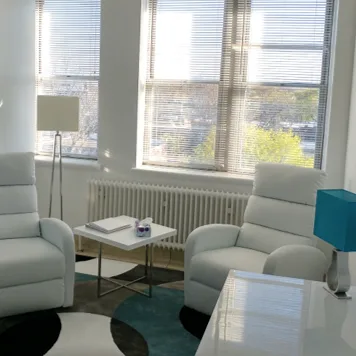
Tell us where you are in the process, and we'll tell you honestly whether we are the right resource. If an assessment or specialist care seems to us the priority, we'll say so — and it is never a refusal, simply the right order of things. Ask us a question or book an appointment. If the anxiety spills well beyond school, see also our page on anxiety in children: selective mutism often sits next to it, and the two are worked on together.
Video consultations are possible from age 6 depending on the child — the guide is here. Our practitioners who work with children in English see families in Montreal, La Prairie and Beloeil, as well as in Paris and Lille.
Where would you like to consult?
All areas
 Annie Mayrand
Gatineau - Cumberland (ON)
👤
🧑🎓
🚭
❤️
💻
Annie Mayrand
Gatineau - Cumberland (ON)
👤
🧑🎓
🚭
❤️
💻
 Christian Rocher
Beloeil
👤
🧑🎓
👶
🚭
❤️
💻
Christian Rocher
Beloeil
👤
🧑🎓
👶
🚭
❤️
💻
 David Veilleux
Montréal - Anjou
👤
🧑🎓
🚭
❤️
🤰
💻
David Veilleux
Montréal - Anjou
👤
🧑🎓
🚭
❤️
🤰
💻
 Florence Aton
Sutton
👤
🚭
❤️
💻
Florence Aton
Sutton
👤
🚭
❤️
💻
 Jessica Reid
Sherbrooke
👤
🚭
💻
Jessica Reid
Sherbrooke
👤
🚭
💻
 Julie Rocque
Montréal - Jean-Talon
👤
🧑🎓
👶
🚭
❤️
🤰
💻
Julie Rocque
Montréal - Jean-Talon
👤
🧑🎓
👶
🚭
❤️
🤰
💻
 Nuria Pérez de León
Montréal - Rosemont - Saint-Lambert
👤
🧑🎓
💻
Nuria Pérez de León
Montréal - Rosemont - Saint-Lambert
👤
🧑🎓
💻
 Romain Rastoin
Bromont
👤
🧑🎓
🚭
❤️
💻
Romain Rastoin
Bromont
👤
🧑🎓
🚭
❤️
💻
 Réjeanne LeBlanc
La Prairie
👤
🧑🎓
👶
💻
Réjeanne LeBlanc
La Prairie
👤
🧑🎓
👶
💻


Frequently asked questions about Hypnosis and Selective Mutism in Children
Shyness eases with familiarity. In selective mutism, the child stays blocked even after months in the same class with the same teacher. That is what should alert you.
No. His silence is a response to intense anxiety, not a refusal. It's the most important thing to understand, and to explain at school.
Not always, and it becomes more entrenched with time. The earlier the support, the simpler it is.
That it is an anxiety disorder, not opposition. That no spoken answer should be required at first, that the child shouldn't be singled out in front of the group, and that other ways of communicating exist in the meantime.
A quiet period is normal while learning a new language, and it usually lasts less than six months. What matters is that it progresses. If the silence doesn't shift, or also affects the home language, talk to a professional.
No. The practitioner knows how to work with a child who doesn't speak, and that is precisely what makes the session possible.
Around 5 or 6 depending on maturity, and from 6 by video.
That's discussed at first contact. Selective mutism takes time, and we don't give a number in advance.
Sources and references
On the disorder and spotting it
- Selective Mutism — American Speech-Language-Hearing Association: "duration of the mutism is at least 1 month (not limited to the first month of school)" and "onset of selective mutism typically occurs between 3 and 6 years of age".
- Driessen, J. et al. (2020). *Anxiety in Children with Selective Mutism: A Meta-analysis*. Child Psychiatry & Human Development. pubmed.ncbi.nlm.nih.gov/31650460 — 22 studies, 837 children: 80 % have another anxiety disorder, 69 % social phobia.
- Toppelberg, C. O. et al. (2005). *Differential diagnosis of selective mutism in bilingual children*. Journal of the American Academy of Child & Adolescent Psychiatry. pmc.ncbi.nlm.nih.gov/articles/PMC3538870 — the non-verbal period of a child learning a language "typically is shorter than 6 months"; what distinguishes selective mutism is the absence of progression.
On support
- Steains, S., Malouff, J. M., & Schutte, N. S. (2021). *Efficacy of psychological interventions for selective mutism in children: A meta-analysis*. Child: Care, Health and Development. pubmed.ncbi.nlm.nih.gov/34265102 — five controlled trials, large effect (g = 0.87).
- Oerbeck, B. et al. (2015). *Selective mutism: follow-up study 1 year after end of treatment*. European Child & Adolescent Psychiatry. pubmed.ncbi.nlm.nih.gov/25267381 — 78 % of 3-5 year-olds against 33 % of 6-9 year-olds free of selective mutism a year later.
- Manassis, K., Oerbeck, B., & Overgaard, K. R. (2016). *The use of medication in selective mutism: a systematic review*. European Child & Adolescent Psychiatry. pubmed.ncbi.nlm.nih.gov/26560144 — limited evidence, not a first-line option.
What not to do, and school
- Mutisme sélectif chez les enfants et les jeunes — eSanteMentale.ca, Quebec portal (in French): "Ne faites pas pression sur votre enfant"; "Même le fait de récompenser l'enfant pour avoir parlé est une forme de pression"; "Ne félicitez pas l'enfant devant les autres pour avoir parlé".
- Information for Professionals — SMIRA: "All pressure to speak must be removed by all those with contact with the child"; ask closed rather than open questions.
- Reconnaissance du mutisme sélectif en tant que handicap — written question no. 32598, French ministry's reply, 1 March 2022 (in French): an individualised reception plan can be drawn up, and adjustments are possible "sans qu'il y ait nécessairement la reconnaissance d'un handicap".
On hypnosis
- Cavarra, M., Brizio, A., & Gava, N. (2016). *Ericksonian hypnotherapy for selective mutism: A single-case study*. Acta Bio-Medica. pubmed.ncbi.nlm.nih.gov/28112698 — the single case report cited above, the only indexed title on the subject.
- Zhao, Y. et al. (2023). *Complementary and alternative medicine recommendations in clinical practice guidelines for anxiety*. Frontiers in Psychiatry. pubmed.ncbi.nlm.nih.gov/38152358 — "No CAM recommendations were provided for … selective mutism."
- Valentine, K. E., Milling, L. S., Clark, L. J., & Moriarty, C. L. (2019). *The Efficacy of Hypnosis as a Treatment for Anxiety: A Meta-Analysis*. International Journal of Clinical and Experimental Hypnosis, 67(3), 336-363. doi.org/10.1080/00207144.2019.1613863 — "Hypnosis was more effective in reducing anxiety when combined with other psychological interventions than when used as a stand-alone treatment." This meta-analysis covers anxiety in general, largely in adults: it says nothing about selective mutism.
Hypnosis as practised by the members of Solutions Hypnose is a complementary support approach. It is neither a medical act, nor a diagnosis, nor psychotherapy in the regulatory sense, and it in no way replaces a consultation, follow-up or treatment prescribed by a health professional.
Our practitioners do not assess and do not treat mental disorders or illnesses. They never ask for an ongoing treatment to be stopped or changed: that decision rests exclusively with your doctor.
No result can be guaranteed. The testimonials and examples presented on this page describe individual experiences and do not predict what you will experience.
In case of significant distress, unexplained physical symptoms or suicidal thoughts, contact a doctor, emergency services or a helpline without delay.
Page written by Réjeanne LeBlanc
hypnotherapist and NLP coach
partner at Solutions Hypnose.
English version reviewed by David Veilleux
Updated .