
Hypnosis for Empty Nest Syndrome
The car left two hours ago. You kept a brave face to the end of the pavement, and now you are in a house that has never been so quiet.
You do not have to choose between being sad and being proud of this departure.


What it feels like when the children leave
In the days that follow, it is the details that catch you. The washing machine running half empty. The cereal you keep buying. The bedroom door you do not open, or open too often. The phone you keep checking while forbidding yourself to write first.
And then there is the other side, the one people mention less readily: relief. Free evenings, the end of the two-in-the-morning worries, the slightly guilty pleasure of eating at any hour. The two coexist, and that is normal.
They are in fact the same thing seen from two angles: you succeeded at what you had to do, and it costs you.
What is empty nest syndrome?
Let us start with a point that matters: empty nest syndrome is not a medical diagnosis. It appears in no classification, and it is not an illness. It is a phrase coined in the 1970s to describe a life transition, the moment when the day-to-day parental role stops.
The phrase describes something real, and it can also mislead. It implies that difficulty is the rule. The available work says otherwise, and we come back to it below.
A few useful distinctions.
- This is not bereavement, in the strict sense. Your child is alive, the relationship continues, and it is going to change shape. What is lost is a role and a daily structure, which is already considerable. If sadness dominates and persists, our page Hypnosis for Sadness, Separation and Grief covers that side.
- This is not depression, and the confusion runs both ways. Adjustment sadness eases gradually over weeks to a few months, with better days and worse ones. A depressive episode is a medical diagnosis, it does not improve by itself, and it is managed.
- It is not only for mothers. Mothers and fathers do not go through this in the same way, and the gap has mostly to do with the place each held with the children: where the parental load rested more on one parent, the emptiness is felt more by them. Fathers rarely escape it altogether, and their tipping point often lies elsewhere, on the side of working life.
- It is not only about the first departure. The last child to leave is often the hardest, because that is when the house really changes function.
A point often overlooked: this period frequently coincides with other transitions, among them perimenopause, ageing parents who need looking after, and sometimes a pivotal moment at work. Putting down to the children's departure what comes from elsewhere can delay the right answer. Our page Hypnosis for Perimenopause covers the hormonal side.
When this is no longer a transition to be supported.
Some signs call for medical assessment: sadness or loss of interest present most of the time for more than two weeks, established sleep or appetite problems, a sense of worthlessness, an inability to cope with daily life, and all the more so dark thoughts.
These deserve to be assessed by a doctor, who can also check what, in the picture, is not psychological. Any decision about your treatment belongs to the doctor who prescribed it.
If you are in distress or having suicidal thoughts: 1 866 APPELLE (1 866 277-3553) in Quebec, 3114 in France, 24 hours a day.
Video available in French
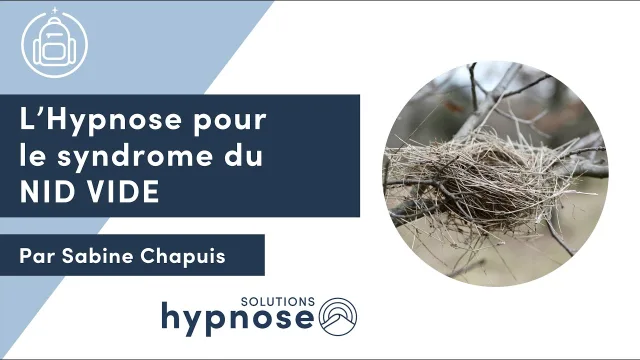
Video transcript
Bonjour, je suis Sabine Chapuis, hypnothérapeute chez Solutions Hypnose et je consulte à Ville Mont-Royal et par vidéo. J'aimerais aujourd'hui vous parler du syndrome du nid vide et comment l'hypnose peut accompagner les parents à mieux vivre le départ des enfants. Pendant des années, les enfants prennent une place centrale dans la vie des parents. Les soins, l'école, le sport, les vacances rythment leur vie. C'est une vie en perpétuel mouvement où il faut penser à tout, agir vite, être organisé, ce qui parfois impose une routine stricte et occupe tellement l'esprit.
Et un jour, tout s'arrête. Les enfants sont grands, ils s'en vont faire leurs études ou commencent à travailler. Et l'univers des parents change totalement, leurs repères ont disparu et les voilà confrontés à un vide soudain. A quoi peut s'ajouter un sentiment de solitude et quelquefois une perte d'identité parentale. Ils se questionnent sur leur rôle, le sens de la vie et de l'avenir qui s'ouvre devant eux. Cette étape, bien que naturelle et inévitable de la vie parentale, peut être un passage difficile et nécessite d'être prise en considération sans être sous estimée.
Parce que ça ne passe pas toujours, il faut en parler et ne pas avoir honte. J'ai régulièrement des parents qui culpabilisent de ne pas savoir comment rebondir après le départ des enfants. Une maman me disait récemment “je n'ai plus goût à rien, mais je n'ose pas en parler à mon conjoint”. Aussi parfois, les réactions sont différentes entre les parents et on peut ne pas savoir comment réagir face à la détresse ressentie par notre conjoint ou conjointe.
La plupart du temps, en quelques mois, de nouvelles habitudes s'installent et l'équilibre revient. Mais il arrive qu'un sentiment de tristesse, de solitude, d'abandon, voire d'inutilité s'accroche et s'installe sur la durée. Les parents peuvent avoir du mal à s'adapter à leur nouvelle réalité, à la fois en terme de changements pratiques dans la vie quotidienne, moins de courses, de lessives, de passages d'amis... et en terme d'ajustements émotionnels.
Certains vont jusqu’à comparer le syndrome du nid vide à une période de deuil. Le deuil, c'est être capable de surmonter un vide, une perte. C'est accepter de passer une étape. Ce n'est pas une fatalité, c'est un sentiment humain qui peut toucher tout le monde. Et l'hypnothérapie peut nous accompagner pour définir un nouvel équilibre. Alors comment l'hypnothérapie peut elle aider à gérer le sentiment de solitude et de perte après le départ des enfants de la maison ?
En premier lieu, il est fondamental d'accueillir les émotions et de comprendre ce à quoi elles font écho. Lorsque les enfants prennent leur envol, il est normal de ressentir de la tristesse, mais parfois aussi de l'anxiété ou même de la colère quand nous avons l'impression d'être abandonnés. L'hypnose permet d'accéder à nos souvenirs, nos expériences, nos apprentissages, nos succès. C'est comme un voyage dans l'inconscient qui nous permet de faire le bilan de ce que la parenté nous a appris et de transformer nos expériences pour créer quelque chose de nouveau.
On part notamment explorer des souvenirs positifs, des moments de joie où on a créé des compétences que l'on a développées au cours de notre vie et cela va aider à renforcer notre sentiment de bien être et à créer un ancrage émotionnel. Le départ des enfants crée également un changement des habitudes et l'être humain est un être de routine, qui est rassuré par les automatismes, il n'aime pas ce qui le pousse hors de ses habitudes, c'est inconfortable.
Essayez par exemple ce soir en allant vous coucher de changer de côté. Pas facile, n'est ce pas ? Avec l'hypnose, on va chercher à réactiver la capacité d'adaptation. grâce à des suggestions hypnotiques. Vous pourrez envisager de nouvelles façons de faire face à la solitude en cultivant des idées sur comment créer de nouvelles connexions et activités enrichissantes. On peut aussi travailler sur la création de nouveaux rituels ou habitudes qui vous apportent de la satisfaction et du sens.
En intégrant ces rituels dans votre vie quotidienne, vous pouvez atténuer le sentiment de vide et favoriser un sentiment d'accomplissement. Pour conclure, s'il peut s'avérer douloureux et déstabilisant pour certains, le syndrome du nid vide ne doit en aucun cas être considéré comme une fatalité. Grâce à l'hypnose on peut développer des stratégies d'adaptation à cette nouvelle dynamique. Et le message essentiel est que le départ des enfants n'est pas la fin de la vie, mais plutôt le début d'un nouveau chapitre.
C'est l'occasion de se recentrer sur soi et sur son couple, sur ses propres besoins et désirs, d'avoir plus de temps libre, moins de responsabilités et de tisser des liens différents avec ses enfants. Pour créer une vie riche et épanouissante, même après le départ des enfants... Alors si vos enfants quittent le nid et que vous ressentez de la tristesse, un sentiment d'abandon et que vous manquez d'intérêt pour ce qui vous entoure...
essayez l'hypnose. L'équipe d'hypnothérapeutes de Solutions Hypnose est là pour vous accompagner, en présentiel, près de chez vous ou en ligne par vidéo, cela fonctionne aussi très bien. Prenez rendez-vous dès maintenant pour créer la vie que vous souhaitez avec l'hypnose. À bientôt.
Hypnotherapy is a complementary form of support and does not replace medical advice, diagnosis, or treatment. If you have any concerns about your health, please consult a physician first.
What the children's departure costs day to day

What unsettles people in this period has less to do with absence than with the disappearance of a structure. The rhythm of the day had been organised around someone else for twenty years: meals, journeys, timetables, worries. When that stops, what is left is not free time, it is a space with no shape, and that is very different. Identity follows. Many parents discover at this point how far "being the parent of" had taken the place of the answer to "who am I". That is not a flaw: it is what happens when you do a job well for a long time.
The couple find themselves face to face, sometimes for the first time in a very long while, with one subject of conversation fewer. Some feel immediate relief, others discover a distance that had settled in quietly. Our page Hypnosis for Love and Relationships covers that side. For single parents the absence is more head-on still, with nobody to share it with in the evening.
Sleep is often affected in the first weeks, and it then weighs on everything else. See Hypnosis for Sleep and Insomnia.
And the relationship itself can strain at the worst moment: too many calls, unanswered messages that take on proportions, or the opposite, a silence kept up for fear of intruding. The relationship is changing shape, and the first months are clumsy on both sides.
Recognised approaches other than hypnosis
The starting point is your doctor if sadness settles in, if sleep is lastingly affected, or if you no longer recognise how you are functioning.
- Psychotherapy, useful in particular when the departure stirs something older: a separation, an abandonment, a family history.
- Couples therapy, when it is the relationship that the departure exposes.
- Activities that rebuild real connection: an association, volunteering, a class, a club, a choir. This is not magazine advice: isolation is the factor that most clearly separates the parents who get through this period well from those who get stuck in it.
- Regular physical activity, whose benefits for mood and sleep are established in adults.
- Returning to a personal project, professional or not, when the time comes. The nuance matters: when it comes, not straight away.
- Talking to other parents at the same point, which relieves above all the feeling of being the only one finding it hard.
Hypnosis sits alongside these approaches, on the side of emotions, inner dialogue and rebuilding daily life.
What a hypnosis session can aim at
Let us start with what hypnosis does not do.
It does not make the missing go away, and that would be a strange ambition: that feeling is proportional to what you built. It does not turn a loss into an opportunity on command. It replaces neither medical follow-up if sadness settles in, nor psychotherapy, nor a real social life. And it does not settle for you the question of what you are going to do with your next ten years.
What the work does aim at:
- Letting the sadness exist without it taking up everything. The aim is not to erase it but to put it back in its place, beside the rest, rather than at the centre of every day.
- Working on inner dialogue. "I am no use any more", "I should have made more of it", "it is ridiculous to react like this": these sentences are often heavier than the situation itself, and they respond well to hypnosis.
- Accepting ambivalence. Being relieved and sad at the same time is not a contradiction to resolve. Much of the suffering in this period comes from the guilt of feeling both.
- Rebuilding a relationship with yourself that no longer runs through the parental role, alongside our page Hypnosis for Self-Confidence.
- Easing the landmark moments of the day, the ones that were organised around the children and now ring hollow: coming home, mealtime, Sunday evening.
The emptiness before the project
A word about the sentence you are going to hear everywhere, including on the previous version of this page: this is a fine chance to rediscover yourself, a new page to write, a chapter opening.
It is not wrong. It is simply too early, and said too fast.
Rushing into a project so as not to feel the emptiness works for a few weeks, then the emptiness comes back, with tiredness on top. The people who get through this period best are not the ones who reinvented themselves in a fortnight: they are the ones who let the loss exist, and who then built something that genuinely resembled them, instead of filling a hole with whatever was to hand.
Support respects that order. First what is ending, then what is beginning.
What the research says
Two things, one of which may surprise you.
The first: the empty nest is not the disaster it was billed as, and that is good news. The phrase was popularised in the 1970s, and the researchers who have looked at it since have largely qualified the picture. A longitudinal study from the University of California, Berkeley, published in *Psychological Science*, followed women for eighteen years through midlife. Marital satisfaction rises after the children leave, and that has to do with the enjoyment of time spent together, not the quantity of that time. An honest caveat: satisfaction with life in general does not rise.
A review published in 2024 in *Communications Psychology* adds an important nuance: the experience depends heavily on cultural context, on gender roles and on the place family occupies in how people define themselves. Some parents lose well-being through the loss of a role, others gain from the easing of the load and a more open social life.
In other words, if you are finding it hard, you are neither abnormal nor in the majority. And if you are finding it rather easy, that is not a lack of attachment.
The second: no clinical trial has studied hypnosis for this specific reason. The available evidence concerns symptoms, notably anxiety, where a meta-analysis published in 2019 in the *International Journal of Clinical and Experimental Hypnosis* brought together 15 studies, that is 17 trials, and reports a greater reduction among people supported with hypnosis than in control groups. The number of trials remains modest, follow-up covers only 7 of them, and results were better where hypnosis accompanied other interventions rather than being used alone. We will not claim that this proves anything about the empty nest.
An example: Sophie

Sophie came to see us a few months after her last child left for university. She described days she could no longer organise, and an awkwardness about mentioning it to anyone: other people thought she was lucky. The work was first about what she was telling herself, which was harsh. Then about the two moments of the day when the absence was most concrete, late afternoon and the evening meal. The question of projects came up only afterwards, and at her own initiative.
> "What helped me most was that nobody told me straight away it was a lucky break. I had heard that enough already." > Sophie, name changed
She took up painting again a few months later. She points out that the early days were less glorious than that sentence suggests, and that she still opens the bedroom door sometimes.
*Every situation is different. Sophie's path is her own and says nothing about what you will experience.*
How a session on this subject unfolds
The conversation. What has been happening since the departure, when it is hardest, what you tell yourself. Your sleep, whether you are in a couple or a single parent, your medical context. We will also ask the questions that help spot a depressive episode, because that is a different matter and not our field.
The objective. Worked out together, and at the right scale. Rarely "feeling better", more often: getting through late afternoon differently, or being able to talk about my son without my throat tightening every time.
The induction. A natural state of focused attention that you already know without naming it. You stay conscious, you hear everything, you can speak and you can stop whenever you want.
The work. On this subject it is mostly about inner dialogue, about the room left for sadness and ambivalence, about the landmark moments of the day, and, when you are ready, about what can be built next.
The debrief and the exercise. A conversation about what you experienced, and a self-hypnosis exercise to take away, often aimed at the moment of the day you identified as the emptiest.
The number of sessions is worked out at the first conversation. Sessions work in person and by video alike.
Book an appointment
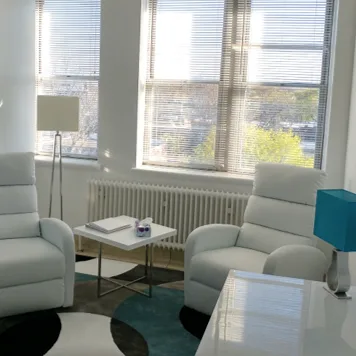
The first conversation is there to work out whether hypnosis is the right resource for your situation, and a clear answer, including "see your doctor first", is part of the work. Ask us a question or book an appointment. Our practitioners who work in English see people in Montreal, Sherbrooke, Gatineau, Paris and Lille, and by video wherever you are in the world. The number of sessions is worked out at the first conversation.
Where would you like to consult?
All areas
 Annie Mayrand
Gatineau - Cumberland (ON)
👤
🧑🎓
🚭
❤️
💻
Annie Mayrand
Gatineau - Cumberland (ON)
👤
🧑🎓
🚭
❤️
💻
 Christian Rocher
Beloeil
👤
🧑🎓
👶
🚭
❤️
💻
Christian Rocher
Beloeil
👤
🧑🎓
👶
🚭
❤️
💻
 David Veilleux
Montréal - Anjou
👤
🧑🎓
🚭
❤️
🤰
💻
David Veilleux
Montréal - Anjou
👤
🧑🎓
🚭
❤️
🤰
💻
 Florence Aton
Sutton
👤
🚭
❤️
💻
Florence Aton
Sutton
👤
🚭
❤️
💻
 Jessica Reid
Sherbrooke
👤
🚭
💻
Jessica Reid
Sherbrooke
👤
🚭
💻
 Julie Rocque
Montréal - Jean-Talon
👤
🧑🎓
👶
🚭
❤️
🤰
💻
Julie Rocque
Montréal - Jean-Talon
👤
🧑🎓
👶
🚭
❤️
🤰
💻
 Nuria Pérez de León
Montréal - Rosemont - Saint-Lambert
👤
🧑🎓
💻
Nuria Pérez de León
Montréal - Rosemont - Saint-Lambert
👤
🧑🎓
💻
 Romain Rastoin
Bromont
👤
🧑🎓
🚭
❤️
💻
Romain Rastoin
Bromont
👤
🧑🎓
🚭
❤️
💻
 Réjeanne LeBlanc
La Prairie
👤
🧑🎓
👶
💻
Réjeanne LeBlanc
La Prairie
👤
🧑🎓
👶
💻


Frequently asked questions about Hypnosis for Empty Nest Syndrome
Yes. Your sadness is not about what is happening to them, which is good news, but about what is ending for you. The two are not contradictory, and the guilt of being sad when "everything is fine" is one of the most common reasons people come to us about this.
It varies, and nobody can give you a timescale. The usual order of magnitude is weeks to a few months, with gradual and uneven improvement. What should alert you is not the length in itself, but the absence of any improvement, or things getting worse: that is when to see a doctor.
No. The hypnotic state is a state of focused attention, not sleep and not being under anyone's influence: the available research shows no loss of control over your own actions. You stay conscious, you hear everything, and you keep at all times the ability to refuse a suggestion, to speak or to stop the session.
Yes. Hypnosis is a non-medicinal approach that adds to your follow-up without interfering with it: simply tell us what you are taking at the first conversation. Any decision about your treatment belongs to the doctor who prescribed it.
Psychotherapy is a regulated framework, practised by professionals whose title is protected, and it can address psychological functioning as a whole and diagnosed disorders. Hypnosis as we practise it is a narrower form of support, centred on a specific objective. If your child's departure stirs something older, or if the sadness settles in, a psychologist or your doctor comes first.
That is common, and it does not always mean indifference. Two parents do not live this departure at the same pace, and the one who talks about it least is not necessarily the one coping best. When the gap becomes a source of tension, couples work is sometimes more useful than individual support.
Not necessarily, and it has become a common situation. A young adult returning home reopens other questions: everyone's place, the rules, a parental role that can no longer be what it was. It is not a failure, for them or for you, but it usually needs thinking through rather than simply being endured.
The number of sessions is worked out at the first conversation, based on your situation. Nobody can tell you beforehand without having met you.
Sources and references
If the load becomes too heavy
- Quebec: if you are in distress or having suicidal thoughts, 1 866 APPELLE (1 866 277-3553), 24 hours a day.
- France: 3114, the national suicide prevention line, free and confidential, 24 hours a day.
Sources
- Gorchoff S. M., John O. P., Helson R., *Contextualizing Change in Marital Satisfaction During Middle Age: An 18-Year Longitudinal Study*, Psychological Science, 2008, 19(11), 1194-1200.
- Hartanto A., Sim L., Lee D., Majeed N. M., Yong J. C., *Cultural contexts differentially shape parents' loneliness and wellbeing during the empty nest period*, Communications Psychology, 2024, 2:105.
- Valentine K. E., Milling L. S., Clark L. J., Moriarty C. L., *The Efficacy of Hypnosis as a Treatment for Anxiety: A Meta-Analysis*, International Journal of Clinical and Experimental Hypnosis, 2019, 67(3), 336-363 (doi 10.1080/00207144.2019.1613863). Full text behind a paywall.
Hypnosis as practised by the members of Solutions Hypnose is a complementary support approach. It is neither a medical act, nor a diagnosis, nor psychotherapy in the regulatory sense, and it in no way replaces a consultation, follow-up or treatment prescribed by a health professional.
Our practitioners do not assess and do not treat mental disorders or illnesses. They never ask for an ongoing treatment to be stopped or changed: that decision rests exclusively with your doctor.
No result can be guaranteed. The testimonials and examples presented on this page describe individual experiences and do not predict what you will experience.
In case of significant distress, unexplained physical symptoms or suicidal thoughts, contact a doctor, emergency services or a helpline without delay.

Page written by Sabine Chapuis
hypnotherapist
partner at Solutions Hypnose.
English version reviewed by David Veilleux
Published .