
Hypnosis for Social Anxiety (Social Phobia)
The invitation arrived three weeks ago. Since then you have thought about it almost every day, and you are still looking for a credible reason not to go.
In conversations you are there without being there: part of you listens, the other watches your voice, your face, your hands, and prepares the next sentence. When you finally speak, you no longer know whether what you said was stupid.
And then there is the evening. The party is over, you are home, and you replay all of it: that one sentence too many, that silence that ran too long, that moment you laughed too loudly. It can last hours, sometimes days, and sometimes years afterwards.
From the outside, nobody notices anything. People find you reserved, perhaps distant. Nobody imagines the work it takes.
What you are living has a name, it is one of the most widespread difficulties there is, and it is also one of those for which the available approaches work best. Most people wait years before saying anything. That is the only real waste in this story.


What is social anxiety?
Social anxiety, also called social phobia, is an intense and lasting fear of situations where you might be observed, evaluated or judged. It is not a fear of other people: it is a fear of what they will think, and in particular a fear of showing signs of anxiety and being humiliated for it.
It is one of the most widespread anxiety disorders, and the median age of onset is thirteen. It settles in quietly, and the people who eventually seek help generally do so after fifteen to twenty years of symptoms.
A few distinctions that matter
- It is not shyness. Shyness is a temperament, very common and with no major consequence. Social anxiety makes you give things up: a job, a course, a relationship, an evening.
- It is not introversion. An introverted person prefers small groups and recharges alone; they are not afraid. You can be extraverted and have social anxiety.
- It can be limited or generalised. Some people dread only one kind of situation, most often speaking in public; others dread interactions as a whole, including phoning or eating in front of someone.
- It is not agoraphobia, even if the two look alike from the outside. In agoraphobia, what is dreaded is feeling unwell with no way of being helped, including alone in an empty place. See Hypnosis for Agoraphobia.
The variants covered elsewhere on this site: the fear of blushing on Hypnosis for Erythrophobia, speaking up and asserting yourself at work on Hypnosis for Assertiveness, and stage fright on Hypnosis for Artistic Performance.
The three mechanisms that keep it going
This is the most useful part of this page, because it explains why social anxiety does not wear off with experience. These are not hypotheses: they are three of the components that British guidelines explicitly require in the reference treatment.
Self-focused attention. During an interaction, your attention is trained on yourself: your voice, your face, what you are about to say. Two consequences. You judge the scene on an internal sensation, always more intense than what shows. And you do not pick up your listeners' actual signals, including the positive ones that might reassure you.
Safety behaviours. Rehearsing your sentences, avoiding eye contact, saying little, having a drink beforehand, staying close to someone you know, keeping your coat on to hide sweating. They relieve in the moment, and they stop you finding out that the situation would have gone fine without them. Some even make the exchange stiffer and produce the very reaction you dread. One honest caveat: researchers are still debating whether all of them are harmful, and the most recent work suggests it is better to drop them gradually rather than all at once.
Going back over the scene afterwards. This is the most recognisable mechanism, and the least known. In the evening, the scene is replayed on a loop, with attention given exclusively to mistakes. This review manufactures a memory far more catastrophic than the event, and it is that distorted memory that will feed the dread next time. In other words, social anxiety does not feed on what happens, but on what you make of it afterwards. It is also the best supported of the three: a review of twenty-six studies shows that treatments explicitly targeting it get better results than those that do not.
These three mechanisms do not exhaust the question. Other models emphasise your relationship to your own thoughts rather than your self-image. But these are the ones the guidelines ask to be worked on, and they are what our support addresses.
Social anxiety is a recognised disorder, and it can be treated.
Talk to your doctor if it stops you working, studying or forming relationships, if it has lasted for years, if you feel persistently sad or worthless, or if you have dark thoughts.
Two frequent companions deserve to be assessed by them: depression and the use of alcohol to get through social situations. British guidelines put them at roughly 19% and 17%, and the French guide asks for them to be taken into account from the start.
Any decision about a treatment rests exclusively with the doctor who prescribed it.
Quebec: Info-Social 811, option 2, and 1 866 APPELLE (1 866 277-3553). France: 3114. Both services are in French.
The daily impact of social anxiety

Life choices get altered, and that is the heaviest cost. A course chosen to avoid presentations, a job turned down because it means running meetings, a promotion not asked for, a city you do not move to. These renunciations do not show and they add up over decades, all the more so because the disorder starts early and is one of the most persistent. From the outside, it passes for a preference.
Relationships thin out. Making a friend means repeating uncomfortable moments, and tiredness leads you to space them out. Isolation ends up confirming the idea that you cannot do it.
Work is affected: meetings, the phone, the canteen, annual reviews, the lift. Many people are excellent at their job and blocked by everything around it.
The fatigue is real and invisible: keeping permanent watch over yourself for a day is more exhausting than the work itself.
And alcohol often invites itself in. A drink before an evening relaxes you and works, which makes it a formidable solution: it genuinely relieves, and it installs a dependence between social life and the substance. The direction of the relationship is documented, and it matters: a cohort followed for some fifteen years shows that social anxiety precedes alcohol dependence rather than the reverse, and that it is the only difficulty of this kind to have that effect. If you recognise yourself, see Hypnosis for Alcohol, without waiting for it to become a second problem.
In young people, social anxiety shows up in other signs: refusing school, avoiding presentations, difficulty asking for help in class, activities abandoned, irritability, or no longer wanting to do anything without a parent. In younger children, it is worth knowing about selective mutism: a child who speaks freely at home and is unable to speak at school or in front of certain people. It is not refusal and not a tantrum, it is a freeze response. It is an anxiety disorder in its own right, very often associated with social anxiety without being the same thing, and it calls for specialist advice without waiting. See Hypnosis for Children and Hypnosis for Teens.
Recognised approaches other than Hypnosis
The entry point is your doctor, who can refer you and spot what else may be going on.
- Cognitive behavioural therapy. This is the reference approach for social anxiety. British guidelines place it first line in an individual format, in a precise protocol of twelve to fifteen sessions over about four months, and they advise against offering a group format as a first option. In France, the national health authority's guide on anxiety disorders places it on a par with medication in the acute phase, the choice resting on the person's preferences and on whether a therapist is available. In both cases, it works on the three mechanisms described above.
- Medication, where indicated, prescribed and monitored by a doctor.
- Group therapies, which have an obvious advantage here, the setting itself being a social situation. British guidelines recognise their real effectiveness while preferring the individual format.
- Public speaking groups, such as speaking clubs, which offer graded and supportive exposure.
- Care for what comes with it, mood and alcohol use first of all.
Hypnosis sits alongside these approaches.
Hypnosis for social anxiety: goals and benefits
Let us start with what hypnosis does not do.
It is not the reference approach for social anxiety, and we will not present it as one. It replaces neither medical advice, nor psychotherapy, nor treatment. It will not make you extraverted, and that is not the aim. And it does not spare you from going, step by step, into the situations you avoid.
What support aims at
- Redirecting attention. Moving from watching yourself to actually listening to the other person. This is the main lever, and it is an exercise in attention, which is where hypnosis is relevant.
- Stopping the evening replay. Spotting the rumination, interrupting it earlier, and no longer giving credit to a memory manufactured by anxiety.
- Reducing anticipation, which often occupies the preceding days and costs more than the event.
- Loosening one safety behaviour at a time, at your pace, to find out what happens without it. Gradually, which is also what the most recent work suggests.
- Preparing a specific situation by walking through it mentally: a meeting, a family meal, a first date.
- Working on how you see yourself, which is almost always harsher than how others see you. See Hypnosis for Self-Confidence.
And if it is phobias in the broader sense that concern you, see Hypnosis for Fears and Phobias.
What other people actually see
One useful point, and a measured one.
When interactions are filmed and rated both by the person themselves and by independent observers, two things appear.
The anxiety you feel barely shows. What you experience as a trembling voice is hardly perceptible from outside, and the gap between what you feel and what shows is markedly larger in socially anxious people than in others. This is the most solid result in the field.
On the performance itself, the nuance is more honest. Observers do sometimes pick up a real difference, but always far smaller than the one you perceive. The researcher who put the question most directly speaks of a kernel of truth doubled by a negative bias, and that is more useful to know than a flat denial: you are not imagining things, you are amplifying them.
This is not enough to make anxiety disappear, and nobody recovers from reading a paragraph. But it shows where the work lies: not on your performance, but on the gap between what you think you are showing and what shows. It is so central that British guidelines prescribe, within the reference treatment, watching yourself on video to correct that distorted self-image.
What the research says
Two findings, said plainly.
For social anxiety, cognitive behavioural therapy has the best level of evidence. A network meta-analysis published in 2025, comparing ninety trials, places the individual protocol described above at the top. If you have not yet started anything, that is where to look, and to raise it with your doctor.
On hypnosis and social anxiety specifically, there is no randomised trial. What exists amounts to a few small studies. A Chinese team measured, in sixty-nine people, a change in how the brain processes faces after six sessions, without assessing symptoms themselves. And a South African study of sixty people compared cognitive behavioural treatment with and without hypnosis: on the attentional measure used, adding hypnosis brought no advantage, and the authors acknowledge lacking the power to conclude. We would rather cite it than leave it out.
The more favourable data concerns anxiety in general. A 2019 meta-analysis of seventeen trials reports a greater reduction among people supported with hypnosis than in control groups, and better results when it accompanies other interventions rather than being used alone. A recent meta-analysis of hypnosis alongside cognitive behavioural therapy, across all conditions, concludes that the benefit is real but modest, clearer on mood and pain than on anxiety.
That is the place we claim: support inside a framework, not an alternative to it.
An example of support
*Illustrative example. The first name has been changed and the course described commits only the person who lived it.*
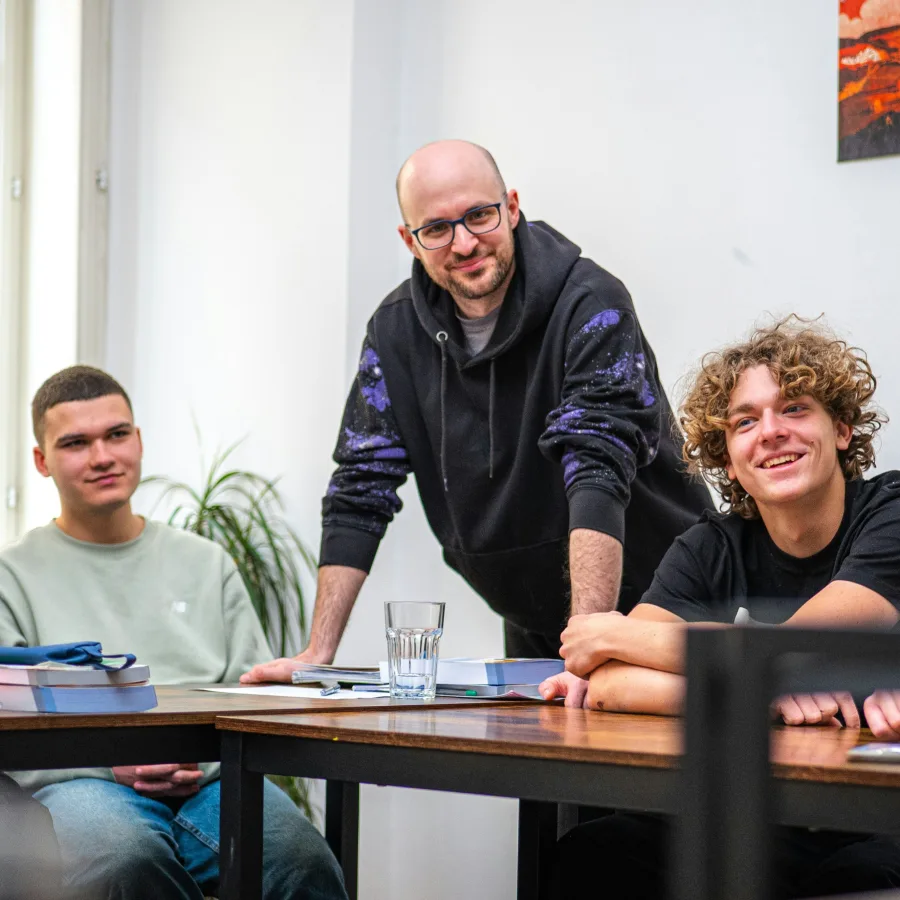
Mathieu, thirty-four, worked in IT. He was well regarded for his work and systematically declined anything that involved speaking in a group. He had twice turned down a technical lead role, a job he wanted, and blamed himself each time. He came saying he did not understand why, at his age, he still could not do something as simple as talk to eight people he knew and worked with every day.
The first interview brought out what took up the most room: not the meetings themselves, but the evenings that followed. He replayed each contribution for hours, sometimes until two in the morning. He drank two or three beers to make it stop, which he had never told anyone.
We suggested he talk to his doctor, which he did, and the work started in parallel. It focused first on that evening replay, then on attention during meetings, with a very concrete exercise: counting the questions other people asked.
> "I stopped doing the daily debrief every evening. That is what changed everything, not the meetings." > Mathieu, name changed
He now speaks up in meetings from time to time, not always. He says he does not know whether he would accept the role, and that it would at least be a choice. Every situation is different, and Mathieu's course says nothing about what you will experience.
How a Hypnosis session on this subject unfolds
The interview. The situations that get stuck, how long for, what you avoid, what you do to cope, and what happens afterwards. If mood or alcohol are part of the picture, you can speak about them freely, without judgement: they are two frequent companions of social anxiety. We do not assess them and we do not treat them, we invite you to raise them with your doctor, because ignoring them would serve nobody.
The goal. Set together, as concrete steps. For instance: ask one question at Thursday's meeting, or go to the leaving drinks and stay twenty minutes.
The induction. A natural state of focused attention that you already know without naming it. You stay conscious, you hear everything, you can speak and stop whenever you wish. One useful detail here: the relationship with the practitioner is itself a social situation, and it is often the first one where you will find that things go differently.
The work. It most often bears on the direction of attention, on interrupting the evening rumination, on preparing a specific situation, and on gradually letting go of one safety behaviour chosen with you.
The debrief and the exercise. A conversation, a self-hypnosis exercise to take away, and one step to take before the next session.
The number of sessions is defined during the first interview.
Booking an appointment
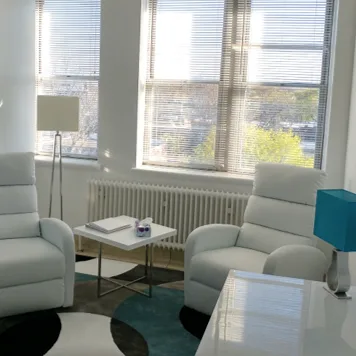
Sessions work by video as well as in person, and that is sometimes a useful first step when going to an unfamiliar place is part of the difficulty. It is not a fallback: on social anxiety, studies comparing remote and in-person treatment do not separate them, and the 2025 meta-analysis cited above says so explicitly, across ninety trials.
In person, our practitioners see clients in Montreal, Sherbrooke, Gatineau, Paris and Lille. Some of them are trained to work with children and teenagers.
A question before you decide? Write to us describing your situation. If someone else would suit you better, we will say so.
Where would you like to consult?
All areas
 Annie Mayrand
Gatineau - Cumberland (ON)
👤
🧑🎓
🚭
❤️
💻
Annie Mayrand
Gatineau - Cumberland (ON)
👤
🧑🎓
🚭
❤️
💻
 Christian Rocher
Beloeil
👤
🧑🎓
👶
🚭
❤️
💻
Christian Rocher
Beloeil
👤
🧑🎓
👶
🚭
❤️
💻
 David Veilleux
Montréal - Anjou
👤
🧑🎓
🚭
❤️
🤰
💻
David Veilleux
Montréal - Anjou
👤
🧑🎓
🚭
❤️
🤰
💻
 Florence Aton
Sutton
👤
🚭
❤️
💻
Florence Aton
Sutton
👤
🚭
❤️
💻
 Jessica Reid
Sherbrooke
👤
🚭
💻
Jessica Reid
Sherbrooke
👤
🚭
💻
 Julie Rocque
Montréal - Jean-Talon
👤
🧑🎓
👶
🚭
❤️
🤰
💻
Julie Rocque
Montréal - Jean-Talon
👤
🧑🎓
👶
🚭
❤️
🤰
💻
 Nuria Pérez de León
Montréal - Rosemont - Saint-Lambert
👤
🧑🎓
💻
Nuria Pérez de León
Montréal - Rosemont - Saint-Lambert
👤
🧑🎓
💻
 Romain Rastoin
Bromont
👤
🧑🎓
🚭
❤️
💻
Romain Rastoin
Bromont
👤
🧑🎓
🚭
❤️
💻
 Réjeanne LeBlanc
La Prairie
👤
🧑🎓
👶
💻
Réjeanne LeBlanc
La Prairie
👤
🧑🎓
👶
💻


Frequently asked questions about Hypnosis for Social Anxiety (Social Phobia)
Shyness is a temperament, with no major consequence. Social anxiety makes you give things up: a job, a relationship, an evening you would have wanted. If you organise your life around avoiding situations, the word is no longer shyness, and the good news is that it can be treated.
Researchers call it post-event processing, and it is one of the central mechanisms of social anxiety. The problem is that this replay keeps only the mistakes and manufactures a memory far more catastrophic than the actual scene. British guidelines explicitly ask for it to be worked on, and the available research shows that treatments targeting it get better results than those that do not.
No. The hypnotic state is one of focused attention, not sleep and not submission. You stay conscious, you hear everything, and you keep the ability to decline a suggestion, to speak, or to stop the session. Nothing will come out of you that you have not decided to say.
That is a question for the doctor who follows you, and only they can answer it for your situation. What we can say on our side: hypnosis is a non-medicinal approach that is added to your care and never replaces it. We do not change, interrupt or comment on any treatment. Simply tell us what you are taking at the first interview.
Psychotherapy is a regulated field, practised by professionals whose title is protected. For social anxiety, cognitive behavioural therapy is the reference approach: British guidelines place it first line in an individual format, and the French guide places it on a par with medication, the choice resting on the person's preferences. This is a subject to raise with your doctor. Hypnosis is a narrower form of support that combines with it.
It is very common and worth mentioning to your doctor, without dramatising it. Alcohol genuinely works in the moment, which is what makes it a trap: social life ends up depending on it, and the next day's anxiety is stronger. Long-term follow-up studies show that social anxiety comes first and dependence after, not the other way round, which is rather good news: that is where there is something to be done, and one more reason to speak about it early.
That is an entirely legitimate objection, and many people start by writing rather than phoning, or with a video session from home. The first appointment asks nothing of you except to be there.
Established school refusal calls for medical advice, without waiting. Social anxiety often begins at that age, the median age of onset being thirteen, and it is the period when support changes the most. In younger children, selective mutism, where a child speaks at home and is unable to speak at school, calls for specialist assessment.
The number of sessions is defined during the first interview. On this subject it depends mostly on the pace at which you take the steps between appointments.
Where to find help.
In Quebec: your doctor first. Info-Social 811, option 2, free and confidential, day and night. 1 866 APPELLE (1 866 277-3553) or 988 if distress takes over. For parents of teenagers, Tel-jeunes Parents (formerly LigneParents) on 1 800 361-5085, 8 am to midnight. Relief and Phobies-Zéro document the subject and run peer support groups. These resources are in French.
In France: your family doctor, and the Médiagora network, which specialises in social phobia and agoraphobia and is named by the national health authority. In case of distress, 3114, free, day and night. For a child at risk, 119. In French.
In the United Kingdom: your GP, and the NHS page below.
Sources and references
Institutional resources
- *Social anxiety disorder: recognition, assessment and treatment*. National Institute for Health and Care Excellence, guideline CG159. This is the text that sets out the reference protocol and its components.
- Social anxiety (social phobia). National Health Service.
- Anxiété sociale. Government of Quebec, in French.
- Affections de longue durée : troubles anxieux graves. Haute Autorité de santé, France, in French. Its section 6 covers social anxiety disorder.
Scientific references
- Psychotherapies for social anxiety disorder in adults: A systematic review and Bayesian network meta-analysis. Sun, L., Dai, X., Zhu, S. et al. (2025). Journal of Affective Disorders, 378, 301-319.
- Psychological interventions for pre-event and post-event rumination in social anxiety: A systematic review and meta-analysis. Donohue, H. E., Modini, M., & Abbott, M. J. (2024). Journal of Anxiety Disorders, 102, 102823.
- Post-event rumination and social anxiety: a systematic review and meta-analysis. Edgar, E. V., Richards, A., Castagna, P. J. et al. (2024). Journal of Psychiatric Research, 173, 87-97.
- Discrepancy between self- and observer ratings of performance in social phobics. Rapee, R. M., & Lim, L. (1992). Journal of Abnormal Psychology, 101(4), 728-731.
- Specificity of social anxiety disorder as a risk factor for alcohol and cannabis dependence. Buckner, J. D., Schmidt, N. B., Lang, A. R. et al. (2008). Journal of Psychiatric Research, 42(3), 230-239.
- Anxiety in Children with Selective Mutism: A Meta-analysis. Driessen, J., Blom, J. D., Muris, P. et al. (2020). Child Psychiatry and Human Development, 51(2), 330-341.
- Scores on an emotional Stroop task after treatment of social anxiety disorder. Nortje, C., & Posthumus, T. (2012). Psychological Reports, 111(2), 461-471. The study comparing treatment with and without hypnosis.
- The Efficacy of Hypnosis as a Treatment for Anxiety: A Meta-Analysis. Valentine, K. E., Milling, L. S., Clark, L. J., & Moriarty, C. L. (2019). International Journal of Clinical and Experimental Hypnosis, 67(3), 336-363.
- Clinical Hypnosis as an Adjunct to Cognitive Behavior Therapy: An Updated Meta-Analysis. Ramondo, N., Gignac, G. E., Pestell, C. F., & Byrne, S. M. (2021). International Journal of Clinical and Experimental Hypnosis, 69(2), 169-202.
And the neighbouring articles
- On the fear of blushing, see Hypnosis for Erythrophobia.
- On speaking up and assertiveness at work, see Hypnosis for Assertiveness.
- On stage fright, see Hypnosis for Artistic Performance.
Hypnosis as practised by the members of Solutions Hypnose is a complementary support approach. It is neither a medical act, nor a diagnosis, nor psychotherapy in the regulatory sense, and it in no way replaces a consultation, follow-up or treatment prescribed by a health professional.
Our practitioners do not assess and do not treat mental disorders or illnesses. They never ask for an ongoing treatment to be stopped or changed: that decision rests exclusively with your doctor.
No result can be guaranteed. The testimonials and examples presented on this page describe individual experiences and do not predict what you will experience.
In case of significant distress, unexplained physical symptoms or suicidal thoughts, contact a doctor, emergency services or a helpline without delay.
Page written by Christian Rocher
hypnotherapist and NLP coach
partner at Solutions Hypnose.
English version reviewed by David Veilleux
Updated .