
Hypnosis for Menopause
Three in the morning. You wake up soaked, you push the duvet away, and twenty minutes later you are cold. That is the second time tonight. Tomorrow there is that meeting, and you already know what state you will be in.
A natural stage of life can be hard to get through, and saying so is not complaining.


What it feels like when menopause sets in
By day it is the waves that rise without warning, often at the worst moment, and the routine that has become automatic: the cardigan slipped off discreetly, the seat near the window, the glass of iced water.
There is also the irritation that comes faster than it used to, the word that goes missing mid-sentence, and the sense of not quite recognising yourself.
And then there is what people say: that it is normal, that it will pass, that all women go through it. That is true, and it settles nothing.
What is menopause?
Menopause is a stage of life, not an illness. It corresponds to the end of ovarian function, and it is established in hindsight: menopause is dated after twelve consecutive months without periods.
Neighbouring terms describe different moments, and the confusion feeds a great deal of misunderstanding.
- Perimenopause is the transition phase before. Cycles become irregular, hormones fluctuate, and the first symptoms can appear while periods are still present. It can last several years.
- Menopause is the marker: twelve months without periods.
- Postmenopause is everything that follows. Symptoms ease over time for most women, but persist for a long while in some.
- Early menopause occurs before forty-five, and premature ovarian insufficiency before forty. These situations call for specific medical follow-up.
- Induced menopause follows surgery or certain treatments. It often arrives abruptly, with no transition phase, which makes it harder to go through.
The most frequent manifestations are hot flashes and night sweats, waking and sleep difficulties, fatigue, changes in mood and irritability, vaginal dryness and changes in desire, and joint pain. They vary enormously from one woman to another: some barely notice them, others are deeply affected for years.
When to see a doctor without delay.
Bleeding occurring after menopause, that is, after twelve months without periods, must always be investigated by a doctor. Also see a doctor for very heavy or very frequent bleeding during the transition, for symptoms appearing before forty-five, or for unusual pain.
Menopausal hormone therapy and prescription non-hormone treatments are a medical decision taken with you: any decision about your treatment belongs to the doctor who prescribed it.
Video available in French
Video transcript
Bonjour, je suis Sabine Chapuis, hypnothérapeute chez Solutions Hypnose et je consulte à Ville Mont Royal et par vidéo. Comment l'hypnothérapie peut elle aider à gérer les symptômes physiques et émotionnels de la ménopause ? La ménopause, on sait que ça existe, que ça touche la moitié de la population mondiale autour de la cinquantaine, que ça peut impacter fortement la qualité de vie. Et pourtant, ça reste un sujet confidentiel presque tabou.
Alors de quoi parlons nous ? La ménopause est un phénomène naturel qui concerne toutes les femmes généralement entre 45 et 55 ans. C'est un moment de transition qui s'accompagne de nombreux changements physiologiques et hormonaux. Ces changements sont dus à la diminution progressive de la production des oestrogènes et de la progestérone qui sont les hormones produites par les ovaires. Cette diminution entraîne une série de symptômes physiques et émotionnels qui peuvent varier d'une femme à l'autre.
Les bouffées de chaleur, les sueurs nocturnes, la sécheresse vaginale, les troubles du sommeil et la prise de poids sont parmi les plus courants. Mais les fluctuations hormonales provoquent également un bouleversement au niveau émotionnel avec des troubles de l'humeur et de la mémoire et une sensibilité accrue au stress et à l'anxiété. Mais bien sûr la ménopause n'est pas une maladie, plutôt une étape naturelle de la vie.
Lorsque l'on envisage des approches pour gérer la ménopause, il est important de garder à l'esprit que chaque femme est unique et qu'un avis médical est nécessaire quand les premiers symptômes apparaissent. Si nécessaire, le médecin pourra prescrire un traitement hormonal de substitution le THS qui donne en général de bons résultats. Cependant, il arrive que les traitements médicamenteux soient impossibles comme dans les cas d'antécédents de cancers, de maladies du foie, d'AVC et bien d'autres encore.
Parfois même ça n'est pas souhaité, par exemple à cause d'un risque accru de cancer du sein. Parmi les alternatives au THS, l'hypnose est une méthode douce et naturelle qui peut vraiment aider à atténuer les symptômes de la ménopause et à gagner en confort de vie. Bien sûr, l'hypnose ne peut pas inverser le processus naturel de la ménopause ni éliminer complètement les symptômes associés mais elle permet de mieux gérer et de mieux vivre.
Alors comment cela fonctionne ? L'hypnothérapeute pourra utiliser des techniques de relaxation profonde et des suggestions hypnotiques pour aider à reprogrammer les réponses du corps aux symptômes de la ménopause et pour renforcer les ressources internes de la femme. Par exemple, pour vous aider à modifier votre perception des bouffées de chaleur, l'hypnothérapeute peut vous guider à visualiser une sensation de fraîcheur ou à associer les bouffées de chaleur à des sensations plus neutres ou agréables.
L'hypnose permet également de créer des ancrages émotionnels associés à des sensations de calme, de sérénité à chaque fois que vous ressentez les symptômes de la ménopause, ce qui aide à baisser l'intensité des épisodes et à améliorer le confort de vie. La respiration contrôlée est souvent intégrée dans les séances d'hypnose et vous pourrez apprendre à utiliser des techniques de respiration profonde pour vous aider à calmer votre système nerveux et à mieux gérer les bouffées de chaleur et d'anxiété.
D'un point de vue physiologique, l'hypnose va vous aider à développer les mécanismes d'adaptation sains, qui renforcent votre résilience émotionnelle. En apprenant à gérer vos réponses émotionnelles face aux changements hormonaux, vous pourrez réduire l'impact des sautes d'humeur, du stress ou de l'anxiété. L’hypnothérapie vous permet par exemple d'explorer la façon dont vos pensées et émotions influent sur votre corps En prenant conscience de cette connexion, vous pouvez travailler à réduire l'anxiété en ajustant votre perception et vos réactions.
Pour réduire le stress et l'anxiété, la relaxation profonde de l'état d'hypnose induit un état de relâchement qui permet de calmer le système nerveux et d'améliorer la qualité de vie. Enfin l'hypnose peut aussi vous aider à reformuler des pensées négatives, comme “ je suis en train de vieillir et je suis moins féminine ”, en des affirmations plus positives, qui favorisent une meilleure acceptation de cette phase de vie.
En conclusion, l'hypnothérapie est une approche complémentaire bien intéressante, naturelle, douce et efficace pour gérer les symptômes physiques et psychiques de la ménopause. Alors si vous commencez à ressentir les premiers signes de ménopause, n'attendez pas, essayez l'hypnose. L'équipe d’hypnothérapeutes de Solutions Hypnose est là pour vous accompagner, en présentiel près de chez vous ou en ligne par vidéo, cela fonctionne aussi très bien.
Prenez rendez-vous dès maintenant pour créer la vie que vous souhaitez avec l'hypnose. À bientôt.
Hypnotherapy is a complementary form of support and does not replace medical advice, diagnosis, or treatment. If you have any concerns about your health, please consult a physician first.
What menopause costs day to day

What wears you down is often not the isolated symptom: it is the accumulation and the unpredictability. Sleep comes first. Nights broken by sweats install a background tiredness that colours everything else, and it is that, more than the hormones, which explains a good part of the irritability and difficulty concentrating. The subject is covered on our page Hypnosis for Sleep and Insomnia. There is work, where the flash arrives during the interview and you dread being seen flushing and sweating. There is social life, with constant anticipation: what to wear, where to sit, which outing to decline. There is intimate life, between physical discomfort and changes in desire, covered on our page Hypnosis for Female Sexuality. And there are the people around you, who play it down without meaning any harm, which adds the feeling of not being taken seriously.
Recognised approaches other than hypnosis
The starting point is your doctor, your gynaecologist or your midwife. Many women never raise it, for want of knowing that options exist.
- Menopausal hormone therapy remains, according to the learned societies, the reference option for hot flashes. It does not suit every situation and is discussed case by case, with regular review.
- Prescription non-hormone treatments, useful in particular when hormone therapy is contraindicated.
- Local treatments for dryness and intimate discomfort, very often overlooked for want of daring to mention them.
- Cognitive behavioural therapy, which appears in the same guidelines as hypnosis.
- Physical activity and weight, whose overall contribution to health in this period is established, even if their own effect on hot flashes is judged differently in the guidelines.
- A sleep specialist, when nights are lastingly affected.
Hypnosis sits alongside these approaches, on the side of how symptoms are perceived and how this period is lived.
What a hypnosis session can aim at
Let us start with what hypnosis does not do.
It does not act on your hormones and does not change the course of menopause. It replaces neither medical advice, nor hormone therapy, nor local treatment. It has no effect on the long-term health matters of this period, such as bone or cardiovascular health, which belong to your doctor. And it guarantees no result, even on the points where the evidence is favourable.
What the work does aim at:
- Reducing the frequency and felt intensity of hot flashes, through suggestion and coolness imagery, together with a daily self-hypnosis exercise. That is the protocol used in the clinical trials.
- Defusing the anxiety-flash loop. Dreading a flash in public raises tension, which raises discomfort and the sense of being exposed. Working on that anticipation often changes the experience before it changes the frequency.
- Improving how sleep comes and how you get back to sleep after waking in the night.
- Easing irritability and mood swings, alongside our page Hypnosis for Stress and Anxiety Management.
- Supporting the change in how you see yourself. This period touches body image, the sense of attractiveness and sometimes identity. It overlaps with our page Hypnosis for Self-Confidence.
What the research says
This is the subject on which the evidence is most favourable to hypnosis, and that deserves saying precisely.
In 2023 the Menopause Society, then the North American Menopause Society, published its position statement on non-hormone therapies. Clinical hypnosis appears there among the options recommended for hot flashes, at the highest level of evidence the panel used, alongside cognitive behavioural therapy and several medicines. In October 2025, Ontario Health's quality standard retains the same two non-pharmacological options.
The same review of the literature does not retain a number of popular approaches: acupuncture, yoga, mindfulness-based interventions and relaxation, for want of sufficient evidence; paced respiration and supplements and herbal remedies, for which the available trials show no benefit. That does not mean these practices are of no interest for your general well-being, but that the studies show no effect of their own on hot flashes.
The recommendation rests in particular on a randomised trial run at Baylor University, published in 2013 in *Menopause*, with 187 women having at least fifty hot flashes a week. They received five weekly sessions and practised self-hypnosis daily. The comparison group was not left with nothing: it received the same number of sessions with a clinician, without the hypnotic induction or the coolness suggestions. At twelve weeks, about seven weeks after the last session, the women in the hypnosis group reported 74% fewer hot flashes, against 17% in the comparison group. The trial publishes no follow-up beyond that date.
Three points matter as much as the result.
- The recommendation is about hot flashes, not about menopause as a whole. On mood, libido or fatigue, the evidence is much thinner.
- Hormone therapy remains the reference option for these symptoms, and the same learned society says so in its introduction and again in its conclusion. Hypnosis is of interest first to women for whom it is contraindicated, notably after certain cancers, or who would rather not use it.
- A more recent trial calls for measure. Published in November 2025, it involved 250 women and compared hypnosis practised alone, from audio files and without a practitioner, with a placebo recording built to be just as credible. Both groups improved. At six weeks the advantage went to hypnosis, a 53% reduction against 41%, but at twelve weeks the gap could no longer be demonstrated with confidence. Two things set it apart from the 2013 trial: the comparison is more demanding, and support from a practitioner is replaced by a recording.
An example: Valérie
Valérie came about frequent hot flashes and broken nights that were starting to weigh on her work. She had seen her doctor, discussed the options, and was looking for complementary support. The work covered two lines: a coolness imagery exercise, repeated at home every day, and anticipating the situations where a flash was most dreaded, in meetings in particular.
> "My nights became calmer again, and I had the impression my hot flashes were less frequent. Or perhaps I was simply less bothered by them." > Valérie, name changed
That last sentence is the truest in this whole text, and we are leaving it as it is. On this subject, the line between what diminishes and what bothers you less is thin, and it does not matter much when you are living better.
*Every situation is different. Valérie's path is her own and says nothing about what you will experience.*
How a session on this subject unfolds
The conversation. Where you are in this transition, which symptoms trouble you most, your sleep, your medical follow-up and any current treatment. We will ask whether you have seen a doctor, and encourage you to if you have not: several options exist that we do not replace.
The objective. Worked out together and ranked, because not everything is worked on at once. Most often the nights first, because the rest lightens when they improve.
The induction. A natural state of focused attention that you already know without naming it. You stay conscious, you hear everything, you can speak and you can stop whenever you want.
The work. On this subject it draws largely on the coolness imagery used in the clinical trials, on preparing the situations you dread, and on the wider experience of this period when you want to bring it up.
The debrief and the exercise. A conversation about what you experienced, and a self-hypnosis exercise to take away. This matters here more than elsewhere: in the available work, daily practice at home is part of the protocol itself.
The number of sessions is worked out at the first conversation. Sessions work in person and by video alike.
Book an appointment
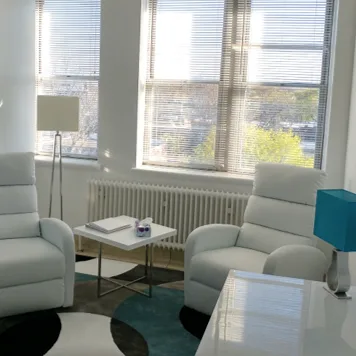
The first conversation is there to work out whether hypnosis is the right resource for your situation, and a clear answer, including "see your doctor first", is part of the work. Ask us a question or book an appointment. Our practitioners who work in English see people in Montreal, Sherbrooke, Gatineau, Paris and Lille, and by video wherever you are in the world. The number of sessions is worked out at the first conversation.
Where would you like to consult?
All areas
 Annie Mayrand
Gatineau - Cumberland (ON)
👤
🧑🎓
🚭
❤️
💻
Annie Mayrand
Gatineau - Cumberland (ON)
👤
🧑🎓
🚭
❤️
💻
 Christian Rocher
Beloeil
👤
🧑🎓
👶
🚭
❤️
💻
Christian Rocher
Beloeil
👤
🧑🎓
👶
🚭
❤️
💻
 David Veilleux
Montréal - Anjou
👤
🧑🎓
🚭
❤️
🤰
💻
David Veilleux
Montréal - Anjou
👤
🧑🎓
🚭
❤️
🤰
💻
 Florence Aton
Sutton
👤
🚭
❤️
💻
Florence Aton
Sutton
👤
🚭
❤️
💻
 Jessica Reid
Sherbrooke
👤
🚭
💻
Jessica Reid
Sherbrooke
👤
🚭
💻
 Julie Rocque
Montréal - Jean-Talon
👤
🧑🎓
👶
🚭
❤️
🤰
💻
Julie Rocque
Montréal - Jean-Talon
👤
🧑🎓
👶
🚭
❤️
🤰
💻
 Nuria Pérez de León
Montréal - Rosemont - Saint-Lambert
👤
🧑🎓
💻
Nuria Pérez de León
Montréal - Rosemont - Saint-Lambert
👤
🧑🎓
💻
 Romain Rastoin
Bromont
👤
🧑🎓
🚭
❤️
💻
Romain Rastoin
Bromont
👤
🧑🎓
🚭
❤️
💻
 Réjeanne LeBlanc
La Prairie
👤
🧑🎓
👶
💻
Réjeanne LeBlanc
La Prairie
👤
🧑🎓
👶
💻


Frequently asked questions about Hypnosis for Menopause
This is the point on which the evidence is strongest. Clinical hypnosis is among the non-hormone approaches recommended by the Menopause Society in 2023, at the highest level of evidence the panel used, and Ontario Health's October 2025 quality standard also retains it. That guarantees no individual result, and hormone therapy remains the reference option for those it suits.
This is a common situation among the people who come to see us, and it has been studied: one trial looked specifically at sixty women who had survived breast cancer, and a more recent trial included one in four. Talk to the team following you, who remain your main point of contact, and tell us where you are at the first conversation.
No, absolutely not, and we will never ask you to. The two combine without difficulty. Any decision about your treatment belongs to the doctor who prescribed it.
No. The hypnotic state is a state of focused attention, not sleep and not being under anyone's influence: the available research shows no loss of control over your own actions. You stay conscious, you hear everything, and you keep at all times the ability to refuse a suggestion, to speak or to stop the session.
Psychotherapy is a regulated framework, practised by professionals whose title is protected, and it can address psychological functioning as a whole and diagnosed disorders. Hypnosis as we practise it is a narrower form of support, centred on a specific objective. On hot flashes, the 2023 North American guidelines place cognitive behavioural therapy and clinical hypnosis at the same level of evidence. They are two distinct approaches, practised in different frameworks, and nothing prevents doing both.
Partly. The symptoms overlap, and the work on sleep, anticipation and mood is the same. But your situation has questions of its own, starting with irregular cycles and contraception, which still apply. Talk to your doctor, and tell us where you are.
It is better, and it causes no difficulty. Hypnosis interferes with no treatment, and a doctor who knows everything you are doing follows you better.
The number of sessions is worked out at the first conversation. For reference, the protocols studied in research involved a small number of weekly sessions together with daily practice at home, but your situation is set out at the first meeting.
Sources and references
- Ontario Health, *Menopause: Care for Women and Gender-Diverse People*, quality standard, October 2025 (French version linked): retains clinical hypnosis and cognitive behavioural therapy among the non-pharmacological options.
- Ontario Health, *Menopause: A Guide for Women and Gender-Diverse People*, October 2025: the patient version.
- Shufelt C. L. et al., *The 2023 nonhormone therapy position statement of The North American Menopause Society*, Menopause, 2023, 30(6), 573-590.
- Elkins G. R., Fisher W. I., Johnson A. K., Carpenter J. S., Keith T. Z., *Clinical hypnosis in the treatment of post-menopausal hot flashes: a randomized controlled trial*, Menopause, 2013, 20(3), 291-298.
- Elkins G. et al., *Self-Administered Hypnosis vs Sham Hypnosis for Hot Flashes: A Randomized Clinical Trial*, JAMA Network Open, November 2025.
- Elkins G. et al., *Randomized Trial of a Hypnosis Intervention for Treatment of Hot Flashes Among Breast Cancer Survivors*, Journal of Clinical Oncology, 2008, 26(31), 5022-5026.
Hypnosis as practised by the members of Solutions Hypnose is a complementary support approach. It is neither a medical act, nor a diagnosis, nor psychotherapy in the regulatory sense, and it in no way replaces a consultation, follow-up or treatment prescribed by a health professional.
Our practitioners do not assess and do not treat mental disorders or illnesses. They never ask for an ongoing treatment to be stopped or changed: that decision rests exclusively with your doctor.
No result can be guaranteed. The testimonials and examples presented on this page describe individual experiences and do not predict what you will experience.
In case of significant distress, unexplained physical symptoms or suicidal thoughts, contact a doctor, emergency services or a helpline without delay.

Page written by Sabine Chapuis
hypnotherapist
partner at Solutions Hypnose.
English version reviewed by David Veilleux
Published .