
Hypnosis and Fibromyalgia
You wake up already tired. The pain moved during the night, it will be somewhere else by this evening, and you have learned not to mention it because it starts to sound like complaining. You pay for a good day the day after, so you calculate everything: the groceries, the stairs, the evening you said yes to three weeks ago.
And there is the other exhaustion, the one that comes from having to convince people. The tests came back normal, you have been told so more than once, and someone eventually suggested it might be stress. So you looked elsewhere, and you read pages that promise a great deal.
This one will not promise to bring your pain down. The evidence does not allow it, and we would rather tell you up front where it stops. What hypnosis can aim for is more modest and better supported: sleep, a calmer state, and the relationship you have with days you do not get to choose.


A fibromyalgia diagnosis belongs to a doctor, and some situations call for one without delay.
See a doctor if an examination finds something objective: a swollen joint, genuine muscle weakness, a neurological abnormality, an abnormal blood result. France's Haute Autorité de santé notes that fibromyalgia assumes a normal clinical examination and the absence of any disease or medication that could explain the pain. Anything objective therefore needs an explanation of its own.
See a doctor if your symptoms change in nature: pain that settles on one specific joint, that wakes you at the same spot every night, or that comes with new signs. Symptoms close to those of fibromyalgia can be the first manifestation of another condition.
And know that fibromyalgia rules nothing out. Since the 2016 revision of the criteria, having another disease no longer prevents the diagnosis. Around 20 to 25% of people with rheumatoid arthritis, lupus or ankylosing spondylitis will also meet the fibromyalgia criteria. An existing diagnosis never removes the need to investigate a new symptom.
If pain and fatigue wear you down to the point of having thoughts of suicide, do not wait. The risk of distress is real, and it is highest around the time the diagnosis is given, which is often when people go looking for information. In Quebec, 1 866 APPELLE (277-3553) or text 535353. Anywhere in Canada, call or text 9-8-8, the Suicide Crisis Helpline. In France, 3114. All free and confidential, day and night. If there is immediate danger, 911 in Canada, 15 in France.
Hypnosis makes no diagnosis, replaces no medical follow-up, and never changes or comments on any treatment.
What is fibromyalgia?
Fibromyalgia combines widespread, persistent pain, a fatigue that rest does not repair, unrefreshing sleep, and difficulties with attention and memory that many people describe as a fog. The symptoms fluctuate, they move, and they cannot be seen.
It is recognised by the World Health Organization. In the International Classification of Diseases in force since 1 January 2022, fibromyalgia syndrome appears under MG30.01, chronic widespread pain, itself grouped under chronic primary pain. This deserves to be said plainly, because many people are still told it does not exist.
The diagnosis is clinical, and no test confirms it. The algorithm published by Quebec's Ministry of Health and Social Services says so without hedging: to this day, no laboratory test and no imaging can confirm a diagnosis of fibromyalgia. Tests serve another purpose, ruling out what might resemble it. The Haute Autorité de santé asks for a minimal blood work-up, a blood count, CRP, TSH, CK and liver enzymes, of which the Quebec ministry retains the first four. Both warn against multiplying investigations, which draws people into a spiral of pointless consultations and ends up focusing all their attention on their symptoms.
What "nociplastic pain" means
You will come across this term, and it is worth understanding, because it is also the one most often overstated.
The idea is that there is a third category of pain, alongside pain caused by tissue damage and pain caused by nerve damage. A pain that arises from a change in the way signals are processed, without a visible lesion. The World Health Organization uses this framework in its own definition, and Inserm sees in it what allows fibromyalgia to be described no longer as a medically unexplained syndrome but as a syndrome with nociplastic pain.
And here is the nuance almost nobody writes down. The term is institutionally accepted, but the mechanism is not established. The landmark review on the subject states that this is the term suggested by the international community of pain researchers, and that the mechanisms underlying this type of pain are not entirely understood. The Haute Autorité de santé stays cautious and speaks of functional alterations of the nociceptive system.
In other words: saying that nociplastic pain is the framework accepted today is accurate. Saying that your fibromyalgia is a proven malfunction of your central nervous system that someone knows how to correct goes well beyond what is known. Be wary of any page that explains the mechanism with too much confidence, including one that is selling hypnosis.
A few figures, and the ones that should stop being repeated
- Between 1.5 and 2% of the population according to the Haute Autorité de santé, between 0.7 and 2.1% according to Inserm, 1.5% in Canada in the Canadian Community Health Survey. It is not a rare condition.
- Not nine women to one man. That figure comes from samples of patients already referred to specialist services, where more than 90% are women. Measured without that bias, in the general population, the proportion of women falls to around 59%. The Haute Autorité de santé writes "almost three times more frequent in women". The nine-to-one ratio erases real men, already underdiagnosed because nobody is expecting them.
- The criteria move the figure as much as reality does. Applied to the same population, at the same moment, by the same team, the 1990, 2010 and modified 2010 criteria give 1.7%, 1.2% and 5.4%. The female-to-male ratio itself shifts from 13.7 to 1 down to 2.3 to 1 depending on which set is used. The criteria that serve as the reference today are those of the American College of Rheumatology as revised in 2016.
- The journey is long, longer than the figure that circulates. The most quoted international survey measured 2.3 years and 3.7 different physicians, but that delay starts from the first consultation, and the people surveyed had waited on average almost a year before consulting. The full journey is therefore more than three years. The European recommendations describe high healthcare use for up to ten years prior to diagnosis.
If you have no diagnosis, start with a doctor, not with us. We make no diagnosis and we do not contradict one either, and we will refer you back to your doctor if the question comes up at the first meeting.
What it changes day to day
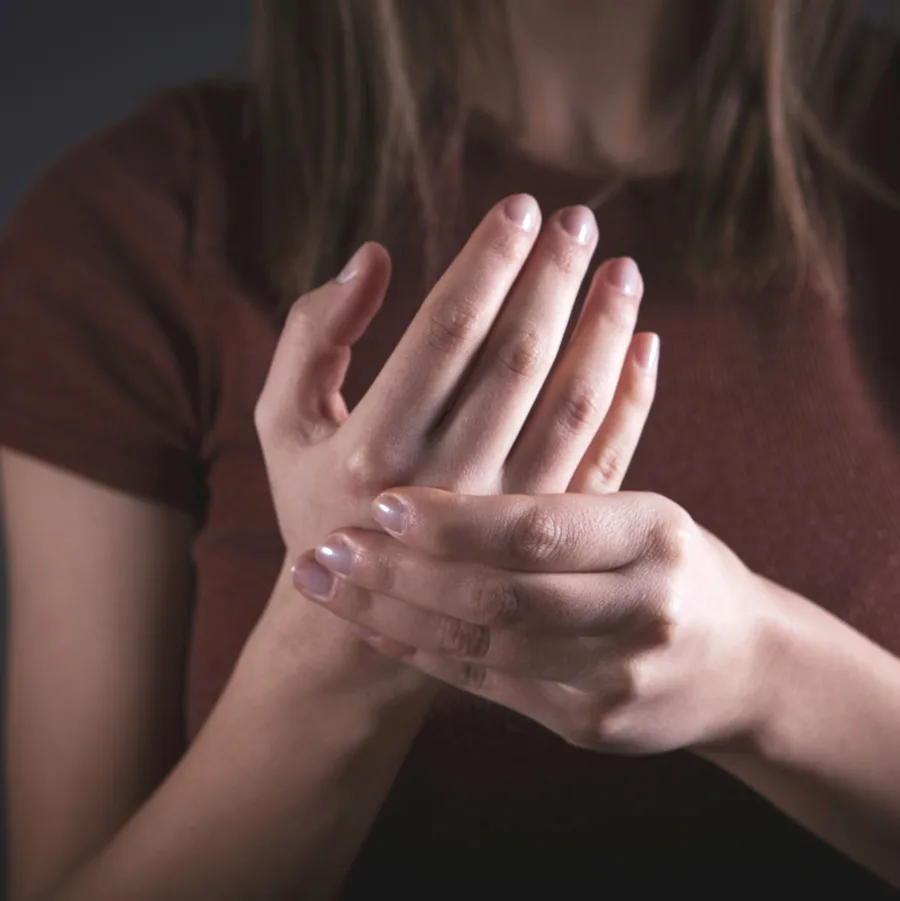
The heaviest part is not always the pain. It is the unpredictability, and the arithmetic it imposes. You do not know what tomorrow will be made of, so you stop committing. You give up distant things first, then nearby ones, and each decision seems reasonable taken on its own. It is the accumulation that shrinks a life, and it happens without anyone around you seeing it.
Sleep sits at the centre. It is unrefreshing by definition in this syndrome, and the fatigue that follows increases the pain, which in turn damages the nights. It is a loop, and a loop is worked on from several points at once.
Cognitive fog is one of the least understood complaints. Losing your words, reading the same line three times, forgetting why you walked into a room. Many people worry about this far more than about the pain, and do not dare say so.
And there is not being believed. The qualitative research on this is unanimous, and it places the question of legitimacy at the centre of the experience of the illness. One synthesis notes that many people given the diagnosis by a rheumatologist report having heard another health professional say that fibromyalgia does not exist. This cannot be measured in percentages, and we will not invent any. It gets told, and it wears people down.
Mood suffers, and that has to be said plainly. The largest meta-analysis on the question puts depression at around 51%, across more than thirty thousand people, and anxiety at around 47%, across more than twenty thousand. Quebec's Ministry of Health, for its part, reports that depression and anxiety are present in 30 to 50% of people at the time of diagnosis. This is not a weakness of character, it is the expected consequence of pain that lasts, and help exists for it.
The risk of distress is real, and it is highest at the beginning. A Danish cohort found no increase in overall mortality, but measured a clear excess risk of suicide among the women it followed, present from the moment of diagnosis and still present five years later; its 84 men were too few to support any conclusion. A Taiwanese national cohort of more than 95,000 people finds the same direction. We will publish no percentage, however: the available estimates vary far too much from one study to the next for any figure to be honest. What is solid is the direction, and the timing. In Quebec, 1 866 APPELLE (277-3553) or text 535353. Anywhere in Canada, call or text 9-8-8. In France, 3114. All free, day and night. See also Hypnosis and Depression.
What the guidelines recommend, before hypnosis
On this point four authorities say the same thing, and it would be dishonest to begin any other way.
Adapted physical activity is first-line. It is the only recommendation graded "strong for" in the 2017 European recommendations, the only one in their entire table. The Haute Autorité de santé places physical activity first, including learning to continue independently, along with personalised self-management strategies and staying in work. Inserm recommends it first-line. Quebec's Ministry of Health recommends starting with information and an exercise programme.
One honest note, because it calibrates everything else: even that strong recommendation rests on low-quality evidence, with a pain improvement of about 11 points out of 100 in the reference Cochrane review. Nothing in this field is spectacular.
- Cognitive behavioural therapies, better documented than hypnosis, deliver what their own Cochrane reviewers call a small benefit. They are practised by professionals whose title is protected.
- Multicomponent approaches, combining several interventions rather than one, are graded "weak for" by the European recommendations. That is the setting in which hypnosis makes the most sense.
- Meditative movement therapies and mindfulness-based stress reduction are likewise graded "weak for".
- Information about the condition itself is a step in its own right, not a formality.
- Medication exists and belongs to your doctor. We will say nothing more about it.
And a warning the Haute Autorité de santé issues itself, which we are glad to repeat: you may at any time seek a doctor's opinion whenever you have doubts about the usefulness and safety of any treatment presented as miraculous, or about any practitioner who disparages conventional medicine. Quebec's ministry says the same thing differently, recommending that self-management be encouraged and that miracle cures be discouraged.
Hypnosis and fibromyalgia: what it aims for, and what it does not do
Let us start with what hypnosis does not do.
It does not cure fibromyalgia, and nothing cures it to this day. It replaces neither your medical follow-up nor adapted physical activity, which remains first-line everywhere. It does not act on the cause, whose mechanisms are not elucidated. And it will not bring your pain down by a percentage announced in advance: nobody can honestly promise that.
What sessions aim for
- Sleep. This is where the signal is least fragile. Inserm's collective expert review, reading the reference meta-analysis, notes that hypnosis on its own still improves sleep disturbance three months after the sessions. Sleep was not, however, one of that study's primary outcomes. It is also, very often, what people come looking for first. See Hypnosis for Sleep and Insomnia.
- A calmer state. The Haute Autorité de santé lists hypnosis among the interventions whose expected effect is relaxation, calm and well-being. It is a modest claim, and it is supported: the same meta-analysis finds a measurable effect on psychological distress. See Hypnosis for Stress and Anxiety.
- Your relationship with pain. The wording is the Haute Autorité de santé's own, and we keep it as it stands: providing resources to learn to change your relationship with pain and how you cope with it. That is not the same thing as lowering pain, and the distinction is the whole subject. See Hypnosis for Pain Management.
- Daily self-hypnosis. This is explicitly what the Haute Autorité de santé singles out: self-hypnosis practised independently once it has been learned. On this subject, what you do between sessions counts for more than the sessions themselves.
- Living with a condition that lasts. The unpredictability, the things given up, the guilt of letting people down. See Hypnosis for Chronic Illness and Hypnosis for Dealing with Uncertainty.
What the research says, without arrangement
We have to be direct, and this section will tell you things most pages on this subject leave out.
The 2017 European recommendations examined hypnotherapy by name, and issued an unfavourable evaluation. The exact wording is "weak against", with 86% agreement among the panel. Guided imagery, often confused with hypnosis, is graded more severely still, "strong against", alongside homeopathy. Two points matter. First, those same recommendations define a weak evaluation as one that a substantial minority of informed people would not endorse: it is not a rejection. Second, their literature review stopped in May 2015, and rests on a single meta-analysis, the one published in 2011.
The most complete meta-analysis came later, and is more favourable. Published in 2017, it brings together seven randomised trials and 387 people. It finds that 18 more people out of 100 reach at least a 50% reduction in pain, with an interval running from 2 to 35, and a measurable effect on psychological distress. Its authors conclude with a well-chosen word: hypnosis and guided imagery hold promise, within multicomponent management. Hold promise, not demonstrated. Two reservations we will not hide: the earlier meta-analysis acknowledged that its effect on pain was associated with low methodological quality and with low quality in the interventions themselves, and none of these studies measured safety.
The French and European sources do not say the same thing, and that needs naming. Inserm's collective expert review, in 2020, writes in its recommendations that the efficacy of hypnosis in supporting people with fibromyalgia is established. That is the sentence competing sites quote. It is almost always quoted without its second half: in its own evidence chapter, the same report states that these results are not robust enough given the significant methodological biases found in the included studies. The same document, a few pages apart.
The most recent position is that of the Haute Autorité de santé, in June 2025, and it is the one we follow. It writes that hypnosis may be considered in fibromyalgia, given its value in other chronic pain conditions and the use of self-hypnosis independently once learned. The important word is "other": the justification does not come from fibromyalgia data. It attaches conditions to that opinion, including stopping if there is no response, and one precaution we have made our own, set out just below.
Something we owe you plainly. That recommendation specifies that hypnosis should be delivered by a health professional or a psychologist trained in the approach. That is the French setting, where hypnosis is largely practised in hospitals. In Quebec the framework is different: hypnosis is not a reserved activity, psychotherapy is, and we do not practise it. We would rather set out that difference than pass over it in silence, and let you judge.
What this means in practice. We do not claim to do better than adapted physical activity, which remains first-line. Nor do we claim that hypnosis is demonstrated in fibromyalgia. We work on sleep, on calm and on your relationship with pain, alongside your medical follow-up, and that is exactly the scope the guidelines recognise.
An example of a course of sessions
*Illustrative example. The name has been changed and the path described reflects only the person who lived it.*

Martine received her diagnosis after almost four years. Four doctors, a long series of tests that all came back normal, and a sentence heard along the way that she has not forgotten, about stress. The diagnosis both relieved her and left her stranded: she finally had a word, and nobody had told her what to do with it.
She arrived asking for the pain to come down. We told her that this was not what we knew how to do, and that her doctor and the adapted physical activity programme she mentioned were, for their part, exactly where they should be. We asked her to discuss it with them before starting anything with us.
The work focused on her nights, because that was where she lost the most. On the four o'clock waking and what she said to herself at that moment, which was never reassuring. Then on the way she organised her days, that constant arithmetic which exhausted her as much as the pain did. And on a short exercise to do on her own, every day.
> "My pain has not gone. But I no longer spend my nights waiting for it, and I have started saying yes to things again." > Martine, name changed
She describes better weeks and worse ones, which is the nature of this syndrome. Every situation is different, and Martine's path says nothing about what yours will be.
How a session works on this subject
The interview. How long, how the diagnosis was made and by whom, what follow-up is in place, and what has already been tried. Then what costs you the most today, what you have stopped doing, and what your nights look like. If you have no diagnosis, or if your doctor does not know about this step, we will ask you to go back to them before we undertake anything. This is not a formality: the Haute Autorité de santé explicitly asks that the doctor following you give an opinion before hypnosis begins.
The objective. Agreed together, and never "make the pain disappear". Rather: get back to sleep after the four o'clock waking, or get through a bad day without it taking the whole week with it.
The induction. A natural state of focused attention that you already know without naming it. You stay conscious, you hear everything, and you can speak or stop whenever you wish. You will not be asked to hold any uncomfortable position.
The work. It most often concerns sleep, calm, the way you speak to your body when it does not keep up, and the things you have given up. Some people also work on perception itself, through images of distance or temperature, without that being a promise.
The debrief and the exercise. A conversation about what you experienced, and a self-hypnosis exercise to take away, short, designed to be practised daily and usable on bad days. That is the part that counts most. Some practitioners provide it as a recording.
And a rule we apply. The Haute Autorité de santé asks that sessions stop if there is no response. We follow it: if nothing moves, we will tell you rather than offer you one more session.
Sessions work in person as well as by video, which matters on the days when getting out of the house is beyond you. The number of sessions is agreed at the first meeting.
Booking an appointment

If you do not yet have a diagnosis, or if your doctor does not know about this step, start there. We will tell you so at the first meeting rather than book you one more appointment. And if adapted physical activity has never been offered to you, that is the question to put to your doctor before any other: it is the only intervention that all four authorities cited on this page place first-line.
In person, our practitioners see clients in Montreal, Sherbrooke, Gatineau, Paris and Lille. By video, wherever you are in the world. The guide is here.
A question before you decide? Write to us describing your situation.
Where would you like to consult?
All areas
 Annie Mayrand
Gatineau - Cumberland (ON)
👤
🧑🎓
🚭
❤️
💻
Annie Mayrand
Gatineau - Cumberland (ON)
👤
🧑🎓
🚭
❤️
💻
 Christian Rocher
Beloeil
👤
🧑🎓
👶
🚭
❤️
💻
Christian Rocher
Beloeil
👤
🧑🎓
👶
🚭
❤️
💻
 David Veilleux
Montréal - Anjou
👤
🧑🎓
🚭
❤️
🤰
💻
David Veilleux
Montréal - Anjou
👤
🧑🎓
🚭
❤️
🤰
💻
 Florence Aton
Sutton
👤
🚭
❤️
💻
Florence Aton
Sutton
👤
🚭
❤️
💻
 Jessica Reid
Sherbrooke
👤
🚭
💻
Jessica Reid
Sherbrooke
👤
🚭
💻
 Julie Rocque
Montréal - Jean-Talon
👤
🧑🎓
👶
🚭
❤️
🤰
💻
Julie Rocque
Montréal - Jean-Talon
👤
🧑🎓
👶
🚭
❤️
🤰
💻
 Nuria Pérez de León
Montréal - Rosemont - Saint-Lambert
👤
🧑🎓
💻
Nuria Pérez de León
Montréal - Rosemont - Saint-Lambert
👤
🧑🎓
💻
 Romain Rastoin
Bromont
👤
🧑🎓
🚭
❤️
💻
Romain Rastoin
Bromont
👤
🧑🎓
🚭
❤️
💻
 Réjeanne LeBlanc
La Prairie
👤
🧑🎓
👶
💻
Réjeanne LeBlanc
La Prairie
👤
🧑🎓
👶
💻


Frequently asked questions about Hypnosis and Fibromyalgia
We do not promise that, and it is a deliberate choice. The 2017 European recommendations examined hypnotherapy on this specific condition and issued an unfavourable evaluation, based on evidence that stopped in 2015. France's Haute Autorité de santé, in June 2025, is more open but places the value of hypnosis elsewhere: relaxation, a calmer state, and learning to change your relationship with pain and how you cope with it. That is what we offer, not a reduction in your pain level.
No. It appears in the World Health Organization's International Classification of Diseases, under chronic widespread pain, in force since January 2022. France's Inserm collective expert review writes that the question is no longer whether fibromyalgia is real, and the Haute Autorité de santé states that giving the diagnosis acknowledges the suffering and legitimises the complaint. Normal test results do not mean the pain is not real: they mean no test can measure it yet.
Yes, and we will ask you to. The Haute Autorité de santé writes that before hypnosis is considered, the doctor following the patient must confirm the absence of an established psychopathology, and that a psychiatrist may indicate or contraindicate hypnosis. We have made this our own rule: sessions are decided with the doctor who follows you, never in their place.
No, never, and we do not comment on any treatment. Hypnosis is a non-drug approach that is added to your medical follow-up. Any decision to stop, reduce or change a treatment belongs exclusively to the doctor who prescribed it. Do not change anything on your own.
No adverse effects have been reported in the published trials, and an algorithm from Quebec's Ministry of Health lists hypnosis among approaches considered safe. One point needs to be precise, though: the most complete meta-analysis on the subject notes that no study reported on safety. Absence of a signal is not proof of harmlessness, which is one more reason to speak to your doctor first.
In Quebec, psychotherapy is a reserved activity, practised by professionals whose title is protected. We are neither psychologists nor psychotherapists, and hypnosis sessions are not psychotherapy. For fibromyalgia, cognitive behavioural therapies are better documented than hypnosis and belong to those professionals: that is a subject to raise with your doctor.
Yes, far more than is usually said. The nine-women-to-one-man figure that circulates everywhere comes from samples of patients already referred to specialist services. Measured in the general population without that bias, the proportion of women falls to around 59%. The Haute Autorité de santé writes that fibromyalgia is almost three times more frequent in women. Men are therefore affected, and underdiagnosed partly because no one is expecting them.
The number of sessions is agreed at the first meeting. In the published trials on this subject, protocols ranged from four to about twenty sessions, with a median of nine. With fibromyalgia more than elsewhere, what matters is daily self-hypnosis practice between sessions: that is what the Haute Autorité de santé singles out, and it explicitly asks that sessions stop if there is no response.
Where to find help.
In distress, first. In Quebec, the Quebec suicide prevention line, 1 866 APPELLE (277-3553), text 535353, and chat at suicide.ca, free and confidential, day and night, in French and English. Anywhere in Canada, the 9-8-8 Suicide Crisis Helpline, by call or text, free and confidential, 24 hours a day, in English and French. Also in Quebec, Info-Social at 811, option 2, for psychosocial support, free, day and night. In France, 3114, free, day and night, in mainland France and overseas.
For support and information in Quebec: the Société québécoise de la fibromyalgie brings together around fifteen regional associations, several of which run a listening line. To check that a professional actually holds a psychotherapist's permit, the Ordre des psychologues du Québec keeps the official register. These resources are in French.
In France: FibromyalgieSOS runs a listening line staffed by volunteers on 09 70 09 22 22, at standard call rates, Monday to Thursday only. Fibromyalgie France informs and represents people with the condition, and publishes no telephone line. In French.
One distinction worth keeping in mind: these associations are support and information resources, run largely by volunteers. They are not crisis lines. On a Friday evening, it is the numbers in the first paragraph that answer.
Sources and references
Institutional resources
- Fibromyalgie de l'adulte : conduite diagnostique et stratégie thérapeutique. Haute Autorité de santé, clinical practice guideline, June 2025. In French. This is the text that places hypnosis, at recommendations 103 and 104.
- Fibromyalgie. Inserm, collective expert review, 2020. In French.
- Algorithme de prise en charge de la fibromyalgie. Quebec Ministry of Health and Social Services, 2021. In French.
- EULAR revised recommendations for the management of fibromyalgia. Macfarlane, G. J., Kronisch, C., Dean, L. E. et al. (2017). Annals of the Rheumatic Diseases, 76(2), 318-328. This is the text that grades hypnotherapy "weak against".
- International Classification of Diseases, 11th revision. World Health Organization. Fibromyalgia syndrome appears under MG30.01, chronic widespread pain.
Scientific references
- Efficacy, acceptability and safety of guided imagery/hypnosis in fibromyalgia. Zech, N., Hansen, E., Bernardy, K., & Häuser, W. (2017). European Journal of Pain, 21(2), 217-227.
- Efficacy of hypnosis/guided imagery in fibromyalgia syndrome. Bernardy, K., Füber, N., Klose, P., & Häuser, W. (2011). BMC Musculoskeletal Disorders, 12, 133.
- Aerobic exercise training for adults with fibromyalgia. Bidonde, J., Busch, A. J., Schachter, C. L. et al. (2017). Cochrane Database of Systematic Reviews, 6(6), CD012700.
- Cognitive behavioural therapies for fibromyalgia. Bernardy, K., Klose, P., Busch, A. J., Choy, E. H., & Häuser, W. (2013). Cochrane Database of Systematic Reviews, 9, CD009796.
- Nociplastic pain: towards an understanding of prevalent pain conditions. Fitzcharles, M. A., Cohen, S. P., Clauw, D. J. et al. (2021). The Lancet, 397(10289), 2098-2110.
- Fibromyalgia diagnosis and biased assessment: sex, prevalence and bias. Wolfe, F., Walitt, B., Perrot, S., Rasker, J. J., & Häuser, W. (2018). PLoS One, 13(9), e0203755.
- The prevalence of fibromyalgia in the general population: a comparison of the ACR 1990, 2010, and modified 2010 classification criteria. Jones, G. T., Atzeni, F., Beasley, M. et al. (2015). Arthritis & Rheumatology, 67(2), 568-575.
- 2016 Revisions to the 2010/2011 fibromyalgia diagnostic criteria. Wolfe, F., Clauw, D. J., Fitzcharles, M. A. et al. (2016). Seminars in Arthritis and Rheumatism, 46(3), 319-329.
- Chronic fatigue syndrome and fibromyalgia in Canada: prevalence and associations with six health status indicators. Rusu, C., Gee, M. E., Lagacé, C., & Parlor, M. (2015). Health Promotion and Chronic Disease Prevention in Canada, 35(1), 3-11.
- A patient survey of the impact of fibromyalgia and the journey to diagnosis. Choy, E., Perrot, S., Leon, T. et al. (2010). BMC Health Services Research, 10, 102.
- Increased risk of a suicide event in patients with primary fibromyalgia and in fibromyalgia patients with concomitant comorbidities. Lan, C. C., Tseng, C. H., Chen, J. H. et al. (2016). Medicine (Baltimore), 95(44), e5187.
- Mortality in a cohort of Danish patients with fibromyalgia: increased frequency of suicide. Dreyer, L., Kendall, S., Danneskiold-Samsøe, B. et al. (2010). Arthritis & Rheumatism, 62(10), 3101-3108.
- The global prevalence of depression and anxiety among fibromyalgia patients. Jafari, M., Zadgari, E., Amouzadeh-Lichahi, M. et al. (2026). Journal of Affective Disorders, 393(Pt A), 120340.
And the neighbouring articles
- If the nights are the hardest part, see Hypnosis for Sleep and Insomnia.
- On working with perception itself, see Hypnosis for Pain Management.
- On living with a condition that lasts, see Hypnosis for Chronic Illness and Hypnosis for Dealing with Uncertainty.
- If the anxiety loop dominates, see Hypnosis for Stress and Anxiety.
Hypnosis as practised by the members of Solutions Hypnose is a complementary support approach. It is neither a medical act, nor a diagnosis, nor psychotherapy in the regulatory sense, and it in no way replaces a consultation, follow-up or treatment prescribed by a health professional.
Our practitioners do not assess and do not treat mental disorders or illnesses. They never ask for an ongoing treatment to be stopped or changed: that decision rests exclusively with your doctor.
No result can be guaranteed. The testimonials and examples presented on this page describe individual experiences and do not predict what you will experience.
In case of significant distress, unexplained physical symptoms or suicidal thoughts, contact a doctor, emergency services or a helpline without delay.
Page written by Réjeanne LeBlanc
hypnotherapist and NLP coach
partner at Solutions Hypnose.
English version reviewed by David Veilleux
Published .