
Hypnosis for Tinnitus
Evenings are the worst. The house goes quiet, the television goes off, and the ringing fills the whole room. You leave the radio on, you run a fan, you come up with tricks nobody around you understands.
During the day it varies. There are hours when you forget about it, and all it takes is thinking about it for it to move back to the front. You catch yourself checking whether it is still there, and of course it is.
What wears you down is not only the noise. It is the thought that it might never stop, and that nobody can do anything about it. It is also what you may have been told: that you will have to learn to live with it, which is exactly right and desperately discouraging when nobody explains how.
This page will not promise to make the sound go away, because nobody honestly can. It explains what can change anyway, and what needs to be checked first.


Some forms of tinnitus call for medical advice, sometimes urgently.
Call emergency services if your tinnitus comes with neurological signs that appeared suddenly, facial weakness, trouble speaking, weakness in an arm or a leg, with intense uncontrollable vertigo, a violent and unusual headache, or altered consciousness.
Seek care the same day if your hearing drops suddenly, especially on one side, or if the tinnitus appeared abruptly alongside fever, nausea or vomiting. Sudden hearing loss responds better the sooner it is seen: guidelines call for action without delay, not the following week.
Seek care within twenty-four hours if the tinnitus appeared after a blast, an explosion, a very loud concert, or a blow to the head or neck.
Make an appointment promptly with a doctor or an ENT specialist if your tinnitus affects only one ear, if it beats in time with your heart, or if it comes with pain or discharge.
If the tinnitus exhausts you to the point of dark thoughts, do not wait. In Quebec, call 811, option 2 (Info-Social), free and confidential, day and night. In France, 3114, free, day and night. If there is immediate danger, 911 in Quebec, 15 in France.
And have your hearing assessed, even if you think you hear well. Tinnitus comes with some degree of hearing loss in roughly 80% of cases, often mild and never noticed. What follows, whatever it may be, belongs to the ENT specialist and the audiologist.
Hypnosis replaces none of these steps and does not act on the origin of the sound. We give no advice on hearing aids or hearing devices: that is not our field.
What is tinnitus?
Tinnitus is the perception of a sound, a ringing, buzzing, hissing or pulsing, with no external source. It is common, and there is nothing imaginary about it: the sound is genuinely perceived by the auditory system, it simply is not produced by the environment. Nor is it a disease in itself, as Quebec's order of speech-language pathologists and audiologists points out, but the symptom of something else.
Where does it come from? Most often from changes in the auditory system, in particular when part of the inner ear cells or auditory nerve fibres has been damaged, by noise, by age, by certain medications or by an ear condition. Deprived of some of the signals it used to receive, the auditory cortex sets up compensation mechanisms that can go astray, what researchers call increased central gain. This is the best-accepted explanation today, and it remains incomplete: comparable changes are seen in people who have no tinnitus. It does account for what is observed in the clinic, a very frequent association with reduced hearing, around 80% of cases. And even when the audiogram is normal, France's national institute of health research notes that finer damage to the nerve fibres cannot be ruled out, which is why mild hearing loss can go unnoticed for years.
A few useful distinctions
- Subjective tinnitus, by far the most common, is heard only by you.
- Pulsatile tinnitus beats in time with the heart. It calls for specific medical investigation, as it can have an identifiable vascular cause.
- The jaw joint matters too: French guidelines ask that it be checked systematically, and Quebec's order of speech-language pathologists and audiologists lists it among the factors that influence tinnitus. Worth mentioning to your doctor if you clench your teeth or your jaw clicks.
- Hyperacusis is an intolerance to ordinary sounds, often associated with tinnitus. It can be managed, and cutting yourself off from all sound is not the answer: France's national health authority recommends advising patients not to withdraw from sound entirely, while protecting themselves during genuinely loud exposure. The exact balance belongs to hearing professionals.
- Distress is not loudness. This is the most important point on the subject: two people with comparable tinnitus may, one of them, no longer think about it, and the other be overwhelmed. What makes the difference is not the volume of the sound, it is the room it takes up.
What stress does, and what it does not
You will often read, including on serious websites, that some tinnitus is "psychological in origin", as if there were two families of tinnitus, the real one and the other. This needs clearing up.
Tinnitus is never imaginary. The sound is genuinely perceived, and in roughly 80% of cases some hearing loss is found. Work-related stress, an emotional shock or auditory hypervigilance are indeed among the circumstances that French guidelines ask doctors to look for, alongside acoustic trauma or a sudden loud noise. That does not mean the tinnitus is in your head, nor that you should stop looking at what is happening in the ear.
And when no examination finds a cause, which happens in close to 40% of cases, it means the cause was not found. Not that it is psychological. The distinction matters, because the first version sends you back to yourself and can delay a hearing assessment that sometimes changes everything.
What stress, fatigue and anxiety certainly do is increase the perception of the sound and the distress it causes, as most people concerned notice for themselves. And tinnitus in turn produces stress and poor nights. It is a loop, and a loop is worked on from several points at once. That is where, and only where, we come in.
Why attention is central. Our brain constantly filters out information of no interest: the feel of your clothes against your skin, until this sentence reminds you of it. A sound perceived as neutral ends up being filtered out. A sound perceived as threatening is held at the front by the alarm systems, and the more it is monitored, the more prominent it becomes. This reasoning is not speculation: the UK's NICE goes as far as advising against certain tinnitus measurement tests, on the grounds that sustained attention on the sound prevents the brain from habituating to it. It is this mechanism, not volume, that explains the difference between bearable tinnitus and overwhelming tinnitus.
An assessment with a doctor or an ENT specialist is the first step, and it usually includes a hearing test.
Some medications may also be involved: report any ongoing treatment, without ever changing it yourself, that decision belonging exclusively to the doctor who prescribed it.
The daily impact of tinnitus

Sleep is complaint number one. Bedtime is when the environment goes quiet and the sound takes up all the space. Nights get shorter, fatigue settles in, and fatigue increases distress: this is the costliest turn of the loop, because it repeats every evening and wears down the days that follow. See Hypnosis for Sleep and Insomnia.
Concentration suffers, particularly for intellectual work and reading.
Group conversations become difficult, especially when hearing loss is added to the mix. Many people begin avoiding restaurants and family gatherings, which isolates them.
Mood suffers, and this needs saying plainly. Irritability, discouragement and sometimes a depressive episode frequently accompany bothersome tinnitus: in a large German population cohort, depression and anxiety were around twice as common among people with tinnitus. This can be treated, and all the better for being raised early. If tinnitus exhausts you to the point of dark thoughts, that is not weakness and it is not something to endure alone: in Quebec 811 option 2, in France 3114. It is the very first NICE recommendation on this subject, and it appears in the French guidelines too.
And then there is checking. That reflex of listening to find out whether it is still there, which guarantees you will hear it. It is deeply human, and it is exactly what keeps the problem going.
Recognised approaches other than Hypnosis
The entry point is a doctor or an ENT specialist, with a hearing assessment.
- The hearing assessment and what follows from it. If hearing loss is found, the ENT specialist and the audiologist will set out the options that exist. Those questions are theirs, and we offer no opinion on them: our only advice is to have the assessment.
- Cognitive behavioural therapies, the best-documented psychological approach on this subject. An important and rarely understood detail: they do not reduce the volume of the sound, they reduce its impact on daily life. That is exactly the realistic goal to aim for. Guidelines place them after a first stage of information and support, and scale their intensity to measured distress.
- Sound-based approaches, offered and adjusted by hearing professionals. Their level of evidence is weaker than that of cognitive therapies: the UK's NICE was unable to make a recommendation on this point, and France's national health authority does not recommend them on their own, but combined with other care.
- Habituation programmes, which combine information, sound enrichment and support. One honest caveat: the best known of them, retraining therapy, was the subject of a large American trial published in 2019. After eighteen months, participants were doing markedly better, but no better than those who had received standard care. The reasoning about attention is sound, that particular protocol did not demonstrate an advantage of its own.
- Care for sleep and mood, which works indirectly but powerfully.
- Patient associations, useful against isolation and well informed. They are named further down.
One question to put to your ENT specialist or audiologist: the daily use of hearing protection. Many people wear it constantly as a precaution, and French guidelines come down on a specific side, not withdrawing from ordinary sound while protecting yourself during loud exposure. The balance belongs to hearing professionals, and to the occupational health doctor if the noise comes from your job.
Hypnosis sits alongside these approaches.
Hypnosis for tinnitus: goals and benefits
Let us start with what hypnosis does not do.
It does not make the sound disappear and does not reduce its volume. It does not act on the inner ear or on the cause of the tinnitus. It replaces neither an ENT assessment, nor hearing aids, nor specialist care. And it is not an alternative to anything.
What support aims at
- Shifting attention. This is the main lever, and it follows directly from the mechanism described above: what makes tinnitus overwhelming is the monitoring it is subjected to. Working on the direction of attention is exactly what a hypnotic state allows.
- Changing what the sound means. As long as it says "something is wrong" or "this will be how it is until the end", the alarm system keeps it at the front. When it becomes background noise with nothing at stake, it loses ground.
- Getting sleep back, particularly falling asleep and returning to sleep after waking.
- Easing the anxious loop, which amplifies perception. See Hypnosis for Stress and Anxiety Management and Hypnosis for Letting Go.
- Working on sensory perception itself. This is hypnosis's historical ground, documented in pain management, and some people describe a sound perceived as more distant, less sharp, or pushed into the background. See Hypnosis for Pain Management.
A realistic goal, and why it is more ambitious than it sounds
Many people arrive with a single request: make the noise stop. That is entirely understandable, and it is not what we can offer.
The realistic goal is elsewhere, and it is far from modest: that the tinnitus stop occupying the front of the stage. That there be hours when you do not think about it. That bedtime become possible again. That the prospect of still hearing it in ten years no longer be a source of dread.
This is what is called habituation. France's national health authority defines it as a natural neurophysiological mechanism, the gradual decrease of the brain's response to a repeated stimulus that carries no information, and specifies that it is not the idea of putting up with it. The whole point of support is to make that process possible, where anxiety and checking prevent it.
One clarification on the phrase you may have heard. "You will have to learn to live with it" is accurate and badly put. It is not resignation, it is a form of learning, and learning can be supported.
What the research says
We need to be direct.
For tinnitus, the best-documented psychological approach is cognitive behavioural therapy. The 2020 Cochrane review, which brings together 28 trials and 2,733 participants, concludes that it reduces the impact of tinnitus on quality of life. The authors themselves describe their level of certainty as low to moderate depending on the comparison, and note that there is no data beyond six months. An older meta-analysis of psychological approaches, which already included hypnosis, had identified the split that still holds: a clear effect on distress, a weak effect on perceived loudness, which disappeared at follow-up.
On hypnosis and tinnitus specifically, the data is old and of limited quality. It is not non-existent, contrary to what is often written: several published series involved substantial numbers, up to 393 patients in a German hospital programme, and a British randomised trial compared hypnotherapy with standard counselling in 86 people in 1996, with no advantage on the scores but three times as much self-reported improvement on the hypnosis side. What is missing, then, is not the number of participants, it is the method: absent or weak comparisons, no blinding, and nothing recent. Any page announcing proven results on this subject goes beyond what is known.
This is exactly the position of France's national health authority, which wrote in June 2026 that evidence of efficacy for bodily and mind-body approaches, "such as sophrology, hypnosis or neurofeedback, is insufficient to recommend them systematically for the specific management of tinnitus". And which adds, in the following recommendation, that these approaches "may nonetheless represent a help for the patient in managing comorbidities, or more broadly improve their experience of tinnitus, and particularly in cases of anxiety disorders, sleep disorders, stress or concentration difficulties", and that they "may be used alongside other forms of care".
That is precisely where we work, and nowhere else. What is documented on the hypnosis side concerns sensory perception, particularly pain, where a meta-analysis of 85 controlled trials finds a consistent effect, and anxiety, with better results when it accompanies other approaches rather than being used alone. That is the reasoning we rely on, and not on proven results for tinnitus itself, which do not yet exist.
An example of support
*Illustrative example. The first name has been changed and the course described commits only the person who lived it.*

Gilles developed a continuous ringing after years in a noisy workplace. His ENT specialist had carried out the assessment and found hearing loss in the high frequencies. A proposal had been made to him, which he had not taken up. He arrived saying he had "tried everything", which mostly meant he had not tried anything for long. What he was asking for, at the first interview, was silence. We told him that was not what we knew how to do.
We invited him to go back to his ENT specialist to discuss it before undertaking anything with us, that decision not being ours to make. He came back two months later: the ringing was less present during the day, and just as overwhelming at bedtime.
The work focused on evenings. On what he told himself as he turned out the light, which was not reassuring. On checking, that reflex of listening to find out whether the sound was there. And on an exercise to use once in bed, in the dark.
> "It is still there. I just no longer spend an hour listening to it before I fall asleep." > Gilles, name changed
He describes days when he does not remember it, which had not happened to him in a long time. Every situation is different, and Gilles's course says nothing about what you will experience.
How a Hypnosis session on this subject unfolds
The interview. How long, both sides or one, what assessment has been done, and whether hearing loss was found. Then when the distress is strongest, what you do to avoid it, and what you tell yourself about this sound. If the ENT assessment has not been done, we will refer you there before starting.
The goal. Set together, and never "make the sound go away". Rather: fall asleep without listening for it, or be able to read for an hour without going back to it.
The induction. A natural state of focused attention that you already know without naming it. You stay conscious, you hear everything, including your tinnitus, and you can speak or stop whenever you wish.
The work. It most often bears on the direction of attention, on the perception of the sound itself, often through images of distance or volume, on what this sound means to you, and on bedtime.
The debrief and the exercise. A conversation about what you experienced, and a self-hypnosis exercise to take away, generally designed to be used lying down, in the dark, at the moment when it is hardest. Some practitioners provide it as a recording.
Sessions work in person as well as by video. The number of sessions is defined during the first interview.
Booking an appointment
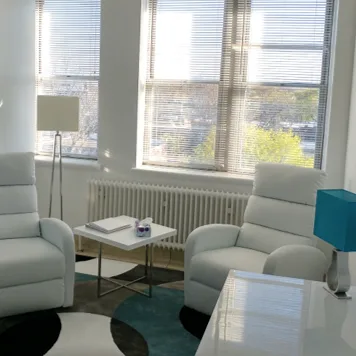
If your hearing assessment has not yet been done, that is where to start, and we will tell you so at the first interview rather than booking you an appointment. This is not a formality: tinnitus comes with some degree of hearing loss in roughly 80% of cases, and it is the only step that can change anything about the origin of the sound. Hypnosis comes afterwards, and alongside. Nobody here will ask you to choose between the two.
In person, our practitioners see clients in Montreal, Sherbrooke, Gatineau, Paris and Lille. By video, wherever you are in the world. The how-to is here.
A question before you decide? Write to us describing your situation.
Where would you like to consult?
All areas
 Annie Mayrand
Gatineau - Cumberland (ON)
👤
🧑🎓
🚭
❤️
💻
Annie Mayrand
Gatineau - Cumberland (ON)
👤
🧑🎓
🚭
❤️
💻
 Christian Rocher
Beloeil
👤
🧑🎓
👶
🚭
❤️
💻
Christian Rocher
Beloeil
👤
🧑🎓
👶
🚭
❤️
💻
 David Veilleux
Montréal - Anjou
👤
🧑🎓
🚭
❤️
🤰
💻
David Veilleux
Montréal - Anjou
👤
🧑🎓
🚭
❤️
🤰
💻
 Florence Aton
Sutton
👤
🚭
❤️
💻
Florence Aton
Sutton
👤
🚭
❤️
💻
 Jessica Reid
Sherbrooke
👤
🚭
💻
Jessica Reid
Sherbrooke
👤
🚭
💻
 Julie Rocque
Montréal - Jean-Talon
👤
🧑🎓
👶
🚭
❤️
🤰
💻
Julie Rocque
Montréal - Jean-Talon
👤
🧑🎓
👶
🚭
❤️
🤰
💻
 Nuria Pérez de León
Montréal - Rosemont - Saint-Lambert
👤
🧑🎓
💻
Nuria Pérez de León
Montréal - Rosemont - Saint-Lambert
👤
🧑🎓
💻
 Romain Rastoin
Bromont
👤
🧑🎓
🚭
❤️
💻
Romain Rastoin
Bromont
👤
🧑🎓
🚭
❤️
💻
 Réjeanne LeBlanc
La Prairie
👤
🧑🎓
👶
💻
Réjeanne LeBlanc
La Prairie
👤
🧑🎓
👶
💻


Frequently asked questions about Hypnosis for Tinnitus
No, and nobody can honestly claim otherwise. It does not act on the origin of the sound. What can change is the room it takes up: the attention you give it, the distress it causes, and its effect on your nights. France's national health authority places approaches such as hypnosis exactly there, alongside psychological and audiological care rather than in their place.
No. The sound is genuinely perceived by your auditory system, and some degree of hearing loss is found in roughly 80% of cases. If a first examination finds no cause, that does not mean the tinnitus is psychological, it means no cause was found, which happens in close to four cases out of ten. Stress and fatigue do modulate perception and distress, which is not at all the same as causing them.
Yes, and it is the first thing to do. Tinnitus comes with some degree of hearing loss in roughly 80% of cases, often mild and never noticed, and only a hearing assessment can tell. What follows is decided with the ENT specialist and the audiologist, and we have no opinion to offer there. Seek care the same day if your hearing drops suddenly.
No. The hypnotic state is one of focused attention, not sleep and not submission. You stay conscious, you hear everything, including your tinnitus, and you keep the ability to decline a suggestion, to speak, or to stop the session.
That is a question for the doctor who follows you, and only they can answer it for your situation. What we can say on our side: hypnosis is a non-medicinal approach that is added to your care and never replaces it. We do not change, interrupt or comment on any treatment. One useful point on this subject: some medications can trigger or worsen tinnitus. If you suspect this, tell the doctor who prescribed them, without changing anything yourself.
Psychotherapy is a regulated field, practised by professionals whose title is protected. For tinnitus, cognitive behavioural therapy is the best-documented psychological approach, and British and French guidelines position it according to measured distress: this is a subject to raise with your doctor or ENT specialist. Hypnosis is a narrower form of support, which the 2026 French guidelines place alongside psychological and audiological care.
Many people find that complete silence makes tinnitus more prominent, and France's national health authority confirms it: very quiet environments are among the factors that favour the appearance or amplification of tinnitus. It recommends advising patients not to cut themselves off from sound entirely, while protecting themselves during genuinely loud exposure. The exact balance belongs to hearing professionals, and we give no advice on devices.
Yes, and it is the factor you have most control over. Exposure to high sound levels is one of the main causes of tinnitus. Protecting your hearing is a subject in its own right that we do not cover here: ask your ENT specialist, your audiologist and, if the noise comes from your work, your occupational health doctor. French guidelines explicitly provide for that referral.
That is accurate and very badly put. France's national health authority defines habituation as a natural neurophysiological mechanism, the gradual decrease of the brain's response to a repeated stimulus carrying no information, and specifies that it is not the idea of putting up with it. The process is natural, anxiety and checking prevent it, and that is precisely where support is useful.
It is more common than people think, and children rarely report being bothered by it. Hearing loss, even temporary during ear infections, and exposure to noise or loud music increase the risk. If your child seems bothered, Quebec's order of speech-language pathologists and audiologists recommends an audiology consultation, and that is where to start.
The number of sessions is defined during the first interview. On this subject, daily practice of the exercise matters more than the number of appointments.
Where to find help.
In Quebec: your doctor, your ENT specialist or your audiologist first. Acouphènes Québec has supported people with tinnitus for more than forty years, at 1 877 276-7772. The Order of Speech-Language Pathologists and Audiologists of Quebec explains tinnitus and lets you find an audiologist. Audition Québec describes how an assessment unfolds. Info-Social 811, option 2, free and confidential, day and night, if distress takes over. These resources are in French.
In France: your family doctor or an ENT specialist, and the association France Acouphènes, recognised as being of public utility, useful against isolation. In case of distress, 3114 is free, day and night. In French.
And everywhere: sudden hearing loss does not wait. It responds better the sooner it is seen.
Sources and references
Institutional resources
- *Tinnitus: assessment and management*. National Institute for Health and Care Excellence, guideline NG155.
- Acouphènes invalidants chez l'adulte : diagnostic et prise en charge. Haute Autorité de santé, clinical practice guideline, June 2026. This is the text that places hypnosis alongside other care, and never as a systematic recommendation. In French.
- Acouphènes. Inserm, information dossier. In French.
- L'acouphène. Order of Speech-Language Pathologists and Audiologists of Quebec. In French.
Scientific references
- Cognitive behavioural therapy for tinnitus. Fuller, T., Cima, R., Langguth, B. et al. (2020). Cochrane Database of Systematic Reviews, 1(1), CD012614.
- A meta-analytic review of psychological treatments for tinnitus. Andersson, G., & Lyttkens, L. (1999). British Journal of Audiology, 33(4), 201-210.
- Tinnitus and Its Relation to Depression, Anxiety, and Stress: A Population-Based Cohort Study. Hackenberg, B., Döge, J., O'Brien, K. et al. (2023). Journal of Clinical Medicine, 12(3), 1169.
- Ericksonian hypnosis in tinnitus therapy. Ross, U. H., Lange, O., Unterrainer, J., & Laszig, R. (2007). European Archives of Oto-Rhino-Laryngology, 264(5), 483-488.
- Client centred hypnotherapy in the management of tinnitus: is it better than counselling? Mason, J. D., Rogerson, D. R., & Butler, J. D. (1996). Journal of Laryngology and Otology, 110(2), 117-120.
- Effect of Tinnitus Retraining Therapy vs Standard of Care on Tinnitus-Related Quality of Life. Scherer, R. W., & Formby, C. (2019). JAMA Otolaryngology-Head & Neck Surgery, 145(7), 597-608.
- The effectiveness of hypnosis for pain relief: a systematic review and meta-analysis of 85 controlled experimental trials. Thompson, T., Terhune, D. B., Oram, C. et al. (2019). Neuroscience & Biobehavioral Reviews, 99, 298-310.
- The Efficacy of Hypnosis as a Treatment for Anxiety: A Meta-Analysis. Valentine, K. E., Milling, L. S., Clark, L. J., & Moriarty, C. L. (2019). International Journal of Clinical and Experimental Hypnosis, 67(3), 336-363.
And the neighbouring articles
- If sleep is the hardest part, see Hypnosis for Sleep Disorders.
- If the anxious loop dominates, see Hypnosis for Stress and Anxiety Management and Hypnosis for Letting Go.
- On working with sensory perception, see Hypnosis for Pain Management.
Hypnosis as practised by the members of Solutions Hypnose is a complementary support approach. It is neither a medical act, nor a diagnosis, nor psychotherapy in the regulatory sense, and it in no way replaces a consultation, follow-up or treatment prescribed by a health professional.
Our practitioners do not assess and do not treat mental disorders or illnesses. They never ask for an ongoing treatment to be stopped or changed: that decision rests exclusively with your doctor.
No result can be guaranteed. The testimonials and examples presented on this page describe individual experiences and do not predict what you will experience.
In case of significant distress, unexplained physical symptoms or suicidal thoughts, contact a doctor, emergency services or a helpline without delay.
Page written by Florence Aton
hypnotherapist and NLP coach
partner at Solutions Hypnose.
English version reviewed by David Veilleux
Updated .