
Hypnosis for Alcohol and drinking less
Hypnosis is not a treatment for alcohol dependence.
What a hypnosis session can change is your relationship with alcohol: the drink that arrives without a decision, the situations that trigger it, and what it was quietly doing in place of something else.
For many people, it is that change in behaviour which then shows up as a different way of drinking: less often, more deliberately, or not at all.
This page explains how, what the research actually says, and in which situations the first step is a doctor.
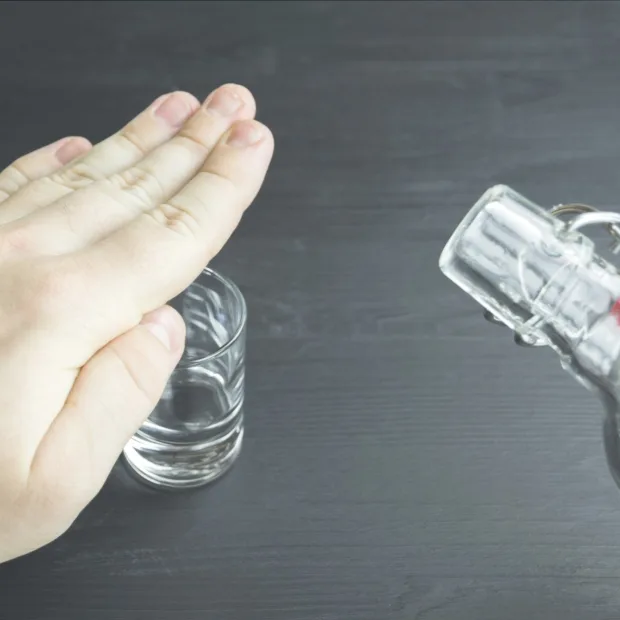

Understanding your relationship with alcohol
The gentle slope
With alcohol there is almost never an event. That is what makes it so hard to look at.
There is the Friday drink that becomes the Thursday one. The second one that follows the first without anyone consciously pouring it. The bottle opened between two people on a Sunday and finished without discussion. The gesture on getting home, before the coat is even off. And the small negotiation that comes back every evening: not tonight, well, all right, just one.
Nothing has broken, nobody has said anything, and that is precisely the problem. There is no threshold crossed, no moment where you could have said "there, that is where it happened". Just a habit that settled in by small additions, each one perfectly reasonable on its own.
The fact that you are asking yourself the question is already information. People who are not troubled by alcohol do not ask it.
Risky use, harmful use, dependence: the distinction that changes everything
Three very different situations go by the same word in everyday language. Confusing them leads to aiming at the wrong objective, and sometimes to putting yourself in danger.
- Risky use is drinking that has no visible consequence yet but does carry health risks. No symptoms, no dependence.
- Harmful use already has consequences on health, work, family or safety, without dependence being necessarily present.
- Dependence adds a physical and psychological dimension: the amount is no longer under control once the first drink is taken, cravings become compelling, tolerance rises, and signs of withdrawal appear on stopping.
It is this third situation that calls for a doctor first, and in which hypnosis can only ever come alongside a course of medical care.
We publish no thresholds of our own. Low-risk drinking guidelines exist, set by health authorities and revised regularly: in Canada, the Canada's Guidance on Alcohol and Health from the Canadian Centre on Substance Use and Addiction; in France, those of Santé publique France (in French). Reading them is worth more than comparing yourself with the people around you, which is always reassuring and rarely relevant.
Why willpower is not the lever
This is where almost every attempt comes apart, and it deserves to be stated plainly.
The first drink is rarely a decision. It is the end of a sequence (arriving, putting the keys down, opening the fridge) built by repetition, which now runs on its own. An automatic habit cannot be reasoned with, and opposing willpower to it amounts to arguing with a reflex.
Alcohol also does real jobs: it takes the pressure off, it marks the end of the day, it lightens an emotion, it makes an evening easier. As long as those jobs are not done by something else, removing the drink leaves a gap, and the gap fills itself, rarely in the way you would choose.
That is why our work rests neither on prohibition, nor on disgust, nor on permanent effort of will. It works where drinking is actually decided: in automatic habits and in emotions.
When alcohol takes up a place you did not choose
The automatic drink

Coming home from work, the empty hour at the end of the afternoon, the start of the evening, Friday. The drink is no longer tied to wanting it: it is tied to a moment. You no longer decide it, you notice it.
Like any automatic habit, it cannot be reasoned with; it comes apart through the same learning mechanism that installed it.
Drinking to make something go away
This is the most common reason, and the one most rarely put in these words: alcohol is doing a job that is not its own. Soothing anxiety, cushioning anger, filling boredom, getting through an evening whose silences you dread, putting distance between you and a difficult day.
The mechanism turns around quickly. Alcohol soothes in the moment, but after a heavy drinking episode anxiety rises again the next day and in the days that follow; when the drinking repeats, it settles in between episodes instead of easing. That explains why people drink precisely when they feel bad, and why they feel bad, in part, because they drank. Sleep follows the same logic: you fall asleep quickly and wake in the middle of the night, sleeping worse while believing you sleep better.
When physical dependence sets in
Some signs no longer belong to behaviour but to physiology: tremors, sweating, nausea or strong anxiety when you do not drink; needing a drink in the morning, or to take those sensations away; being unable to stop once the first drink is taken.
How Hypnosis can work on drinking
The hypnotic state is a natural state of focused attention, in which you remain conscious and in charge of yourself, and where automatic habits become reachable and open to change.
In practice, the work happens on four levels.
- Undoing the automatic habits. We work on uncoupling the triggers you have identified (getting home, the hour, the place, certain people) from the gesture that attached itself to them.
- Handing to other resources what alcohol was doing. Rather than creating a gap, the work replaces the jobs the drink was doing (unwinding, transition, comfort, social ease) with resources that do the same work without the drawbacks. This is the heart of the method: we do not fight alcohol, we relieve it of a role that was never its own.
- Getting through social situations without it being an ordeal. Turning down a drink without having to explain yourself is a skill, not a character trait. It is one of the most requested goals and one of the most concrete to work on.
- Easing what feeds the drinking. End-of-day anxiety, difficulty sleeping, and the way you look at yourself, because shame is fuel for relapse, never a brake on it.
What we do not do
We use no aversion suggestions. Pairing alcohol with an unpleasant sensation under hypnosis is an old idea: it was tried as early as the 1950s and tested in controlled trials in the 1960s and 1970s, which showed no advantage over usual care. The approach was abandoned, it swaps one constraint for another, and it is not part of what we offer.
We do not replace medical withdrawal, and we do not supervise it in place of a care team.
We do not set your goal for you. Cutting down and stopping are both legitimate goals in contemporary addiction medicine, and the second is not morally superior to the first. Where there is dependence, abstinence is generally the safest goal and that is what practice guidelines recommend; but it is not the only recognised path, and those same guidelines ask that a person's own goal be accepted rather than imposed on them. What is not negotiable lies elsewhere: whatever the goal, it is discussed with a doctor before anything is changed, because of the risk of withdrawal. And we sell moderation to nobody as a universal answer.
What the research says, and how a session works
What does the research say?
We may as well be blunt, which is rare on this subject: research on hypnosis and alcohol is scarce and does not allow any conclusion.
A Norwegian randomised trial published in 2019 compared Ericksonian hypnosis sessions with motivational interviewing, in people hospitalised for alcohol use disorder, inside an otherwise intensive treatment programme. Thirty-one people took part, far too few to settle anything. Both groups reduced their drinking, and the gap in favour of hypnosis at one year did not reach statistical significance. The authors note themselves that only two randomised controlled trials existed at the time on this question, and they consider several readings of their result, including the one where neither hypnosis nor motivational interviewing adds much to the treatment programme itself.
A Cochrane review of hypnotherapy for smoking cessation reaches a comparable conclusion: the evidence does not show that hypnosis does better than other forms of behavioural support, and if a benefit exists, it is small at most.
That is our reading, and it does not suit a page offering a service: what is documented in the field of alcohol is addiction medicine — in Quebec, dependency services: early identification, brief interventions, motivational interviewing, cognitive and behavioural therapies, behavioural self-control training where the goal is to cut down, medication where it is indicated, and taking part in peer support groups, which are among the best-supported approaches for maintaining abstinence. We offer hypnosis as support inside that framework, not instead of it. Any promise of a measured reduction or of abstinence through hypnosis cannot be an argument.
How the work unfolds

It always begins with a thorough conversation: your actual habits (when, where, with whom, in what state), your sleep, your history with alcohol, your medical context and any current medication. We will also ask you the screening questions set out at the top of this page.
If your answers point to physical dependence, we will refer you to a doctor before going any further, and we will say so plainly. That is not a formality: it is the most useful thing we can offer you that day.
The number of sessions is worked out at that first conversation. Behaviour is relearned in real life, between meetings, not least through the self-hypnosis you will be taught. Sessions work just as well in person as by video.
Hypnosis also fits very well inside multidisciplinary support: it complements the work of a doctor, an addiction specialist, a psychologist or a peer support group. They handle diagnosis, the framework of care and treatment; we handle "why that drink, at that moment, without my having decided it".
Three ways in, depending on your situation
- You want to try a month off, just to see → Hypnosis for Dry January
- You want to drink less, lastingly, without aiming for abstinence → Hypnosis to Drink Less
- You have been through withdrawal and you are working on staying well → Hypnosis for Alcohol Withdrawal
When to see a doctor first
See a doctor first, and make hypnosis a complement (never a substitute), in the following situations:
- settled daily drinking, whatever the amount
- tremors, sweating, nausea, a racing heart or strong anxiety when you do not drink, or when you cut down
- needing a drink in the morning, or to take those sensations away
- being unable to stop once the first drink is taken
- a previous seizure, episode of confusion or delirium when stopping
- disease of the liver, pancreas or heart, or any chronic condition
- taking benzodiazepines, sleeping pills or anti-anxiety medication alongside
- any current medication
- being isolated: living alone, with nobody you can reach
- pregnancy, or planning a pregnancy
- drinking combined with other substances
- dark thoughts or significant distress
We will ask you these questions at the first conversation, to be sure we are the right resource for you.
Free and anonymous helplines
- Quebec: Drogue : aide et référence, 1 800 265-2626 (or 514 527-2626 in the Montreal area), free, confidential, 24 hours a day, 7 days a week.
- Quebec: Info-Social: 811, option 2 · the dependency rehabilitation centre for your region, through your CLSC.
- Quebec: Alcoholics Anonymous, peer support across the province.
- France: Alcool info service (in French), 0 980 980 930, anonymous and charged at a local rate, from 8 a.m. to 2 a.m., 7 days a week.
- If you are having suicidal thoughts: 1 866 APPELLE (1 866 277-3553) in Quebec, 24 hours a day; 3114 in France, free and confidential, 24 hours a day.
More on some alcohol-related subjects

Christian Rocher — hypnotherapist and NLP coach
Find a Hypnotherapist for Alcohol near you
All areas
 Annie Mayrand
Gatineau - Cumberland (ON)
👤
🧑🎓
🚭
❤️
💻
Christian Rocher
Beloeil
👤
🧑🎓
👶
🚭
❤️
💻
Annie Mayrand
Gatineau - Cumberland (ON)
👤
🧑🎓
🚭
❤️
💻
Christian Rocher
Beloeil
👤
🧑🎓
👶
🚭
❤️
💻
 David Veilleux
Montréal - Anjou
👤
🧑🎓
🚭
❤️
🤰
💻
David Veilleux
Montréal - Anjou
👤
🧑🎓
🚭
❤️
🤰
💻
 Florence Aton
Sutton
👤
🚭
❤️
💻
Florence Aton
Sutton
👤
🚭
❤️
💻
 Jessica Reid
Sherbrooke
👤
🚭
💻
Jessica Reid
Sherbrooke
👤
🚭
💻
 Julie Rocque
Montréal - Jean-Talon
👤
🧑🎓
👶
🚭
❤️
🤰
💻
Julie Rocque
Montréal - Jean-Talon
👤
🧑🎓
👶
🚭
❤️
🤰
💻
 Nuria Pérez de León
Montréal - Rosemont - Saint-Lambert
👤
🧑🎓
💻
Nuria Pérez de León
Montréal - Rosemont - Saint-Lambert
👤
🧑🎓
💻
 Romain Rastoin
Bromont
👤
🧑🎓
🚭
❤️
💻
Romain Rastoin
Bromont
👤
🧑🎓
🚭
❤️
💻
 Réjeanne LeBlanc
La Prairie
👤
🧑🎓
👶
💻
Réjeanne LeBlanc
La Prairie
👤
🧑🎓
👶
💻


Frequently asked questions about Hypnosis and Alcohol
Not in your place, and be wary of anyone who says it can.
Hypnosis works on automatic habits, on triggers and on what alcohol was standing in for. It is that change which, for many people, then shows up as a different way of drinking. The distinction matters: we do not work on the drinks, we work on what makes them arrive.
No, and this is the most important question on this page.
In someone who is dependent, unsupervised withdrawal can cause serious complications, including life-threatening ones. No serious practitioner will offer to have you stop under hypnosis without medical follow-up. If someone does, change practitioner.
No, and we do not try to.
Aversion suggestions are not part of our practice. The idea was tried as early as the 1950s and tested in controlled trials that showed no advantage over usual care; it sets up a power struggle, and the effect does not hold. The work is about situations, and about what the drink was filling in for.
Both goals are recognised, and the choice is yours, with one important caveat: where there is dependence, cutting down alone rarely holds, and the goal has to be discussed with a doctor. We do not settle that question for you, and we sell moderation to nobody.
No.
The hypnotic state is a state of focused attention, not sleep and not being under anyone's influence: the available research shows no loss of control over your own actions, and people told they can resist a suggestion do resist it. You stay conscious, you hear everything, and you keep at all times the ability to refuse a suggestion, to speak, to open your eyes or to stop the session.
Yes. Hypnosis is a non-medicinal approach that adds to your follow-up without interfering with it: simply tell us what you are taking at the first conversation. How a medication interacts with alcohol, on the other hand, is a strictly medical question. Any decision about your treatment belongs to the doctor who prescribed it, and we will never ask you to stop it or change it.
Psychotherapy is a regulated framework, practised by professionals whose title is protected, and it can address psychological functioning as a whole and diagnosed disorders. Hypnosis as we practise it is a narrower form of support, centred on a specific objective and on the automatic habits attached to it. In alcohol dependence, addiction medicine remains the reference and hypnosis a complement.
The number of sessions is worked out at the first conversation, based on your situation and on the rest of your care. Nobody can tell you beforehand without having met you, and a package sold in advance is a bad sign.
No.
Relapse is common on these journeys and it does not undo what has been built. What decides what comes next is not the drink taken, it is what happens in the days that follow, and the factor that tips it is almost always silence. Tell someone, get back in touch with the team following you, or call a helpline that same evening. If daily drinking has resumed, medical advice is needed before any new attempt to stop.
This is one of the most requested goals. The difficulty is almost never the craving: it is other people's eyes and the awkwardness of having to justify yourself. Part of the work is making the refusal ordinary: for you first, for everyone else afterwards.
No. You simply have to be willing and ready to take part.
Hypnosis is not a belief but a natural state of attention everyone already knows. That said, if you are looking for something that would do the work in your place, no honest method can promise you that.
Going further
- Dry January: the trial pause, and who should not attempt it without medical advice.
- Drinking Less: cutting down lastingly, without aiming for abstinence.
- Alcohol Withdrawal: the afterwards, staying well, and relapse.
- Behaviour Change: the habit loop, beyond alcohol.
- Stress Management and Anxiety Symptoms: what often feeds the evening drink.
Hypnotherapy is a complementary well-being approach: it is neither a diagnosis, nor a treatment, nor psychotherapy in the regulated sense, and it replaces neither medical or psychological advice nor follow-up. Our practitioners do not assess or treat mental disorders or illnesses, and they never ask anyone to stop or change a current treatment: that decision belongs to your doctor alone. No result can be guaranteed. Where there is alcohol dependence, stopping must be medically supervised. In case of significant distress, unexplained physical symptoms or suicidal thoughts, contact a doctor, the emergency services or a helpline without delay.