
Hypnosis for Erythrophobia (Fear of Blushing)
The meeting starts, and you know your turn to speak is coming. Three people before you. Two.
You feel the heat rising in your neck before you have even opened your mouth. And at that exact moment, only one thing matters: that it should not show. You lower your head, you let your hair fall across your face, you look for a short sentence to get it over with quickly.
Afterwards, you cannot remember what you said. You remember the heat.
So you organise around it. The polo neck rather than the open collar. The seat at the back. The question you do not ask. The invitation declined. The job you do not apply for.
And the hardest part: it is invisible to everyone but you. Nobody imagines that an entire day can be organised around the colour of a face. What you are living with is common, it is documented, and it can be worked on. But probably not in the direction you are looking for, and that is what this page is about.


Blushing a lot is not always a matter of emotion.
If your face is red for long stretches, if it reddens outside social situations, after a spicy meal, a glass of alcohol, a hot drink, a hot shower or exercise, or if the redness comes with spots, tingling or lasting heat, talk to a doctor. Rosacea, hot flushes or the effect of certain medicines may be involved, and those can be treated.
This page is about the fear of blushing, which is something else. The two can coexist, and knowing which one you are dealing with changes everything about what comes next.
What is Erythrophobia?
The word erythrophobia refers to an intense fear of blushing in public and of being judged for it.
One point of vocabulary first, because it shapes everything else. The classifications do not all draw the line in the same place: the French-language index of ICD-10 still files erythrophobia under specific phobias, while clinical research and the more recent classifications treat it as a manifestation of social anxiety. The DSM-5 and ICD-11 describe social anxiety as the fear of showing signs that others would judge badly, and blushing is its most cited example, alongside the fear of sweating, trembling or having one's voice break. It is this second reading that the research on fear of blushing follows, because what is dreaded is neither an object nor a place, but other people's gaze. The distinction is not academic: it points to different approaches from those used for phobias of objects.
Blushing is normal. It is an involuntary response of the autonomic nervous system, occurring when we feel exposed to other people's gaze. Darwin already called it the most human of all expressions. Everyone blushes. The difference lies in how much weight it takes on.
The fear works on two levels
- Before: the fear of blushing, often while it is not yet happening. Anticipation alone is enough to set off the heat.
- During: the fear that it will show, and that you will be judged weak, emotional, or not up to it.
Other fears often join in: sweating, trembling, having one's voice break. The common thread is always the same: losing control of your body in front of others.
Three useful distinctions
- It gets confused with shyness, and it is not the same thing. Many shy people have no particular dread of blushing, and people who are very comfortable in public do suffer from it. See Hypnosis for Shyness if the awkwardness is broader than the question of redness.
- It is not the same as redness of medical origin. Rosacea, hot flushes linked to menopause or perimenopause, the effect of certain medicines: these causes produce real redness and can be treated. See Hypnosis for Menopause and Hypnosis for Perimenopause if hot flushes are involved. When in doubt, a doctor settles it in one appointment.
- And the two can coexist, which is the most disorienting case of all: genuine redness, and on top of it, the fear that it shows.
The broader subject is covered on Hypnosis for Fears and Phobias.
What you feel, and what the measurement records
This is the most useful thing the research has to offer, and it needs to be stated precisely.
Several teams have measured blushing and reported intensity side by side, using skin colour and temperature or facial blood flow. What comes up most often is a gap. In a Dutch study of 57 women, no difference in facial colour or temperature appeared between those who greatly dreaded blushing and the others, while the intensity they reported was markedly higher in the first group.
The other half of the picture has to be said too, because it may be yours. Other work, with other measures, has found real differences: blushing that takes longer to subside between two situations, and therefore builds up over the course of a meeting; and, in a proportion of those affected, a genuinely stronger reaction, which observers were able to detect. Researchers now describe two distinct profiles.
In other words: you may blush like everyone else and find it enormous, and you may genuinely blush more. In both cases, what gets worked on is the same, and it is the rest of this page.
There is also an ordinary mechanism at play: we all overestimate the attention others pay us. The people you are talking to are busy with their own preoccupations, including, sometimes, the fear of blushing themselves.
Facial redness that lasts, that appears outside social situations, or that comes with spots, burning sensations, heavy sweating or palpitations, deserves to be assessed by a doctor. Several medical causes and several medicines produce this kind of reaction.
And if social anxiety is present almost every day and leads to lasting avoidance of work, study or relationships, medical advice is equally called for: recognised forms of care exist.
Any decision about your treatment belongs solely to the doctor who prescribed it.
How the fear of blushing affects daily life

What costs is not the blushing. It is a whole life organised around it. Blushing lasts a minute; the fear of blushing fills the hours before and the hours after, and it is that disproportion that wears you down. Nobody around you registers the constant calculation: where to sit, when to speak, which outfit keeps the neck covered, which meeting can be handled in writing. From the outside, nothing shows. From the inside, it is a second job held alongside the first, every day, without a break, and without anyone knowing.
Avoidance goes in disguise. You do not say you are avoiding: you are busy that evening, you would rather send an email, you let a colleague present. From the outside it looks like discretion; from the inside it is a series of things given up.
Work is affected: speaking up, meetings, interviews, sometimes a promotion that would mean being more visible. See Hypnosis for Assertiveness at Work and Hypnosis for Stage Fright and Performance.
Romantic and social life too, since the situations that matter are precisely the ones that set it off.
Camouflage strategies take up a considerable amount of energy: make-up, clothes chosen to cover the neck, hair across the face, where you stand in the room, the lighting. Each one brings a little relief, and reinforces the idea that there was indeed something to hide.
Alcohol plays a double role, and it is worth knowing. It is a recognised trigger of rosacea and flushing, so it can genuinely make you red; and it is the most common chemical camouflage in social anxiety, the one that helps on the night and tightens the grip afterwards.
Attention is confiscated. During a conversation, part of you is monitoring your face instead of listening. That precise point is why those exchanges leave such a blurred memory.
And there is the shame about the shame, the sense that all this is ridiculous, which stops people mentioning it and delays doing anything about it by years.
Recognised approaches other than Hypnosis
Your starting point is your doctor, both to rule out a physical cause and to point you onward if social anxiety is significant.
- Cognitive behavioural therapies, which are the reference approach for social anxiety.
- Task concentration training, developed specifically for the fear of blushing, trembling and sweating. Its principle is counter-intuitive: rather than controlling the symptom, you relearn to direct your attention outward, towards the conversation and the person in front of you.
- Graded exposure, social skills training and psychoeducation, which are among the established approaches for this symptom.
- Video feedback, which means watching yourself back in situation, and which goes straight at the gap between what you think you showed and what you showed.
- Mindfulness and self-compassion, more recent on this subject.
- A dermatologist, in the case of rosacea or persistent redness.
- Medication, where indicated, prescribed and monitored by a doctor. Worth knowing: no medicine targets blushing itself, but those that treat social anxiety may help some people.
Hypnosis sits alongside these approaches.
A word on surgery
Some people, at the end of their rope, look into thoracic sympathicotomy, an operation that interrupts nerves of the sympathetic system and is sometimes offered for facial blushing. We are not qualified to advise you on this, and we will not try. Here is only what the published work says, in both directions.
It works, and it would be dishonest to leave that out. A systematic review covering nine studies and 1,369 people who had the operation found good relief of blushing in about 78 % of them, and complete satisfaction in about 84 %.
The trade-offs are substantial. Excessive sweating appears elsewhere on the body in about 74 % of those operated on, sweating triggered by food in about 24 %, and close to 7 % regret the operation. There is at present no reliable treatment for that compensatory sweating once it has set in.
And the effect is not secured for good. The only randomised trial on this indication reviewed its participants after a median of sixteen years: 82 % still rated the result excellent or satisfactory, but blushing had returned in 41 % of them, milder than before in most cases, and 77 % reported compensatory sweating.
The authors of the systematic review conclude themselves that no trial has compared this surgery with non-surgical approaches, which rules out any firm recommendation. If you are considering it, talk to your doctor, ask for a second opinion, and find out what else exists.
And if you have already had the operation, including if you are struggling with compensatory sweating, this too can be worked on, differently. You are not at the end of the road.
Hypnosis for the fear of blushing: aims and benefits
Let us start with what hypnosis does not do.
It will not stop you blushing, and that is not the aim. Blushing is an autonomic nervous system response, and it does not take orders. It replaces neither medical advice, nor psychotherapy if social anxiety is significant, nor dermatological treatment. And it will not turn you into someone whom other people's gaze never touches.
What a session aims for
- Shifting attention. This is the main lever. During a conversation, your attention is trained on your own face; the work consists of bringing it back outward, towards what is being said and towards the person in front of you. This works well in hypnosis, because it is precisely an exercise in attention.
- Reducing anticipation, which often sets off the heat before the situation itself.
- Loosening the camouflage strategies, one at a time and at your pace, to find out that the situation goes fine without them.
- Changing what the blushing means to you. As long as it means "I am weak and everyone can see it", it is unbearable. When it goes back to being an ordinary bodily event, it loses its charge.
- Working on your relationship with other people's gaze, which goes beyond the question of redness. See Hypnosis for Confidence and Self-Esteem.
Why trying to stop blushing makes things worse
This is the central point of this page, and it runs against what you were looking for when you arrived.
To control your blushing, you have to monitor it. Monitoring your face means directing your attention to it. And it is that self-directed attention which amplifies the sensation of heat, raises anxiety, and sustains the redness. The effort of control is part of the problem, not part of the solution.
And this is not a figure of speech. One experiment asked 28 people to sing or read aloud while an experimenter, seated beside them, looked closely at one cheek only. The observed cheek warmed more than the other, in both tasks, including the one that was not embarrassing at all. When the experimenter looked straight ahead, the difference disappeared. The simple fact of attention resting on an area of the face is enough to change the blood flow there. Turning your own attention on your own face amounts to doing the same thing from the inside.
That does not mean attention explains everything: what you believe others will conclude counts at least as much, and can be worked on too.
Should you expect the blushing itself to lessen? The trials that measured both show that the fear of blushing can fall considerably without the measured blushing changing, which is already a great deal for daily life. Some people do also notice less redness, others do not. That is why the aim of this work is never to stop you blushing, but to make it weigh less. That road takes longer to explain, and it is far more honest.
What the research says
Two findings, and we give them in both directions.
For the fear of blushing, the reference approach is attention training combined with cognitive therapy. At least four trials have evaluated it on this specific symptom, including a German randomised trial of 82 people with a remission rate of 69 to 73 % at six months, and a French trial of 55 patients run at the Pitié-Salpêtrière hospital. The landmark study, published in *Behaviour Research and Therapy* in 2006, compared task concentration training with applied relaxation in 65 people, each followed by cognitive therapy: both proved highly effective, and it is at one year that attention training pulls ahead, through a lasting change in where attention is directed. This is the literature that underpins the principle adopted here: redirect attention rather than fight the symptom.
On hypnosis, there is no trial at all on the fear of blushing. We looked: on that intersection the indexed medical literature holds only two isolated case reports, published in 1956 and 1978, with no comparison group. That is very little, and we say so.
What does exist is less direct, and of two kinds. First, a meta-analysis published in 2019 in the *International Journal of Clinical and Experimental Hypnosis*, covering fifteen studies and seventeen comparisons, reports a greater fall in anxiety among people supported with hypnosis than in control groups, and better results when hypnosis accompanies other interventions rather than being used on its own. Second, two recent studies evaluated hypnotherapy in 69 people with social anxiety disorder, over six weekly sessions, and observed a change in the brain markers of attention to faces perceived as threatening. Their limits must be stated: the control groups received no treatment, the measures are mainly electrophysiological, and this is a single team. These results do not demonstrate clinical efficacy, but they bear on the very mechanism this page is built on.
So we offer hypnosis as a support, on a principle borrowed from what does work, and not as a method whose value has been shown on this specific subject.
An example of a session
*Illustrative example. The first name has been changed and the path described commits only the person who lived it.*

Thomas, an engineer, had just turned down a job he wanted because it involved running client meetings. He had blushed since adolescence, wore high collars all year round including in summer, and avoided video calls with the camera on, blaming an unreliable connection. He had told nobody, neither his partner nor his doctor, and he arrived at the first meeting announcing straight away that he found his own request a bit ridiculous.
The first meeting served to establish something he had never put into words: he did not know how much he actually blushed. Nobody had ever mentioned it to him, except once, at school. His entire certainty rested on an internal sensation.
The work focused on attention, first in session and then in real situations, with a deliberately trivial exercise: counting how many times the person opposite touched their cup. Then on one camouflage strategy at a time, starting with the camera on video calls.
> "I still blush. But I no longer spend the meeting thinking about it, and so I hear what people say to me." > Thomas, name changed
He did not reapply for the job he turned down. He says he is considering the next one. Every situation is different, and Thomas's path tells you nothing about what yours will be.
How a Hypnosis session works on this subject
The conversation. In which situations it happens, what you do to hide it, what you avoid, and how long it has been going on. We will also ask whether a doctor has ever looked at this redness, and whether it occurs outside social settings.
The goal. Set together, and never in the form of "stop blushing". Rather: ask a question in Thursday's meeting, or keep the camera on during Monday's video call.
The induction. A natural state of focused attention that you already know without naming it. You stay aware, you hear everything, you can speak and stop whenever you wish.
The work. On this subject it focuses mainly on where attention goes, on preparing for a specific situation, on what the blushing means to you, and on gradually letting go of one camouflage strategy.
The debrief and the exercise. A conversation about what you experienced, a self-hypnosis exercise to take away, and often a very concrete attention exercise to practise in ordinary conversations, where nothing is at stake.
Sessions work in the practice as well as by video, which is sometimes a useful first step in its own right. The number of sessions is agreed at the first meeting.
Booking an appointment
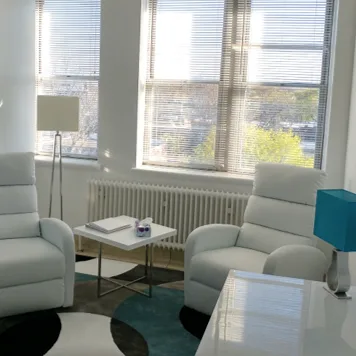
The first meeting is partly there to work out whether hypnosis is the right resource for your situation. If your redness occurs outside social settings, or if social anxiety fills almost every one of your days, it is a doctor you need to see first, and we will tell you so. It is never a refusal, it delays nothing, and nothing stops you coming back afterwards: a great many people take exactly that route.
In the practice, our practitioners see clients in Montreal, Sherbrooke, Gatineau, Paris and Lille. By video call, wherever you are in the world. The how-to is here.
A question before you decide? Write to us describing your situation.
Where would you like to consult?
All areas
 Annie Mayrand
Gatineau - Cumberland (ON)
👤
🧑🎓
🚭
❤️
💻
Annie Mayrand
Gatineau - Cumberland (ON)
👤
🧑🎓
🚭
❤️
💻
 Christian Rocher
Beloeil
👤
🧑🎓
👶
🚭
❤️
💻
Christian Rocher
Beloeil
👤
🧑🎓
👶
🚭
❤️
💻
 David Veilleux
Montréal - Anjou
👤
🧑🎓
🚭
❤️
🤰
💻
David Veilleux
Montréal - Anjou
👤
🧑🎓
🚭
❤️
🤰
💻
 Florence Aton
Sutton
👤
🚭
❤️
💻
Florence Aton
Sutton
👤
🚭
❤️
💻
 Jessica Reid
Sherbrooke
👤
🚭
💻
Jessica Reid
Sherbrooke
👤
🚭
💻
 Julie Rocque
Montréal - Jean-Talon
👤
🧑🎓
👶
🚭
❤️
🤰
💻
Julie Rocque
Montréal - Jean-Talon
👤
🧑🎓
👶
🚭
❤️
🤰
💻
 Nuria Pérez de León
Montréal - Rosemont - Saint-Lambert
👤
🧑🎓
💻
Nuria Pérez de León
Montréal - Rosemont - Saint-Lambert
👤
🧑🎓
💻
 Romain Rastoin
Bromont
👤
🧑🎓
🚭
❤️
💻
Romain Rastoin
Bromont
👤
🧑🎓
🚭
❤️
💻
 Réjeanne LeBlanc
La Prairie
👤
🧑🎓
👶
💻
Réjeanne LeBlanc
La Prairie
👤
🧑🎓
👶
💻


Frequently asked questions about Hypnosis for Erythrophobia (Fear of Blushing)
No. Blushing is an automatic nervous system response, and hypnosis does not command it. What can be worked on is how much weight it carries and how much attention you give it, and that is where the results are best documented. Surgery does act directly on blushing, with the trade-offs described further down this page.
Often less, but not always, and it is better to say so honestly. Studies that measured blushing and reported intensity side by side most often find a gap: the heat is far more vivid from the inside than the colour is from the outside. Other work, however, has identified a group of people whose reaction really is stronger, or takes longer to subside. Knowing this is not enough to change things, but it shows where the work goes, and it does not rest on the idea that you are imagining it all.
No. The hypnotic state is one of focused attention, not sleep and not being placed under anyone's influence. You stay aware, you hear everything, and you keep the ability to refuse a suggestion, to speak, or to stop the session.
That is for your doctor to say, and they are the right person to ask: simply tell them you are considering hypnosis support. On our side, we never ask anyone to stop or alter a treatment, and we do not intervene in your medical care. One useful point: some medicines cause flushing. If you think that may be your case, raise it with the doctor who prescribed them, as that decision belongs to them alone.
Psychotherapy is a regulated activity, practised by professionals whose title is protected. For social anxiety, which fear of blushing is most often part of, cognitive behavioural therapies are the reference approach, and attention training has been evaluated on this specific symptom. Hypnosis is a narrower form of support that combines with them.
Thoracic sympathicotomy is sometimes offered for facial blushing, and it should be said that it works: a systematic review covering 1,369 people who had the operation found good relief in about 78 % of them. The rest should be said too. Excessive sweating appears elsewhere on the body in about 74 %, close to 7 % regret the operation, and in the only randomised trial on this indication, reviewed after sixteen years, blushing had returned in 41 % of participants, milder than before in most cases. This decision belongs to a doctor and should follow a second opinion. We give no advice on this point.
Not overnight, and nobody will ask you to. These are strategies that bring relief, and that at the same time keep alive the idea that there is something to hide. You loosen one at a time, starting with the easiest, and you are the one who picks which.
The two get confused often, and they are not the same thing. Many shy people have no particular dread of blushing, and people who are very comfortable in public do suffer from it. What characterises fear of blushing is that it bears on a bodily reaction and on what others are supposed to conclude from it.
That is the age at which it most often begins, and it deserves to be taken seriously rather than brushed aside with "they will grow out of it". One useful detail for parents: a study has shown that inflated praise makes socially anxious children blush, so insisting that "but you are doing great" can backfire. Talk to your child's doctor, especially if school avoidance is setting in.
The number of sessions is agreed at the first meeting. On this subject it depends above all on how much the attention exercises are practised between appointments.
Where to find help.
In Quebec, Info-Social 811, option 2: a free and confidential telephone consultation service, 24 hours a day, 365 days a year, reachable from within Quebec.
In Quebec as well, Phobies-Zéro welcomes people over 14 living with an anxiety disorder, and their families, through support groups in person and online. And Relief offers individual support and self-management workshops for anxiety. Both operate mainly in French.
In France, there is no helpline dedicated to social anxiety: talk to your family doctor, who can refer you to a therapist trained in cognitive behavioural therapy. In case of distress, 3114 is free and open day and night.
Sources and references
On social anxiety and blushing
- Social anxiety. Government of Quebec.
- Social Anxiety Disorder. MSD Manual, Consumer Version. The fear of blushing appears there among the manifestations described, alongside sweating and trembling.
- Social anxiety (social phobia). NHS.
On redness of medical origin
- Rosacea. NHS. Source of the trigger list in the box above: alcohol, spicy foods, hot drinks, sunlight, hot or cold temperatures, exercise, stress.
On the attention mechanism
- Staring at one side of the face increases blood flow on that side of the face. Drummond, P. D., & Mirco, N. (2004). Psychophysiology, 41(2), 281-287. The experiment with 28 participants cited above.
- Fear of blushing: fearful preoccupation irrespective of facial coloration. Mulkens, S., de Jong, P. J., Dobbelaar, A., & Bögels, S. M. (1999). Behaviour Research and Therapy, 37(11), 1119-1128. The study of 57 women.
- Physiological blushing in social anxiety disorder patients with and without blushing complaints: two subtypes? Voncken, M. J., & Bögels, S. M. (2009). Biological Psychology, 81(2), 86-94. The work describing the two profiles.
- Blushing during social interactions in people with a fear of blushing. Drummond, P. D. et al. (2007). Behaviour Research and Therapy, 45(7), 1601-1608. Blushing that subsides more slowly.
On treatment approaches
- Treatment Options for Fear of Blushing. Drummond, P. D., Shapiro, G. B., Nikolić, M., & Bögels, S. M. (2020). Current Psychiatry Reports, 22(6), 28. The reference synthesis, and the source of the list of established approaches.
- Task concentration training versus applied relaxation, in combination with cognitive therapy, for social phobia patients with fear of blushing, trembling, and sweating. Bögels, S. M. (2006). Behaviour Research and Therapy, 44(8), 1199-1210.
- Cognitive Therapy and Task Concentration Training Applied as Intensified Group Therapies for Social Anxiety Disorder with Fear of Blushing: A Randomized Controlled Trial. Härtling, S. et al. (2016). Clinical Psychology & Psychotherapy, 23(6), 509-522.
- Efficacy of a cognitive-behavioral group therapy in patients with fear of blushing. Lobjoie, C., & Pélissolo, A. (2012). L'Encéphale, 38(4), 345-350. In French. The French trial.
- Fear of blushing: effects of task concentration training versus exposure in vivo on fear and physiology. Mulkens, S. et al. (2001). Journal of Anxiety Disorders, 15(5), 413-432. The trial showing that fear can fall without the measured blushing changing.
On surgery
- Role of surgical thoracic sympathetic interruption in treatment of facial blushing: a systematic review. Girish, G. et al. (2017). Postgraduate Medicine, 129(2), 267-275. Nine studies, 1,369 people: the source of the rates cited.
- Sympathicotomy for isolated facial blushing: long-term follow-up of a randomized trial. Dittberner, F. A. et al. (2024). European Journal of Cardio-Thoracic Surgery, 65(3), ezad414. The sixteen-year follow-up.
On hypnosis
- The Efficacy of Hypnosis as a Treatment for Anxiety: A Meta-Analysis. Valentine, K. E., Milling, L. S., Clark, L. J., & Moriarty, C. L. (2019). International Journal of Clinical and Experimental Hypnosis, 67(3), 336-363. On anxiety in general.
- Event-related potentials reveal hypnotherapy's impact on attention bias in social anxiety disorder. Zhang, H. et al. (2025). World Journal of Psychiatry, 15(5), 102552.
- Hypnotic control of blushing: a case study. Welsh, D. K. (1978). American Journal of Clinical Hypnosis, 20(3), 213-216.
In children and teenagers
- When gushing leads to blushing: Inflated praise leads socially anxious children to blush. Nikolić, M. et al. (2018). Behaviour Research and Therapy, 106, 1-7.
And the neighbouring articles
- If the awkwardness is broader than the question of redness, see Hypnosis for Shyness.
- If speaking up is what costs you most, see Hypnosis for Stage Fright and Performance.
- If it is your teenager who is affected, see Hypnosis and Coaching for Teenagers.
- For the broader subject, see Hypnosis for Fears and Phobias.
Hypnosis as practised by the members of Solutions Hypnose is a complementary support approach. It is neither a medical act, nor a diagnosis, nor psychotherapy in the regulatory sense, and it in no way replaces a consultation, follow-up or treatment prescribed by a health professional.
Our practitioners do not assess and do not treat mental disorders or illnesses. They never ask for an ongoing treatment to be stopped or changed: that decision rests exclusively with your doctor.
No result can be guaranteed. The testimonials and examples presented on this page describe individual experiences and do not predict what you will experience.
In case of significant distress, unexplained physical symptoms or suicidal thoughts, contact a doctor, emergency services or a helpline without delay.

Page written by Nassim Zafar
hypnotherapist and NLP coach
partner at Solutions Hypnose.
English version reviewed by David Veilleux
Updated .