
Hypnosis for Burnout (Professional Exhaustion)
You sleep ten hours and wake up tired. The weekend no longer repairs anything. Nor do holidays, or only for three days.
You read a six-line email four times without taking in what it says. You forget things you never used to forget. You snap at people who have nothing to do with it, then blame yourself in the evening.
And there is that moment, in the car park or at the office door, when your body refuses to go any further.
What makes it so hard to admit is that it nearly always happens to committed, conscientious people who held on for a long time. Nobody burns out over a job they do not care about.


If you are cracking right now, read this and nothing else. Exhaustion that rest no longer fixes is not a question of willpower, organisation or badly drawn limits. The first step is medical. Your GP can assess the situation and sign you off work if needed. In France, you can also ask to see the occupational physician at any time, including while on sick leave, and without informing your employer if the visit takes place outside your working hours. It is a right, recalled by the Haute Autorité de santé, that very few people know about. This page is not asking you to hold on. It explains what hypnosis can do, at what moment, and above all at which moments it has no business being there. Dark thoughts: Quebec 811 option 2 or 1 866 APPELLE (277-3553) · Canada 988 · France 3114, free and 24/7.
What is Burnout?
Occupational burnout syndrome is a set of reactions following situations of chronic work stress. It is recognised by three things:
- Deep exhaustion, physical and emotional, that does not give way to rest.
- Detachment, even cynicism, towards your work and sometimes towards the people you look after.
- A sense of ineffectiveness, with difficulty concentrating, forgetfulness, the feeling that nothing works any more.
It sets in over months, sometimes years. Not to be confused with brown-out and loss of meaning: in burnout you cannot go on, in brown-out you no longer believe in it.
What Burnout is, and is not, officially
A point that often surprises people, and that has very concrete consequences. The World Health Organization includes it in its international classification, but as a work-related phenomenon, not as a psychiatric condition. France's INRS draws the direct conclusion: since burnout is not an illness, it cannot be recognised as an occupational disease.
On the other hand, three psychological conditions can be: major depressive episode, generalised anxiety disorder and post-traumatic stress disorder. If you are considering a claim for recognition, it is a medical diagnosis that will carry it, not the word "burnout".
In other words: nobody can "diagnose burnout" in the strict sense, and our practitioners least of all. What your doctor can diagnose are the disorders that come with it.
Burnout or depression? The two look very alike. The INRS says so plainly, while noting that burnout remains mainly tied to work. But prolonged burnout can develop into a major depressive episode, and the two often coexist — see also our page on depression. Telling them apart is not our role. It is a medical act, and it is what determines the care you receive. See a doctor if the exhaustion persists despite rest, if your sleep or appetite are affected over time, if you are withdrawing from others, if you are drinking more or taking more medication, or if you have dark thoughts.
And the causes are not all inside you. You will read a lot that burnout comes from perfectionism, from finding it hard to delegate or to say no. That is sometimes true. It is never the whole story. The INRS is clear: prevention measures must be centred on the work and how it is organised. An objectively impossible workload, failing management, a lack of resources or recognition are not fixed by working on yourself. In France, employers have a legal duty to protect the physical and mental health of their staff. Support that led you to believe you cracked for want of knowing how to set limits would make you carry a responsibility that is not entirely yours.
The impact on daily life

The body speaks first, often months before the word is spoken: sleep problems, back pain or headaches, digestive trouble, repeated infections, palpitations. Abilities decline, and that is often what alerts people at work: concentration, memory, decision-making. Then comes self-blame, which does a great deal of damage: you conclude that you have become incompetent. Private life takes the hit. Irritability, withdrawal, having nothing left for the people close to you, against a background of mental load that never stops. Many people describe having given their work everything they no longer had for their family.
Identity wavers. When you have defined yourself by your profession for twenty years, time off does not just suspend an activity.
And there is the guilt of stopping, often the most stubborn symptom of all. It pushes people back to work too early, and that is the leading cause of relapse.
What exists, and in what order
First, the medical side.
- Your GP, who assesses, refers and signs you off work if needed.
- Psychological or psychiatric follow-up, depending on the situation.
- The occupational physician, whom you can ask to see at any time, including while on sick leave. They know both your health and your working environment, which no other professional combines. They can also alert the employer and propose adjustments.
- The pre-return visit, to be requested before going back to work.
Then, the work side.
- In France, the works council (CSE), human resources, the labour inspectorate.
- In Quebec, the CNESST for psychological health at work, and the employee assistance programme, often free and confidential.
And alongside.
- Sleep, gentle movement with no performance goal, and the support of those close to you.
- Hypnosis, whose place we are about to spell out.
The INRS insists on one point: care is multidisciplinary, with the GP, the specialist and the occupational physician working together. No single professional is enough, ourselves included.
Hypnosis and Burnout: a question of timing
This is where most pages get it wrong. They offer, without distinction, to manage your energy, recover your motivation and strengthen your confidence. Those aims are useful. They are not useful at the same moment, and offered at the wrong moment they do harm.
Phase 1: you are cracking, or you have just stopped
This is not the time to work on yourself, it is the time to stop. An exhausted body needs neither motivation, nor projects, nor personal development. It needs sleep, care and time.
At this stage, hypnosis has almost no place, with one exception: sleep, when it is badly damaged, and sometimes calming night-time rumination. That is all, and it is already useful — our page on sleep and insomnia goes into detail.
A practitioner who offered at that point to restore your motivation or strengthen your self-image would have the wrong phase. We would rather tell you to go and see your doctor.
Phase 2: recovery
Once rest is under way and medical follow-up is in place, hypnosis has a real place, alongside it:
- Sleep, to consolidate, often the first sign of improvement.
- The guilt of stopping, which poisons the time off and pushes people back too early.
- Rumination, work scenes that replay on a loop.
- Anxiety, even at the mere sight of a work email — see our page on stress and anxiety.
- Your relationship with your body, after months of ignoring its signals.
- Putting words to what happened, without settling for the conclusion that you failed to say no.
Phase 3: going back
This is the hardest phase, the least supported, and the one where relapses are decided. It is also, in our view, the one where hypnosis brings the most:
- Preparing the first day, concretely: the journey, the pass, the desk, the first conversations.
- Easing the apprehension of places, people or situations tied to the collapse.
- Installing an anchor you can use on the spot when tension rises.
- Spotting the early warning signs, so as never again to discover exhaustion at the last minute.
- Holding an uncomfortable position when conditions have not changed and you cannot leave straight away.
This work is done in step with the pre-return visit and the adjustments agreed with the occupational physician, never in their place.
Prevention, for those who are not there yet
If you are reading this page wondering whether you are heading that way, the ground is different and much more comfortable. Spotting your own signals, learning to recover for real, telling normal tiredness from exhaustion, setting limits where they genuinely depend on you: all of this works well, and without urgency. It is also at this stage that work motivation and self-confidence become good aims again.
What Hypnosis does not do
It does not get you back to work faster, and that would be the wrong aim: a rushed return is the leading cause of relapse. It does not prevent relapse on its own, especially if nothing has changed in your environment. It acts on no hormone in any measurable way, contrary to what you often read. And it does not fix an organisation that is not working.
Our practitioners give no opinion on your fitness for work, nor on whether your condition is work-related, and issue no medical or administrative document. They will never ask you to go back earlier: that decision belongs to your doctor.
What the research says
There is no solid study showing that hypnosis treats burnout. What is documented is its effect on anxiety: a 2019 meta-analysis bringing together fifteen studies reports a large average effect, better as a complement to other psychological interventions than used alone. That is exactly the position we take here.
An example of support: Karim's case
*An illustrative example, built from situations frequently encountered. It is not the testimony of a real person.*

Karim, 41, a department head, had stopped work in February after spending fourteen months covering two posts because nobody had been replaced. His doctor had signed him off and set up follow-up care. Two months later, he was sleeping a little better but could not bear the thought of opening his work inbox, and the return date was getting close. The work did not begin with motivation or confidence. It began with sleep and with the guilt of having stopped, which was pushing him to consider going back early.
Only then, and after his pre-return visit, came the concrete preparation of the first day: the journey, the pass, the first meeting, and what he would do if he felt the tension rising. Part of the work focused on the signals he had not been able to read the year before.
This example describes one possible course of support. It predicts nobody's. Pace and results vary from one person to another, and no support can guarantee a result or shorten a convalescence.
How a Hypnosis session on this subject unfolds
The first conversation begins with a question of timing. Where are you: still at work, on sick leave, approaching your return, or thinking about prevention? The answer shapes everything else, and sometimes the conclusion will be that it is too early. We will tell you so.
The practitioner will ask whether you have medical follow-up. If you do not and the signs are there, they will refer you to it before going any further.
A realistic goal is set for the phase you are in. Not "feel better", but: sleep more than five hours, open my work inbox without my heart racing, get through the first week back.
The induction, then work adapted to you: calming and sleep, guilt and rumination, or preparing the return, depending on the case. The general course of a session is described on the page what to expect in a hypnosis session.
Carrying it forward. A short exercise, very short in the exhaustion phase. Giving an exercise programme to someone with no energy left is adding a task to a list that is already crushing.
The pace. Spaced out, as a rule. Stringing sessions together makes no sense with someone who is exhausted.
How many sessions? That is discussed at the first conversation. We give no figure in advance, and a convalescence cannot be scheduled.
Book an appointment
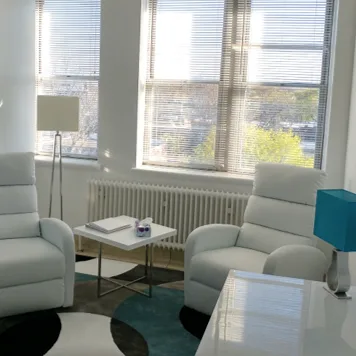
Wherever you are in the world, video consultation spares you the journey, which matters when simply leaving the house already takes an effort. It happens from home, with no travel and no waiting room, and the session itself is the same as in the consulting room. Our consultations are private and confidential, and your employer knows nothing of them. We see people this way from France, Quebec, Morocco and well beyond. During convalescence, it is often the simplest way to begin. Here is how it works.
Tell us where you are. Ask us your question: if your situation belongs first with a doctor, we will tell you so frankly, and that is common on this subject.
Where would you like to consult?
All areas
 Annie Mayrand
Gatineau - Cumberland (ON)
👤
🧑🎓
🚭
❤️
💻
Annie Mayrand
Gatineau - Cumberland (ON)
👤
🧑🎓
🚭
❤️
💻
 Christian Rocher
Beloeil
👤
🧑🎓
👶
🚭
❤️
💻
Christian Rocher
Beloeil
👤
🧑🎓
👶
🚭
❤️
💻
 David Veilleux
Montréal - Anjou
👤
🧑🎓
🚭
❤️
🤰
💻
David Veilleux
Montréal - Anjou
👤
🧑🎓
🚭
❤️
🤰
💻
 Florence Aton
Sutton
👤
🚭
❤️
💻
Florence Aton
Sutton
👤
🚭
❤️
💻
 Jessica Reid
Sherbrooke
👤
🚭
💻
Jessica Reid
Sherbrooke
👤
🚭
💻
 Julie Rocque
Montréal - Jean-Talon
👤
🧑🎓
👶
🚭
❤️
🤰
💻
Julie Rocque
Montréal - Jean-Talon
👤
🧑🎓
👶
🚭
❤️
🤰
💻
 Nuria Pérez de León
Montréal - Rosemont - Saint-Lambert
👤
🧑🎓
💻
Nuria Pérez de León
Montréal - Rosemont - Saint-Lambert
👤
🧑🎓
💻
 Romain Rastoin
Bromont
👤
🧑🎓
🚭
❤️
💻
Romain Rastoin
Bromont
👤
🧑🎓
🚭
❤️
💻
 Réjeanne LeBlanc
La Prairie
👤
🧑🎓
👶
💻
Réjeanne LeBlanc
La Prairie
👤
🧑🎓
👶
💻


Frequently asked questions about Hypnosis for Burnout (Professional Exhaustion)
No. Care is medical and multidisciplinary, and rest is its first step. Hypnosis can accompany it, above all on sleep, guilt and preparing the return to work.
It depends on where you are. In the acute phase of exhaustion, the priority is rest and medical follow-up. Once recovery has begun, yes. Tell us where you are and we will talk it through frankly.
We do not promise that, and it would be the wrong aim. Going back too early is the leading cause of relapse.
The two look very alike and often combine. Only a doctor can tell them apart, and that changes the care you receive.
Not as such, since burnout is not classified as an illness. On the other hand, major depressive episode, generalised anxiety disorder and post-traumatic stress disorder can be recognised in this way. It is a medical and administrative process: talk to your doctor and to the occupational physician.
No, our consultations are private and confidential. In France, a visit to the occupational physician is confidential too, and you can request it yourself without informing your employer if it takes place outside your working hours.
It is the most frequent reason for coming on this subject, and the most useful one. In France, also ask the occupational physician for a pre-return visit: it exists precisely to prepare a return that holds.
That is the best time to act, and the ground is far more comfortable. Talk to your doctor about it too, and in France to the occupational physician.
Mention it at the first conversation. We will never ask you to stop it or change it: that decision belongs solely to the doctor who prescribed it.
Sources and references
In French
- Clinical identification and management of occupational burnout — Haute Autorité de santé, in French
- Occupational exhaustion or burnout: the essentials — Institut national de recherche et de sécurité (INRS), in French
- Occupational exhaustion or burnout: frequently asked questions — INRS, in French
- Occupational burnout syndrome: a prevention guide — INRS, Anact and the Direction générale du travail, in French
The study cited on Hypnosis
- Valentine, K. E., Milling, L. S., Clark, L. J., & Moriarty, C. L. (2019). The Efficacy of Hypnosis as a Treatment for Anxiety: A Meta-Analysis. International Journal of Clinical and Experimental Hypnosis, 67(3), 336-363. doi.org/10.1080/00207144.2019.1613863 — it covers anxiety in general, not burnout.
Need to talk?
- Quebec: Info-Social 811 option 2 · 1 866 APPELLE (277-3553) · 988, anywhere in Canada · your employee assistance programme
- France: your GP · the occupational physician · 3114, free and 24/7
Hypnosis as practised by the members of Solutions Hypnose is a complementary support approach. It is neither a medical act, nor a diagnosis, nor psychotherapy in the regulatory sense, and it in no way replaces a consultation, follow-up or treatment prescribed by a health professional.
Our practitioners do not assess and do not treat mental disorders or illnesses. They never ask for an ongoing treatment to be stopped or changed: that decision rests exclusively with your doctor.
No result can be guaranteed. The testimonials and examples presented on this page describe individual experiences and do not predict what you will experience.
In case of significant distress, unexplained physical symptoms or suicidal thoughts, contact a doctor, emergency services or a helpline without delay.
Page written by Christian Rocher
hypnotherapist and NLP coach
partner at Solutions Hypnose.
English version reviewed by David Veilleux
Updated .