
Hypnosis for Panic Attacks
You're standing in line at the grocery store. Nothing unusual. And all at once your heart takes off, your chest tightens, your legs go soft, and a single thought fills the whole space: I have to get out of here, now.
It lasts a few minutes. Sometimes twenty. Afterwards come the fatigue, the embarrassment, and above all the question that settles in: what if it happens again? It's often that question, more than the attack itself, that ends up taking over. You avoid the subway. You turn down an invitation. You locate the exit before sitting down anywhere. Life narrows by a notch, then another, without your ever really deciding anything.
If you recognise yourself here, know this much already: you are not exaggerating, and you are far from alone.


Anxiety, anguish, panic attack: what are the differences?
The three words travel together, but they do not mean the same thing.
Anxiety is a fairly diffuse state of worry, turned towards what might happen. It can last for weeks and wear you down quietly, without ever producing an attack. That is the ground covered by our page on stress and anxiety.
Anguish is a sharper form of it, with very distinct bodily signs: pressure in the chest, shortness of breath, trembling, nausea.
A panic attack is an episode of intense fear that rises very fast and then subsides. France's national health insurance describes an average duration of twenty to thirty minutes.
The Government of Quebec makes a point that reassures a great many people: these attacks are extremely unpleasant, but they carry no medical danger in themselves.
When attacks repeat and the dread of having another one settles in for good, we speak of panic disorder, sometimes accompanied by agoraphobia. It is distinct from fears and phobias, which attach to a specific object or situation.
One important point, said plainly. Panic disorder is a medical diagnosis. It is not established on the internet, nor in a hypnosis session. The symptoms described here, palpitations and breathlessness in particular, can also stem from a physical cause that a doctor needs to rule out. First step: your family doctor, a clinic, or 811 (Info-Santé) in Quebec. Our hypnotherapists make no diagnosis and do not stand in for any ongoing medical or psychological care.
The impact of Panic Attacks on daily life
Attacks are counted in minutes. Their influence is counted in habits.
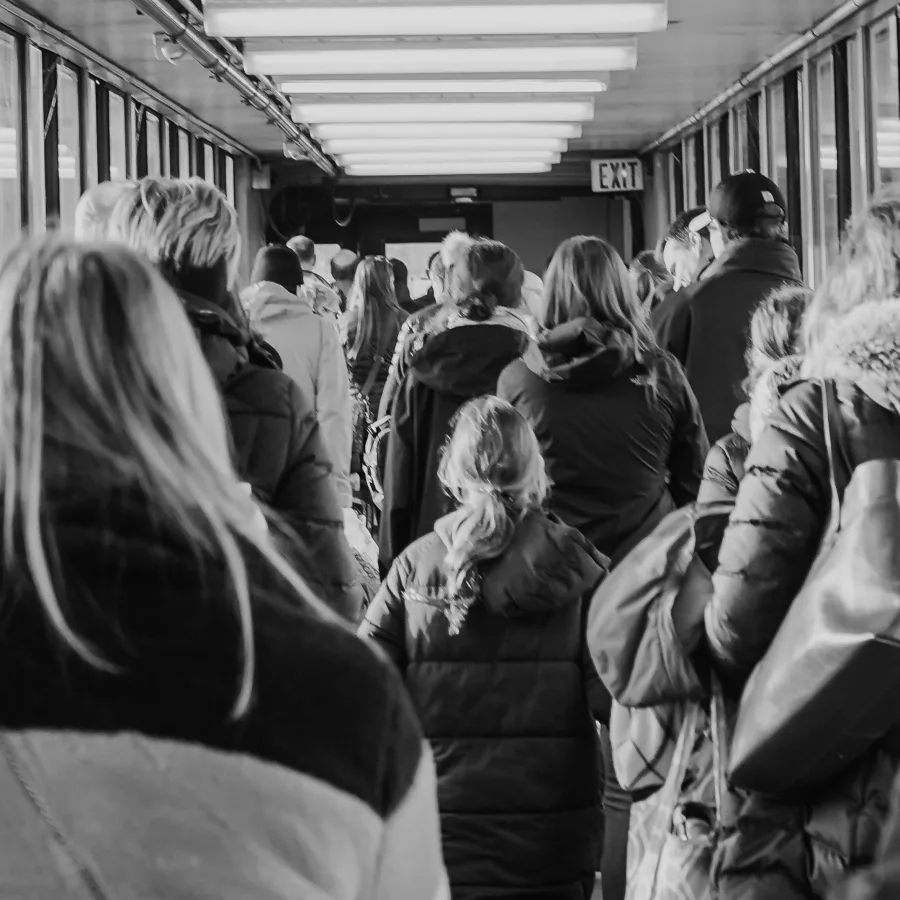
Sleep usually goes first: you go to bed monitoring your own heartbeat, and the nights get short — the subject of our page on sleep problems. Then comes avoidance, which looks reasonable at first and closes in little by little: the bridge, the highway, the lift, the meeting room, the three-hour flight to visit family. The Government of Quebec puts it well: avoiding does not protect you from attacks, it reinforces them, because you never get to find out that the situation was bearable.
There is also what nobody sees. The energy spent acting as if nothing were wrong. The explanations invented to decline.
And the people around you, who want to help, don't know how, and sometimes end up saying the most useless sentence in the world: "just relax".
Recognised approaches outside Hypnosis
Documented answers exist, and it would be dishonest to pass over them in silence in order to sell you something else. Your doctor is the person best placed to guide you among them:
- Cognitive behavioural therapy (CBT), the most studied psychotherapeutic approach for panic disorder. In Quebec it is framed by the Programme québécois pour les troubles mentaux (PQPTM).
- Medical follow-up and, if your doctor considers it appropriate, medication.
- Breathing regulation techniques. France's national health insurance notes that they are learned in three or four sessions and serve to counter hyperventilation.
- Regular physical activity, recommended as a way of lowering background stress.
- Supervised self-care: guides, apps, peer support groups. In Quebec, La Ressource ATP in Laval and organisations affiliated with the CMHA offer them.
- Relaxation and mindfulness approaches, useful for lowering the general level of reactivity.
Hypnosis adds itself to this list. It does not replace it. That, incidentally, is what the research suggests, and we come back to it below.
Hypnosis for Panic Attacks: aims and benefits
Let's start with what it cannot do, because that is what most often unblocks the conversation.
Hypnosis does not put you to sleep. It does not make you lose control. It lets no one act without your knowledge, and you will not say or do anything that makes you uncomfortable.
You stay conscious from beginning to end, you hear everything, and you can interrupt the session whenever you want. Many clients describe a state close to being absorbed in a film, or to those car journeys where you arrive without remembering the route.
If the principle intrigues you, we explain it in detail on our page what is therapeutic hypnosis.
Nor does it make anguish disappear on command. No one serious will promise you that.
What hypnosis support aims at, concretely:
- Regaining quick access to bodily calm, by installing what is called an anchor: a gesture, an image, a specific breath, associated in session with a state of relaxation, and reusable afterwards in the grocery store queue.
- Changing your relationship with physical sensations. In panic disorder, a racing heart is often read as the start of a catastrophe, which makes the heart race further. Hypnosis works precisely on that link.
- Spotting the triggering situations and the mental scenarios that loop before an attack.
- Regaining ground step by step, by mentally preparing avoided situations before facing them for real.
- Recovering better sleep, often the first change people notice.
What the research says
A meta-analysis published in 2019 in the International Journal of Clinical and Experimental Hypnosis brought together fifteen studies comparing hypnosis with control conditions for the reduction of anxiety. The authors report a mean effect of 0.79 at the end of the sessions, which counts as a large effect in clinical research.
The most interesting detail lies elsewhere, and it matches our position exactly: hypnosis obtained better results as a complement to other psychological approaches than when used on its own.
That is why we work willingly alongside medical or psychological follow-up, and why we encourage you to have one.
An example of support: Nicole's case
Nicole (name changed) dreaded travelling. Not flying as such, but the idea of being far away, in a country whose language she did not speak, with a return that depended on a flight. "Trapped" was the word she used.
The attacks had become systematic, to the point where holidays turned into family arguments and certain work trips became impossible to accept. Over the sessions, she first put words to what precisely set off the surge, which was not quite what she had believed. She then built a calm anchor she could draw on by herself, and worked through the stages of departure, boarding and arrival in imagination.
She started travelling again gradually, beginning small.
This case illustrates one possible course. It does not predict yours. The number of sessions, the pace and the outcomes vary from one person to another, and no support can guarantee a result.
How a Hypnosis session on anxiety unfolds
First: the interview. Twenty to thirty minutes of conversation. How long it has been going on, in which situations, what has already been tried, what treatment or follow-up you are currently under. This step also serves to check that hypnosis is relevant for you, and to redirect you if it is not.
We define a concrete objective. Not "feeling better", but something verifiable: crossing the Jacques-Cartier bridge again, sleeping without checking your pulse, sitting through a meeting without locating the exit.
The induction. The practitioner guides you towards a state of relaxation and focused attention, drawing on breathing, voice and imagery. You stay seated or lying down, fully dressed, eyes usually closed.
The work itself. It is built to measure. On anxiety, it often involves setting up a safe mental place, putting an anchor in place, changing the mental images that anticipate an attack, and gradually preparing the avoided situations.
The return and what follows. You talk over what happened. You almost always leave with a self-hypnosis or breathing exercise to practise between sessions, because that is where much of the work happens.
The full sequence, step by step, is described on our page what to expect in a hypnosis session.
And if an attack occurs during the session? It happens, rarely, and it is not a problem. Your practitioner supports you through it. It is sometimes even a useful opportunity to work.
How many sessions? For anxiety, support is generally counted in a handful of sessions rather than in years, but anyone who announces a precise figure before having met you is selling you something. The subject is discussed at the first interview.
Booking an appointment
Anxiety does not get to decide the perimeter of your life. Our hypnotherapists practise in Montreal, Sherbrooke, Gatineau, Paris, Lille and by video anywhere in the world, a format that matters when some journeys are still difficult. The first interview is there for exactly that: to look closely at your situation and decide together whether going further makes sense. Hesitating? Write to us describing your situation. We will tell you frankly whether hypnosis seems suited to you, and where to turn if it is not.
Where would you like to consult?
All areas
 Annie Mayrand
Gatineau - Cumberland (ON)
👤
🧑🎓
🚭
❤️
💻
Annie Mayrand
Gatineau - Cumberland (ON)
👤
🧑🎓
🚭
❤️
💻
 Christian Rocher
Beloeil
👤
🧑🎓
👶
🚭
❤️
💻
Christian Rocher
Beloeil
👤
🧑🎓
👶
🚭
❤️
💻
 David Veilleux
Montréal - Anjou
👤
🧑🎓
🚭
❤️
🤰
💻
David Veilleux
Montréal - Anjou
👤
🧑🎓
🚭
❤️
🤰
💻
 Florence Aton
Sutton
👤
🚭
❤️
💻
Florence Aton
Sutton
👤
🚭
❤️
💻
 Jessica Reid
Sherbrooke
👤
🚭
💻
Jessica Reid
Sherbrooke
👤
🚭
💻
 Julie Rocque
Montréal - Jean-Talon
👤
🧑🎓
👶
🚭
❤️
🤰
💻
Julie Rocque
Montréal - Jean-Talon
👤
🧑🎓
👶
🚭
❤️
🤰
💻
 Nuria Pérez de León
Montréal - Rosemont - Saint-Lambert
👤
🧑🎓
💻
Nuria Pérez de León
Montréal - Rosemont - Saint-Lambert
👤
🧑🎓
💻
 Romain Rastoin
Bromont
👤
🧑🎓
🚭
❤️
💻
Romain Rastoin
Bromont
👤
🧑🎓
🚭
❤️
💻
 Réjeanne LeBlanc
La Prairie
👤
🧑🎓
👶
💻
Réjeanne LeBlanc
La Prairie
👤
🧑🎓
👶
💻


Frequently asked questions about Hypnosis for Panic Attacks
A session is not held in the middle of an attack. Part of the work, however, is precisely about equipping you for the moments when it builds: breathing, anchoring, points of reference. These are tools you use on your own, on the spot.
No. You stay conscious and present throughout, you hear what is said, and you decide what you share. You can open your eyes and stop at any time.
Yes, and it is common. Simply mention it during the initial interview. One non-negotiable point: we will never ask you to change or stop a treatment. Any such decision belongs exclusively to the doctor who prescribed it.
No. Our practitioners are not psychologists and do not practise psychotherapy. They offer complementary support. If your situation calls for supervised care, we will tell you so.
The vast majority of people can, to varying degrees. The question that matters more is whether you want to work on it. Very anxious people sometimes take a little longer to let go during the first session, which is normal and can be worked on.
Yes. For anxiety in particular, being at home is often an advantage. You need a quiet place, a good connection, and to be undisturbed for an hour.
Allow sixty to ninety minutes for the first one, a little less afterwards. Fees vary by practitioner and are listed on their page.
Yes, and it is something to mention at the first interview. Where trauma is involved, appropriate medical or psychological follow-up comes first, and hypnosis can come alongside it.
Sources and references
Our answers to the most common questions about the practice are also in the network's frequently asked questions.
In French
- Trouble panique : définition, symptômes, traitement — Assurance Maladie (ameli.fr)
- Trouble panique — Government of Quebec
In English
- Panic Disorder: When Fear Overwhelms — National Institute of Mental Health (NIH)
- Panic Attacks & Panic Disorder — Cleveland Clinic
Study cited
- Valentine, K. E., Milling, L. S., Clark, L. J., & Moriarty, C. L. (2019). The Efficacy of Hypnosis as a Treatment for Anxiety: A Meta-Analysis. International Journal of Clinical and Experimental Hypnosis, 67(3), 336-363. doi.org/10.1080/00207144.2019.1613863
Need help right now? Quebec: Info-Social 811, option 2 · Crisis line 1 866 APPELLE (277-3553). France: 3114, the national suicide prevention number, free and available 24/7.
Hypnosis as practised by the members of Solutions Hypnose is a complementary support approach. It is neither a medical act, nor a diagnosis, nor psychotherapy in the regulatory sense, and it in no way replaces a consultation, follow-up or treatment prescribed by a health professional.
Our practitioners do not assess and do not treat mental disorders or illnesses. They never ask for an ongoing treatment to be stopped or changed: that decision rests exclusively with your doctor.
No result can be guaranteed. The testimonials and examples presented on this page describe individual experiences and do not predict what you will experience.
In case of significant distress, unexplained physical symptoms or suicidal thoughts, contact a doctor, emergency services or a helpline without delay.
Page written by Rachelle Letarte
hypnotherapist and family coach
partner at Solutions Hypnose.
English version reviewed by David Veilleux
Updated .