
Hypnosis for Musicians' Inner Hearing (Audiation)
The score is in front of you. You read the notes, you understand the intervals, and yet nothing sounds in your head. You have to go through the instrument to find out what it gives.
Or you improvise, and you play what your fingers know how to do rather than what you hear. The difference, you hear it perfectly well.
Or you have known a piece by heart for months, and on the day of the concert it vanishes, as though the memory were lodged in the hands and nowhere else.
The most discouraging part is that you know other people have it. That a colleague hears a chord before playing it, that another reads a score on the train and hears it. And that nobody has ever really explained how you get there.


What is Audiation?
The term comes from the American music educator Edwin E. Gordon, who devoted his work to how people learn music. Audiation means hearing and understanding music mentally when the sound is not physically present.
Gordon insisted on a point often lost: it is not simply "having a tune in your head". Humming a song you have heard a thousand times is memory. Audiation involves understanding: recognising a harmonic function, anticipating a resolution, hearing an interval you have never played. It is a form of musical thinking, not an internal soundtrack.
Three pages, three subjects. Here is how to find your way. This page deals with what happens in your head and in the practice room: hearing mentally, intonation, improvisation, memorising, sight-reading. If what weighs on you happens in front of someone — stage fright, the audition, the concert, the studio, the eyes of colleagues — see Hypnosis for Musicians. If you are trying to understand the mechanics of stage fright itself, why the brain confuses the stage with danger and how that is worked on, see our page Hypnosis for Artistic Performance. The test is simple: does it happen when you are alone at home too? If so, you are in the right place.
It comes into everything
- Sight-reading: hearing before playing, and so anticipating instead of decoding.
- Improvisation: knowing where you are going before the fingers get there.
- Memorising: retaining a musical structure rather than a choreography of fingers.
- Intonation, particularly in singing and on fretless instruments, where the note has to exist in your head before it exists in the air.
- Composing and arranging, where it is quite simply the working tool.
What builds it, and what blocks it
Let us be direct, because this is the question that matters: audiation is built through musical practice, not through hypnosis. Sung solfège, ear training, transcription, singing internally while playing, regular work with a teacher: that is where it happens, and no session will replace that work.
What support can address is something else: what stops you using what you have already built. The fear of a mistake that takes over your attention. The permanent inner commentary while playing. The idea that you do not have the ear and that it is too late. The rumination after a wrong note, which makes you miss the next three.
Many musicians do not have an audiation deficit. They have a cluttered access to it.
One point not to miss, because it changes a life. If you lose control of certain fingers, of your embouchure or of your hand only when you play, while everything works normally in daily life, it is probably not a mental block. That picture corresponds to musician's focal dystonia, a task-specific neurological movement disorder affecting 1 to 2% of high-level musicians and showing itself in involuntary movements, most often in the upper limbs or the embouchure. It is regularly taken for a problem of technique, of practice or of confidence, and years are lost that way. See a neurologist, ideally in a clinic specialising in musicians' disorders. Psychological or hypnosis support may have a place alongside, never instead. Two other situations to send elsewhere: pain, numbness, loss of strength while playing, a medical opinion first, these are signs of overuse injury; tinnitus, a blocked-ear sensation, hearing loss, an ENT without delay, the profession exposes you and damaged hearing does not repair itself. Our practitioners make no diagnosis and assess no disorder.
The impact on a Musician's daily life
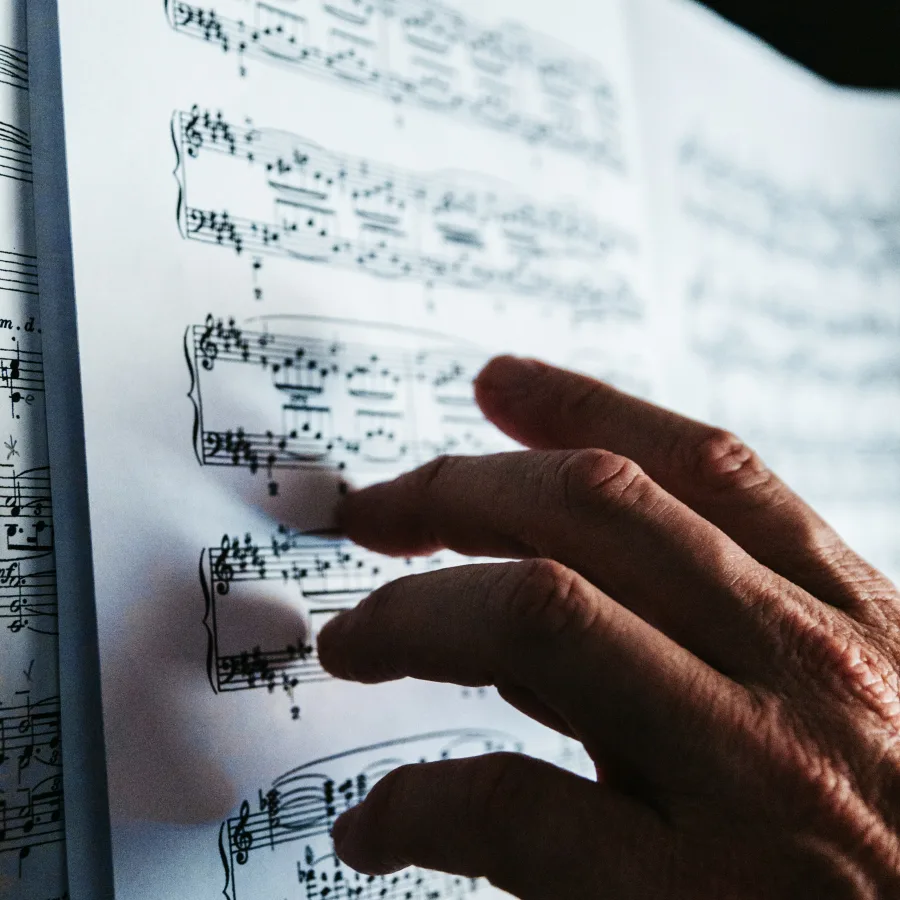
Practice time. Without inner hearing, you decode note by note and memorise through motor repetition. It is far slower, and far more fragile. The memory that gives way in concert. A purely digital memory holds as long as nothing disturbs it. At the first slip there is no safety net: you no longer know where you are in the music, only where the fingers were. Holding attention over time is a matter of concentration and focus, and that is a separate skill, worked on in its own right.
Improvisation avoided. Many classically trained musicians work around it all their lives, convinced it cannot be learned, when it is first of all a question of audiation.
The progress ceiling. There comes a point where practising more gives nothing, because what is missing is not in the fingers. That is often where self-confidence starts to crumble.
And the pleasure. It is what people mention least and what brings them in most often. Playing becomes a performance under surveillance. Something that was a joy becomes a permanent assessment.
What exists outside Hypnosis
- Ear training and sung solfège, with a teacher. It is the main route, and it has no substitute.
- Transcribing by ear, demanding and effective.
- Mental practice, that is, working on a piece without the instrument. It has been documented for a long time in musicians and athletes.
- Singing, even for instrumentalists, which forces you to produce what you hear.
- Performance support, for everything to do with the stage. That side is covered on our pages Musicians and Artistic Performance.
- A consultation in performing arts medicine, when the body is involved.
Hypnosis adds itself to that list, on the side of the obstacles.
Video available in French
Video transcript
Tu es chanteur. Tu chantes… mais ça ne sonne pas juste. Tu écoutes, tu sens que la note n’est pas parfaite, que tu te forces… Ton oreille est là, mais ton corps ne suit plus vraiment. Tu es instrumentaliste. Tu joues ton instrument… mais tu n’es pas dans le bon rythme. Tu as l’impression de décaler, de manquer le tempo… Même en répétition avec d’autres musiciens, tu n’arrives pas à t’insérer naturellement dans le groove.
Je connais ça. Je suis percussionniste, batteur et chanteur, et j’ai eu la chance de chanter avec des artistes comme Peter Gabriel. Même au plus haut niveau, on peut perdre le lien entre l’oreille, le corps et le tempo. Ce n’est pas un problème de technique. C’est un problème d’écoute intérieure. L’hypnose permet de retrouver ce lien. De reconnecter ton oreille, ton corps et ton ressenti du temps. De retrouver ton horloge rythmique naturelle, celle qui te rend juste, précis et fluide.
C'est cette recherche d'alignement, aussi cruciale en musique qu'en bien-être, qui a naturellement orienté ma voie vers l'hypnose. Je suis devenu praticien fasciné par cette découverte fondamentale : notre esprit possède un pouvoir direct sur notre corps, nos émotions et notre état intérieur. Un pouvoir que nous pouvons apprendre à canaliser. Je t’accompagne en deux temps : • D’abord en hypnose, pour libérer ce qui bloque ton écoute et ton lâcher-prise.
• Puis dans la pratique musicale, au chant ou derrière ton instrument, pour ancrer ce nouveau ressenti dans ta performance. Parce qu'un musicien accompli, ça n'est pas celui qui fait tout juste, mais celui qui est juste à l'intérieur. Si cette recherche de justesse intérieure résonne en toi, je serai heureux de t’accompagner pour la cultiver. Je reçois à Montréal et en séance vidéo, une modalité qui se prête parfaitement à ce travail d'écoute profonde.
Merci beaucoup et à très bientôt.
Hypnotherapy is a complementary form of support and does not replace medical advice, diagnosis, or treatment. If you have any concerns about your health, please consult a physician first.
Hypnosis for Inner Hearing: aims and benefits
It will not give you perfect pitch. It replaces neither the teacher nor the hours on the instrument, and it does not build a skill you have not worked on. It does not put you to sleep, does not make you lose control, and guarantees no result.
What support aims at
- Quieting the commentator. This is the main use. A musician's attention is a limited resource: if part of it is monitoring and judging, less is left for listening. The hypnotic state reduces that control activity, and what we call stress and anxiety management elsewhere is exactly the same lever.
- Supporting mental practice. Working on a passage in imagination demands sustained concentration that few people hold for long. The hypnotic state makes it easier, and self-hypnosis lets you reproduce it alone.
- Setting an anchor you can use in the wings or before going into the studio.
- Revisiting a specific memory. The memory lapse in an exam, the teacher's remark, the concert that went wrong. Those events leave traces that reactivate at the worst moment.
- Undoing learned beliefs, of the "I don't have the ear" or "it's too late" kind, often installed by a sentence heard at twelve.
- Finding the pleasure of playing again, which is not a bonus but often the condition for everything else. The "daring to follow what you perceive" side is covered on our page on developing your intuition.
What the research says, without over-reading it
There is no study specifically on hypnosis and audiation. We will not claim otherwise. Two things are better documented and inform the reasoning.
Mental practice really does change the motor brain. A study that has become a classic compared, over five days, people learning a piano sequence physically and others only mentally. The reorganisations observed in the motor cortex were comparable in both groups. That says nothing about hypnosis, but it validates the principle of working without the instrument, which is one of the tools used in session.
Hypnosis has a documented effect on anxiety. A 2019 meta-analysis bringing together fifteen studies reports a large average effect, with better results alongside other approaches than used alone.
So the reasoning runs like this: anxiety and self-monitoring consume the attention audiation needs; hypnosis acts on those and makes mental practice easier. It is coherent and observed in practice. It is not a demonstration.
An example of support: Nadia's case
*An illustrative example, built from situations frequently encountered. It is not the testimony of a real person.*

Nadia, 31, sings in a band. In rehearsal, with a piano two metres away, everything is in place. On stage it is another matter: the monitors crackle, the drums cover everything, and from the second song she drifts flat. Not by much. Enough for the keyboard player to mention it afterwards, kindly, and for her to spend the rest of the concert hunting for her note inside a wall of sound. She had put it down to nerves and to the sound system, and nobody around her had suggested anything else.
The work showed something different: she was not hearing her notes before producing them, she was going out to find them. Without a reliable external reference, there was nothing left. The sessions were about settling the note inside before attacking it, first in quiet with no music, then with an increasingly loaded backdrop of sound. In parallel, her teacher took up the interval work, which nothing replaces.
This example describes one possible course of support. It predicts nobody's. Pace and results vary from one person to another, and no support can guarantee a result.
How a Hypnosis session for Musicians unfolds
The conversation. Your instrument, your background, your current practice, and above all what is jamming exactly. The practitioner will try to distinguish what is a skill to be built, what is an obstacle, and what is something else that should be sent elsewhere.
They may ask you to play or to sing, if you want to and if the setting allows. Watching someone at the moment it blocks teaches more than a description.
A concrete aim is set. Not "develop my audiation", but: get through next month's audition, improvise eight bars in front of someone, hold the June concert without losing the thread.
The induction, then the work itself: lowering control and commentary, guided mental practice, an anchor, or revisiting a memory depending on what has been identified. The general shape of a session is described on the page what to expect in a hypnosis session.
The debrief and carrying it home. Many practitioners record part of the session so that you can reuse it before a rehearsal or a concert. That is often the most useful part, because it makes you self-sufficient.
Choosing your practitioner. A professional used to musicians will understand what you are talking about without translation. Ask for a first conversation to check that it clicks.
How many sessions? That is discussed at the first conversation. Nobody can know in advance.
Book an appointment
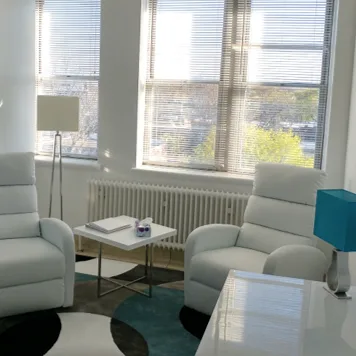
Wherever you are in the world, video consultation suits this subject particularly well. The work happens in your head and in your practice room, not on a stage: nothing requires being in the same room. Plan for a quiet place, and a decent microphone if you want to play or sing during the session. We see musicians this way from Europe, North America, Africa and well beyond, often from their own practice room — which is rather an advantage when you want to show exactly where it jams. Here is how it works.
A practitioner who is also a professional musician
A professional used to musicians will understand what you are talking about without translation. The conservatoire teacher's sentence, the memory that lives in the fingers, the improvisation avoided for twenty years — these are things he has lived, not things that were described to him.
David Veilleux is a professional musician and a hypnotherapist, and he is the practitioner in the network who covers this subject in English. He sees clients in Montreal East and by video, wherever you are.
Tell us about your situation. Ask us your question: if what you are going through is first a matter for work with your teacher, for a doctor or for a specialist consultation, we will say so.
Where would you like to consult?
All areas
 Annie Mayrand
Gatineau - Cumberland (ON)
👤
🧑🎓
🚭
❤️
💻
Annie Mayrand
Gatineau - Cumberland (ON)
👤
🧑🎓
🚭
❤️
💻
 Christian Rocher
Beloeil
👤
🧑🎓
👶
🚭
❤️
💻
Christian Rocher
Beloeil
👤
🧑🎓
👶
🚭
❤️
💻
 David Veilleux
Montréal - Anjou
👤
🧑🎓
🚭
❤️
🤰
💻
David Veilleux
Montréal - Anjou
👤
🧑🎓
🚭
❤️
🤰
💻
 Florence Aton
Sutton
👤
🚭
❤️
💻
Florence Aton
Sutton
👤
🚭
❤️
💻
 Jessica Reid
Sherbrooke
👤
🚭
💻
Jessica Reid
Sherbrooke
👤
🚭
💻
 Julie Rocque
Montréal - Jean-Talon
👤
🧑🎓
👶
🚭
❤️
🤰
💻
Julie Rocque
Montréal - Jean-Talon
👤
🧑🎓
👶
🚭
❤️
🤰
💻
 Nuria Pérez de León
Montréal - Rosemont - Saint-Lambert
👤
🧑🎓
💻
Nuria Pérez de León
Montréal - Rosemont - Saint-Lambert
👤
🧑🎓
💻
 Romain Rastoin
Bromont
👤
🧑🎓
🚭
❤️
💻
Romain Rastoin
Bromont
👤
🧑🎓
🚭
❤️
💻
 Réjeanne LeBlanc
La Prairie
👤
🧑🎓
👶
💻
Réjeanne LeBlanc
La Prairie
👤
🧑🎓
👶
💻


Frequently asked questions about Hypnosis for Musicians' Inner Hearing (Audiation)
No. Perfect pitch depends on factors settled very early and is not acquired in a session. Relative pitch, on the other hand, can be worked on at any age, through ear training and sung solfège.
No, but you do need to know what hypnosis does and does not do. It lifts obstacles, it does not build the skill. Work with a teacher remains indispensable alongside it.
Not at all. Amateurs account for a good share of the requests, often with pleasure rather than career at stake, which is an excellent reason.
That depends on your situation and is discussed at the first conversation.
Yes, and it is often the most practical format for musicians on the move. Plan for a quiet place and, if you want to play during the session, a decent microphone.
Then you should look elsewhere: our page on hypnosis for musicians for what is specific to a musician's life, and the one on artistic performance for the mechanics of stage fright. This page is about inner hearing and the work upstream. If several apply to you, say so at the first conversation: they can be worked on together.
See a neurologist before anything else. That picture suggests focal dystonia, a task-specific neurological disorder frequently mistaken for a problem of technique or confidence.
It is common in the profession. Mention it at the first conversation. We will never ask you to stop or change a treatment: that decision belongs solely to the doctor who prescribed it.
Our page on hypnosis for children sets out what is done at that age. Before that, a conversation with their teacher often resolves a great deal.
Sources and references
On Audiation
- Gordon, E. E. Learning Sequences in Music: A Contemporary Music Learning Theory. GIA Publications. The reference work in which the concept of audiation is developed.
On mental practice
- Pascual-Leone, A. (2001). The Brain That Plays Music and Is Changed by It. Annals of the New York Academy of Sciences, 930, 315-329. doi.org/10.1111/j.1749-6632.2001.tb05741.x
On Musician's focal dystonia
- Konczak, J., & Abbruzzese, G. (2013). Focal dystonia in musicians: linking motor symptoms to somatosensory dysfunction. Frontiers in Human Neuroscience. pmc.ncbi.nlm.nih.gov/articles/PMC3691509
- Détári, A., & Egermann, H. (2022). Towards a Holistic Understanding of Musician's Focal Dystonia. Frontiers in Psychology. pmc.ncbi.nlm.nih.gov/articles/PMC9125209
The study cited on Hypnosis
- Valentine, K. E., Milling, L. S., Clark, L. J., & Moriarty, C. L. (2019). The Efficacy of Hypnosis as a Treatment for Anxiety: A Meta-Analysis. International Journal of Clinical and Experimental Hypnosis, 67(3), 336-363. doi.org/10.1080/00207144.2019.1613863
If your child is learning music and losing heart, our page on hypnosis for children sets out what is done at that age. Before that, a conversation with their teacher often resolves a great deal.
Hypnosis as practised by the members of Solutions Hypnose is a complementary support approach. It is neither a medical act, nor a diagnosis, nor psychotherapy in the regulatory sense, and it in no way replaces a consultation, follow-up or treatment prescribed by a health professional.
Our practitioners do not assess and do not treat mental disorders or illnesses. They never ask for an ongoing treatment to be stopped or changed: that decision rests exclusively with your doctor.
No result can be guaranteed. The testimonials and examples presented on this page describe individual experiences and do not predict what you will experience.
In case of significant distress, unexplained physical symptoms or suicidal thoughts, contact a doctor, emergency services or a helpline without delay.

Page written by Daby Touré
hypnotherapist
partner at Solutions Hypnose.
English version reviewed by David Veilleux
Updated .