
Hypnosis for Assertiveness at Work
The meeting ends. You had an objection, a real one, and you did not say it. Someone else put it into words ten minutes later, less well, and they were listened to.
On the way home you replay the scene. This time you find the words. That evening, you find them again.
There is also the extra file accepted with a "of course, no problem" when the week was already full. The message sent at ten at night that you answer straight away. The out-of-place remark you smiled at. And that one time when, after enough of it, it came out all at once and far too loud, which confirmed to you that it was better to stay quiet.
None of this is a personality flaw. Speaking up is a skill, not a character trait, and a skill can be learned at any age.


What is Assertiveness?
Assertiveness means expressing what you think, what you feel and what you need, while taking the other person into account. No more, no less.
The notion comes from behavioural therapies, where assertiveness training has been an established practice for decades. It rests on a simple distinction between four positions.
- Passive: you accept, you stay quiet, you let it go. The cost is paid later, in exhaustion and resentment.
- Aggressive: you may get your way, at the price of the relationship. That side is covered on our page Hypnosis for Anger.
- Passive-aggressive: you say nothing but you let it be felt. That is often what happens after being passive for too long.
- Assertive: you say the thing, clearly, without attacking and without apologising for existing.
Nobody sits in a single box. Most people are assertive with some people and not with others, which is already useful information.
A few distinctions that matter
Assertiveness is not self-confidence. Confidence is a feeling, assertiveness is a behaviour. You can act assertively while feeling uncomfortable, and that is in fact how it starts. The deeper work on self-esteem is covered on Hypnosis for Confidence, Esteem and Assertiveness.
It is not charisma, which is a matter of presence and influence, and not the subject here. Nor is it shyness: shyness is a temperament, and many shy people are perfectly clear about their limits.
Social anxiety is something else. When fear of judgement becomes intense, when it spreads well beyond work, when it leads to avoiding situations and when it lasts, that is a recognised disorder, one that responds to care and for which cognitive and behavioural therapies are the reference approach. Only a doctor or a psychologist can assess it: if you recognise yourself in this description, that is where to go first. See also Hypnosis for Fears and Phobias.
When it is not an assertiveness problem. Some situations have nothing to do with personal development and must certainly not be treated as though they did.
Harassment at work is governed by law. In Quebec, the *Act respecting labour standards* provides that every employee has the right to a workplace free from psychological or sexual harassment, and that the employer must take reasonable action to prevent it and, once informed, to put a stop to it; a complaint can be filed with the CNESST, and a time limit applies. Federally regulated employers (banks, telecommunications, interprovincial transport) fall under a different regime.
In France, moral harassment is defined by article L1152-1 of the Labour Code, and the employer is obliged to take the steps needed to prevent it. Several people can be turned to: the employer or human resources, occupational health services, staff representatives and the works council, the labour inspectorate and, where necessary, the industrial tribunal or a criminal complaint. The detail is on service-public.gouv.fr, and public-sector employees fall under a separate regime. Discrimination follows the same logic of recourse.
Burnout shows itself through other signs: exhaustion that no longer repairs, detachment, a sense of ineffectiveness, disturbed sleep, physical symptoms. These deserve to be assessed by a doctor or by occupational health services.
In all three cases, working on yourself will not settle the situation, and it can delay a step that would help. That does not mean you should go through it without support: it means support does not replace the steps. We will tell you so if that is what we hear at the first conversation. We are not lawyers, and none of the above replaces legal advice.
The impact of holding back at work

What it costs not to say things is rarely paid in the moment, and almost always somewhere else. The load builds up first: every task accepted by default adds to the last, and the overload ends up looking like a problem of organisation or of personal efficiency when it is in fact a problem of boundaries. Then resentment settles in, and you find yourself resenting colleagues who asked for nothing, since you never once told them no.
Rumination takes over the evenings. You replay conversations, you prepare answers you will not give. That mechanism is covered on our page Hypnosis for Letting Go.
Recognition goes missing, because invisible work stays invisible, and that weighs on progression as much as on morale.
The body absorbs it: sleep, tension, a knotted stomach before certain meetings. See Hypnosis for Stress and Anxiety.
And there is the occasional explosion, the one that arrives after months of silence, that strikes everyone as disproportionate, and that leaves the person convinced they were right to keep quiet until then.
The recognised approaches outside Hypnosis
If the signs of burnout are there, the point of entry is your doctor or occupational health. And if the situation amounts to harassment or discrimination, it is the recourse mentioned above that applies first.
- Assertiveness training, as practised in cognitive and behavioural therapy. It is the only approach to have been tested in controlled trials on assertiveness itself, and it is named in the French guidance on social anxiety. It is very concrete: you learn phrasings, you rehearse them, you try them out.
- Psychotherapy, where the difficulty is long-standing, touches every area of life, or is rooted in a personal history.
- Professional coaching and communication training, useful for technique: preparing for a meeting, structuring a disagreement, negotiating. See our page Life Coaching.
- Staff representatives, your union or human resources, when the difficulty is collective or structural. It is more often than people think.
- A mentor or a trusted colleague, whose practical contribution often outweighs any method.
Hypnosis places itself alongside these approaches, on the side of apprehension and of the automatic reactions that stop you doing what you already know you should do.
Video available in French
Video transcript
Bonjour ! Je m'appelle Anne Géraldine Lavielle, je suis hypnothérapeute, coach professionnelle et formatrice. J'interviens régulièrement en entreprise pour du coaching individuel, collectif et organisationnel, mais je travaille aussi en cabinet de ville et en visioconférence. Alors mes clients viennent souvent à la fois pour des problématiques personnelles et professionnelles car j’ai une approche holistique, donc globale de la personne.
Je propose aussi de l'hypno-coaching, c'est à dire des séances de coaching classiques avec une ou deux séances d'hypnose pour faciliter les changements. L'hypnose est une méthode que nous utilisons dans le champ des thérapies brèves afin de pouvoir coopérer avec le cerveau de la personne et plus spécifiquement son inconscient quand il vient nous consulter. La magie de l'hypnose c'est de permettre d'impulser des changements psychologiques et comportementaux qui vont être durables, car notre cerveau a cette capacité à changer.
C'est une méthode qui a à la fois des bases scientifiques solides en lien avec les neurosciences, mais qui est aussi très créative. Alors l'hypnose est très indiquée quand vous avez essayé plein de méthodes classiques qui n'ont pas donné de résultats. J'utilise aussi d'autres approches comme la méditation de pleine conscience, l’EFT “Emotional Freedom Technique”, la PNL, ou l'art coaching... Cette approche de l'hypnose permet notamment d'apprendre à s'affirmer dans le milieu personnel mais également dans le milieu professionnel.
C'est ce dont nous allons parler ici. De manière générale, ces clients qui ont du mal à s'affirmer cherchent à réduire leur anxiété, à prendre confiance en eux et à améliorer leurs compétences en communication, par exemple dans la gestion des conflits, mais aussi à réduire leurs croyances limitantes. Plus précisément, ils souhaitent travailler sur leur assertivité, c'est à dire mettre mieux leurs limites, apprendre à dire non et aussi à travailler sur leur communication.
Par exemple, s'affirmer en réunion, prendre plus facilement la parole en public. Alors par exemple, une personne qui manage une équipe de cinq collaborateurs et qui ressent un grand stress qui la paralyse, quand elle doit s'affirmer face à une personne qui est déjà très assertive et qui cherche à avoir raison, ou alors quand elle doit prendre la parole en public, elle a peur de faire des erreurs et elle craint aussi le jugement des autres.
En échangeant avec elle, nous nous rendons compte qu'elle a vécu des situations de ce type durant son parcours scolaire et que son cerveau, qui cherche la sécurité pour elle, lui indique, grâce au stress qu'elle est en danger. L'idée ici est de commencer à déprogrammer le cerveau afin qu'il ne confonde pas le présent et le passé et qu'elle développe de nouvelles ressources et compétences. Après plusieurs séances, elle confirme que son niveau de stress a baissé, qu'elle a lâché prise et qu'elle se sent plus sereine dans ces situations.
Alors très concrètement, et bien nous commençons bien sûr par discuter de leurs objectifs, de quelles situations sont délicates pour eux. Souvent, dans des situations qui ont été mal vécues dans le passé et qui sont restées stockées dans la mémoire inconsciente ce qui crée justement ces blocages et ces angoisses. Alors je peux proposer quelques exercices qui peuvent être facilement mis en place : par exemple des exercices de renforcement de l'estime de soi.
L'estime de soi, c'est la valeur que l'on s'accorde, quelles que soient nos réussites et nos échecs. On peut aider la personne à se centrer plus sur ses réussites passées et l'aider à se visualiser en train de réussir ses objectifs. Car notre cerveau a une grande capacité à oublier le positif et à se concentrer plus sur le négatif. J'utilise aussi des suggestions posts-hypnotiques. Il s'agit de donner des suggestions après la séance d'hypnose qui renforce un comportement assertif.
Par exemple : “à chaque fois que je parle en réunion, je ressent un calme et une confiance profonde”. Cela permet de renforcer les comportements positifs du client après l'hypnose. Et puis enfin les transformations du passé grâce au recadrage, Milton Erickson disait « il n'est jamais trop tard pour avoir un passé heureux ». Alors tout cela permet de reprogrammer le cerveau afin qu'il « ramollisse » vos expériences passées négatives et qu'il les transforme.
Je rencontre beaucoup de managers, de directeurs ou de dirigeants, que ce soit des hommes ou des femmes. Des personnes qui sont entre plusieurs niveaux hiérarchiques et qui ont peu de marge de manœuvre. Mais aussi des personnes qui sont sensibles à l'autorité. Des personnes qui viennent de vivre un échec personnel ou professionnel et donc qui ont perdu confiance en elles. Mais j'ai également des personnes qui ont vécu des traumatismes dans leur enfance.
En conclusion, vous avez à présent quelques outils pour vous aider à vous affirmer au travail. Pour plus d'informations sur l'hypnose et comment elle peut vous aider au quotidien, prenez contact avec moi. Toute l'équipe de Solutions Hypnose est là pour vous accompagner en cabinet ou par visioconférence, cela fonctionne aussi très bien. N'hésitez surtout pas à poser vos questions et à partager votre expérience, nous aurons un plaisir à vous lire.
Et puis si vous avez aimé cette vidéo, n'oubliez pas de liker et de vous abonner pour plus de conseils. A très bientôt pour une nouvelle vidéo.
Hypnotherapy is a complementary form of support and does not replace medical advice, diagnosis, or treatment. If you have any concerns about your health, please consult a physician first.
Hypnosis for Assertiveness: aims and benefits
Let us start with what hypnosis does not do.
It does not change your manager, your organisation or your company culture. It will not make you charismatic, and that is not the aim. It does not teach you the phrasings to use, which is a matter of training or coaching. It replaces no legal recourse in a case of harassment. And it will not turn you into someone else, which would in fact be the opposite of assertiveness.
What support aims at
- Reducing the apprehension that comes before the situation. That is often where it all happens: you know what to say, and something closes at the moment of saying it.
- Setting up an anchor you can use on the spot. A discreet gesture tied to a state of calm, practised in self-hypnosis, available before walking into a meeting.
- Preparing a specific situation by rehearsing it mentally, the way an athlete or a musician prepares for a fixture.
- Working on what is being replayed. Many difficulties with assertiveness at work are not about work: it is one figure of authority that recalls another. Spotting it is sometimes enough to loosen things.
- Getting out of all-or-nothing, that alternation between prolonged silence and the outburst that ends it.
- Recovering afterwards, so the evening is not spent redoing the conversation.
The deeper work on self-esteem, on which part of all this depends, is covered on Hypnosis for Confidence, Esteem and Assertiveness.
When it is not a confidence problem
This needs saying plainly, because no page on this subject says it.
Some of the people looking to be more assertive at work have no assertiveness problem at all. They are perfectly clear everywhere else: with friends, in their family, in a previous job. What changed is the environment.
A manager who systematically cuts you off, a team where mistakes are punished, an insecure status, a setting where saying no carries a real cost: in those situations, keeping quiet is not a flaw, it is a rational adaptation. Working on limiting beliefs that do not exist will produce nothing, except the added conviction of having failed at something.
So the right question at the first conversation is not "what is blocking you?", but "does this happen to you elsewhere?". If the answer is no, the work changes nature: it bears on what you want to do about this situation, what you are prepared to lose over it, and what steps exist. And sometimes the honest conclusion is that the problem is not in you.
What the research says
First, a correction. You will often read, including in the previous version of this page, that "the brain does not tell the difference between the real and the imagined". That is false. A person under hypnosis stays aware of where they are, hears what is going on around them and remembers the session afterwards. That is precisely what makes the experience safe. What changes is that what is suggested is often experienced as coming of its own accord, without effort. It is that quality, not a confusion between the real and the imagined, that does most of the work.
What is true, and sufficient, is that picturing a movement or a scene in detail engages part of the brain regions involved in actually carrying it out. Part only: the most recent work shows that overlap to be more limited than has long been written. That is what makes mental rehearsal worthwhile, long used in sports preparation, where it modestly improves performance without ever replacing real practice. We prefer to put it correctly: an appealing but false formula always ends up turning against whoever uses it.
Then the state of knowledge. Assertiveness is not among the indications of hypnosis that have been evaluated. The widest review available to date (forty-nine meta-analyses of randomised trials published since 2000, collected in *Frontiers in Psychology* in 2024) covers pain, medical procedures, anxiety, depression, sleep and irritable bowel syndrome, not assertiveness. The report the French Inserm devoted to hypnosis in 2015 does not evaluate it either. What exists on this particular subject amounts to old case descriptions. What is documented, on the other hand, is the assertiveness training that comes from behavioural therapies.
On the hypnosis side, the data covers neighbouring manifestations. A meta-analysis published in 2019 in the *International Journal of Clinical and Experimental Hypnosis*, covering fifteen studies and seventeen trials, reports a greater reduction in anxiety among people supported with hypnosis than in control groups, with a modest number of trials, and better results when hypnosis accompanies other interventions rather than being used on its own. The 2024 review already cited reaches a comparable conclusion across all indications: real effects, highly variable between fields, and methodological quality that is often poor, only nine of those forty-nine reviews being rated as high quality.
In other words, hypnosis is a credible support for apprehension and preparation, and it is not the reference method for learning to be assertive. The two combine very well.
An example of support
*An illustrative example. The name is changed and the path described belongs only to the person who lived it.*
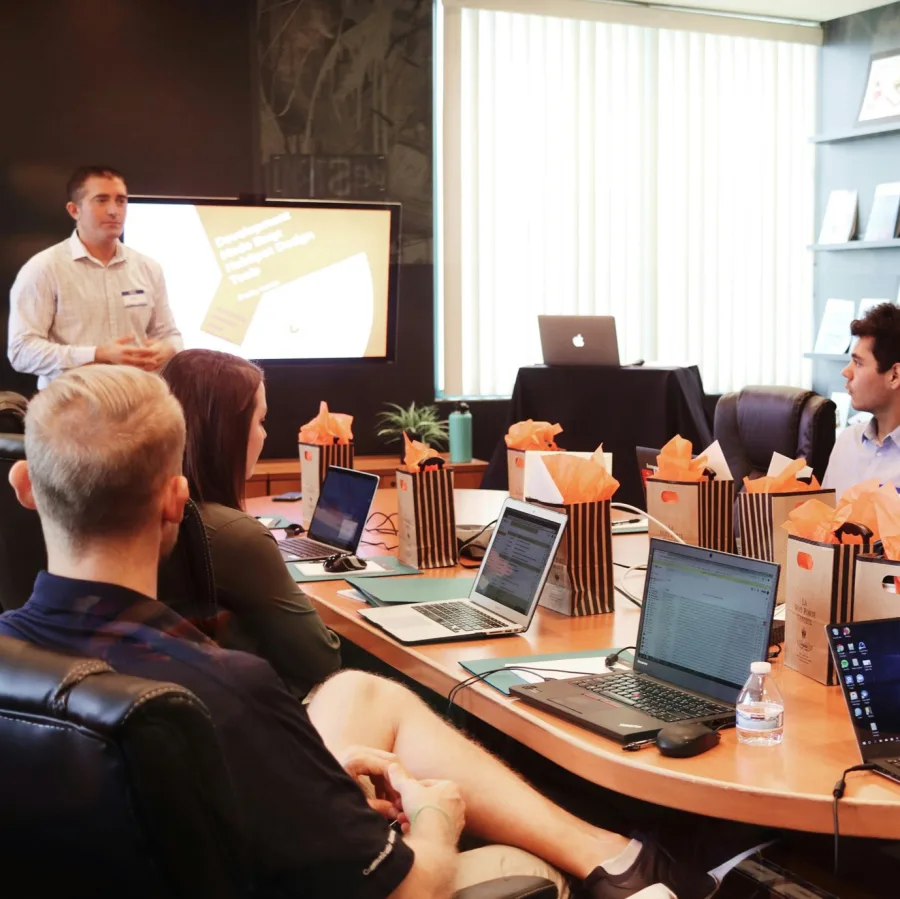
Karim, an engineer, described a scenario that kept repeating: in team meetings he did not speak up, then spent the evening formulating what he should have said. He had ended up treating it as a character trait nothing could be done about, and what worried him most was not the silence itself but the idea of finishing his career in that role, sitting there watching other people say what he was thinking.
The first conversation served to check one point: did it happen to him elsewhere? The answer was mixed. With friends, no. With his direct manager and two more senior colleagues, every time. There was neither harassment nor overload, but a specific configuration.
The work bore on the apprehension of the minutes before speaking, on an anchor usable while seated at the table, and on what that configuration reminded him of, which he had not been aware of until then.
> "I did not start speaking up in meetings. I started not thinking about it in the evening. It came in that order." > Karim, name changed
He says he now speaks up from time to time, not always, and no longer takes every silence personally. Every situation is different, and Karim's path says nothing about what you will experience.
How a Hypnosis session on this subject unfolds
The conversation. The precise situations where it sticks, with whom, since when, and above all whether it also happens outside work. We will also cover your workload, your sleep and the atmosphere in your team, so that we can point you to the right person if your situation is about burnout or harassment, which are not ours to handle.
The aim, framed together and tied to a real situation, never to a general quality. Not "having confidence", but for instance: asking a question at Tuesday's meeting, or answering an evening message the next morning rather than straight away.
The induction. A natural state of attention you already know without naming it. You stay conscious, you hear everything, you can speak and you can stop whenever you wish.
The work. On this subject it usually takes three forms. Recalling moments when you did assert yourself, even outside work, to identify what you drew on then and make it available elsewhere. Setting up an anchor, that is, tying a discreet gesture to a state of calm, reactivable before a meeting. And rehearsing a coming situation mentally, in detail, until it becomes familiar.
The return and the exercise. A conversation about what you experienced, and a self-hypnosis exercise to take away, often designed for the five minutes before the moment itself. Some practitioners hand over a recording of the session.
The number of sessions is settled at the first conversation. Sessions work in person as well as by video.
Book an appointment

The first conversation is there to determine whether hypnosis is the right resource for your situation, and that is particularly true here: the question "does this happen to you elsewhere?" comes up in the first few minutes, and its answer changes everything that follows. If your situation belongs to someone else (your doctor, occupational health, a harassment procedure, a coach), we will tell you.
In person, the practitioners who cover professional coaching and working life in English see clients in Quebec, in Montreal, Sherbrooke and Gatineau, and in France in Paris and Lille. By video, wherever you are: it is often the simplest format when the point is to prepare for a fixed date. Here is how it works.
A question before you decide? Write to us describing your situation.
Where would you like to consult?
All areas
 Annie Mayrand
Gatineau - Cumberland (ON)
👤
🧑🎓
🚭
❤️
💻
Annie Mayrand
Gatineau - Cumberland (ON)
👤
🧑🎓
🚭
❤️
💻
 Christian Rocher
Beloeil
👤
🧑🎓
👶
🚭
❤️
💻
Christian Rocher
Beloeil
👤
🧑🎓
👶
🚭
❤️
💻
 David Veilleux
Montréal - Anjou
👤
🧑🎓
🚭
❤️
🤰
💻
David Veilleux
Montréal - Anjou
👤
🧑🎓
🚭
❤️
🤰
💻
 Florence Aton
Sutton
👤
🚭
❤️
💻
Florence Aton
Sutton
👤
🚭
❤️
💻
 Jessica Reid
Sherbrooke
👤
🚭
💻
Jessica Reid
Sherbrooke
👤
🚭
💻
 Julie Rocque
Montréal - Jean-Talon
👤
🧑🎓
👶
🚭
❤️
🤰
💻
Julie Rocque
Montréal - Jean-Talon
👤
🧑🎓
👶
🚭
❤️
🤰
💻
 Nuria Pérez de León
Montréal - Rosemont - Saint-Lambert
👤
🧑🎓
💻
Nuria Pérez de León
Montréal - Rosemont - Saint-Lambert
👤
🧑🎓
💻
 Romain Rastoin
Bromont
👤
🧑🎓
🚭
❤️
💻
Romain Rastoin
Bromont
👤
🧑🎓
🚭
❤️
💻
 Réjeanne LeBlanc
La Prairie
👤
🧑🎓
👶
💻
Réjeanne LeBlanc
La Prairie
👤
🧑🎓
👶
💻


Frequently asked questions about Hypnosis for Assertiveness at Work
That is a hypothesis to take seriously, and the first conversation is there precisely to check it. If you are perfectly clear everywhere else, the subject is not your confidence. And if the situation amounts to harassment or discrimination, recourse exists: through the CNESST in Quebec, through occupational health services and staff representatives in France. Working on yourself does not replace those steps.
No. The hypnotic state is a state of focused attention, not sleep and not being placed under someone's influence. You stay conscious, you hear everything, and you keep the ability to refuse a suggestion, to speak or to stop the session. Hypnosis in itself cannot make someone act against their will. What calls for vigilance is the relationship: as in any form of support, a clear framework and a practitioner who lets you say no are part of what makes a session safe. You can stop at any moment, and that is not up for discussion.
Generally yes: hypnosis is a non-medicinal approach that comes alongside your care and does not replace it. It introduces no substance and changes nothing about what you are taking. Tell us what that is at the first conversation, and mention it to your doctor: every decision about your treatment belongs exclusively to them.
Psychotherapy is a regulated framework, practised by professionals whose title is protected, and it can cover the whole of psychological functioning and established disorders. Hypnosis as we practise it is a more circumscribed form of support, focused on a specific aim. If the difficulty is long-standing and present in every area of your life, or if fear of judgement is overwhelming, a psychologist remains the reference.
No, and it is a common worry among people who tend to stay in the background. Being assertive means saying things, not imposing them. In practice the opposite is what we see in our work: outbursts come after long periods of silence, and they become rarer once things get said as they arise.
No, and be wary of anyone who promises it. Charisma is not assertiveness, and it is not a serious aim for support. What can be worked on is your ability to say what you have to say, in your own style and not someone else's.
They can help you become familiar with the hypnotic state and keep up a practice. They are not tailored to your situation, nobody checks what they contain, and they obviously do not spot burnout or a harassment situation. Steer clear of any that promise results.
The number of sessions is settled at the first conversation, depending on whether it is about preparing for a specific deadline or working on something older.
Sources and references
Work and health
- Psychological or sexual harassment at work. CNESST, Quebec, in French
- Moral harassment: service-public.gouv.fr, and article L1152-1 of the Labour Code on Legifrance, France, in French
- Preventing psychosocial risks. Institut national de recherche et de sécurité, France, in French
On assertiveness and social anxiety
- Troubles anxieux graves. Haute Autorité de santé, June 2007, in French. Its section on social anxiety names assertiveness training among the components of cognitive behavioural therapy.
- Social Anxiety Disorder: Recognition, Assessment and Treatment. NICE clinical guideline CG159, full text.
On hypnosis
- Valentine, K. E., Milling, L. S., Clark, L. J., & Moriarty, C. L. (2019). The Efficacy of Hypnosis as a Treatment for Anxiety: A Meta-Analysis. International Journal of Clinical and Experimental Hypnosis, 67(3), 336-363. doi.org/10.1080/00207144.2019.1613863: 15 studies, 17 trials, on anxiety in general.
- Meta-analytic evidence on the efficacy of hypnosis for mental and somatic health issues: a 20-year perspective. Rosendahl, J., Alldredge, C. T., & Haddenhorst, A. (2024). Frontiers in Psychology, 14, 1330238: 49 meta-analyses, 261 studies.
- Évaluation de l'efficacité de la pratique de l'hypnose. Inserm, 2015, in French, report commissioned by the French health directorate.
If you are struggling at work
- Quebec: the CNESST, for a psychological or sexual harassment complaint · your union · Info-Social 811, option 2
- France: the employer or human resources · occupational health services · staff representatives and the works council · the labour inspectorate · 116 006, victim support · 3114 in case of distress
The legal information on this page is given for guidance only and does not constitute legal advice. Check it with the bodies named.
Hypnosis as practised by the members of Solutions Hypnose is a complementary support approach. It is neither a medical act, nor a diagnosis, nor psychotherapy in the regulatory sense, and it in no way replaces a consultation, follow-up or treatment prescribed by a health professional.
Our practitioners do not assess and do not treat mental disorders or illnesses. They never ask for an ongoing treatment to be stopped or changed: that decision rests exclusively with your doctor.
No result can be guaranteed. The testimonials and examples presented on this page describe individual experiences and do not predict what you will experience.
In case of significant distress, unexplained physical symptoms or suicidal thoughts, contact a doctor, emergency services or a helpline without delay.

Page written by Anne-Géraldine Lavielle
hypnotherapist and holistic coach
partner at Solutions Hypnose.
English version reviewed by David Veilleux
Updated .