
How many Hypnosis Sessions do you need?
Nobody can tell you before meeting you.
It is a disappointing opening, and it is the only true answer. A practitioner who announces a number of sessions from a contact form is selling a forecast they have no means of making.
What we can give you, on the other hand: ranges observed in practice, what lengthens or shortens support, how to spot that it is working, and what to do if it is not. That is what this page is about.
And one point that answers the question behind the question: you are committed to nothing. You book one session at a time and you stop whenever you want, without having to justify yourself. For a specific goal such as quitting smoking, some practitioners offer a format that announces the session and its reinforcement in advance: that is different from a commitment over several months, and both the content and the price are given to you before you decide.


What the first session tells you
You will know very quickly whether it suits you. Often by the end of the first appointment, whose length and course are described on the page what to expect in a hypnosis session.
Three clues: do you feel at ease with this person, does the hypnotic state suit you — our page am I hypnotizable helps you know what to expect —, and does the goal you defined together mean something to you.
If any of the three answers is no, say so. Sometimes it can be fixed by adjusting, and sometimes it is better to see someone else.
What makes the length vary
The nature of the subject. A targeted, well-defined difficulty is worked on faster than a way of functioning in place for twenty years. It is the most decisive variable.
The goal you set yourself. Making a situation bearable and transforming it entirely do not call for the same path. Both are legitimate.
Trust in the relationship. It cannot be decreed. That is also why the first session is long. Some people arrive worried, marked by the image of stage hypnosis — our page what is therapeutic hypnosis puts it back in its place —, and need time before letting go. That time is not wasted.
What you do between sessions. You are the one doing the work, during the session and above all afterwards. Exercises, putting things into practice, sometimes listening again to a recording: that is where a good part of the result is decided.
Your context. An environment pushing the other way — people around you, a job, a situation — inevitably slows things down. That is not a failing on your part.
The ranges we observe
How to read these figures. They are ranges observed in practice, not commitments. They vary from one person to another, and falling outside the range says nothing about you. No practitioner on the team commits to a number of sessions, and if you read elsewhere that a precise number "is enough", that is a sales argument, not information.
Quitting smoking. Often a few sessions, sometimes just one for people who have already made up their mind. It is the subject where the gaps are widest, and where most caution is needed: every approach to quitting smoking, medical treatments included, sees frequent relapses. A reinforcement session is often useful, notably to avoid shifting to another habit.
A targeted phobia — flying, lifts, insects. A few sessions are often enough to bring the intensity down. The realistic goal is not to become enthusiastic about flying, but to be able to go on holiday.
Long-standing anxiety, self-confidence, self-esteem. Longer, because there are old beliefs to undo and avoidance behaviours to take back. Count in months rather than weeks.
A subject that shifts. It is common, and it is not a problem. Someone comes for anger, and behind it appear self-confidence, difficulty saying no, sometimes deeper questions about what they want to do with their life. The support follows what emerges, at your pace.
How long between two sessions
One to three weeks, most often.
The interval is not a detail. It gives the change time to settle, and above all to be tested in your real life rather than in the consulting room. It is also what allows the next steps to be adjusted according to what actually happened.
Booking sessions too close together rarely gives better results, and sometimes the opposite. It varies with the situation: closer together when a deadline approaches, further apart towards the end of support.
Video available in French
Video transcript
Bonjour, Une question bien légitime de nos clients : combien de séances cela va prendre ? Et il n’y a pas de réponse. Cela dépend de vous, de votre problématique. Ce qui est sûr c’est que vous saurez vite si cela vous convient, si vous aimez l’état d’hypnose, si vous appréciez la relation avec votre hypnothérapeute, et si vous voyez des changements positifs vers votre objectif. 1er cas assez fréquent par exemple pour l’arrêt de fumer : 1 seule séance permet de changer le comportement.
Et lors de la séance de suivi, le retour presque étonné du client, ben oui j’ai arrêté de fumer. Donc nous faisons juste une séance de renforcement, notamment par rapport aux tentations ou pour éviter le transfert sur d’autres habitudes. C’est parfait : visiblement c’était la bonne technique, au bon moment, et quand la personne est prête. 2ème cas : quelques séances, 3-4 par exemple pour avancer sur une problématique un peu plus complexe comme l’anxiété, les troubles du sommeil, la gestion de la douleur.
Car au-delà des symptômes, il y a souvent un équilibre de vie ou des automatismes de pensée à retravailler. 3ème cas : une dizaine de séances parfois sur un sujet qui se transforme, par exemple la demande initiale concerne la gestion des émotions, comme la colère, et puis derrière peuvent surgir d’autres thèmes : la confiance en soi, ou bien comment je mets mes limites dans ma vie, comment je dis non. Ou même des questions assez existentielles où nous allons combiner l'hypnose et le coaching : où je veux vivre, qu’est-ce que je vais faire de ma vie…
Et puis, quand l’objectif initial est atteint, certains clients reviennent des mois ou des années après pour un nouveau sujet ou une nouvelle étape de vie… C’est vous qui choisissez et allez à votre rythme. Nous, nous sommes là pour vous accompagner. Alors si vous voulez changer des choses dans votre vie, essayez l’hypnose thérapeutique. L’équipe d’hypnothérapeutes de Solutions Hypnose est là pour vous accompagner. En présentiel près de chez vous ou par vidéo, cela fonctionne aussi très bien.
Prenez rendez-vous dès maintenant pour créer la vie que vous souhaitez grâce à l’hypnose ! A bientôt
Hypnotherapy is a complementary form of support and does not replace medical advice, diagnosis, or treatment. If you have any concerns about your health, please consult a physician first.
How to tell whether it is working
This is the most useful question on this page, and the one nobody addresses.
Changes are rarely spectacular, and they almost never arrive in the expected order. What moves first, very often:
- Sleep. It is the first indicator on most subjects.
- Intensity rather than frequency. The reaction still happens, but it rises less high or comes down faster.
- Recovery time. You are still upset, but you no longer think about it the next day.
- What you do again. An outing, a journey, a conversation you used to avoid.
- What other people say. Those around you often notice before you do.
A practical marker: note where you are at the start, on a simple scale. Without that starting point, you very quickly forget where you began, and you underestimate how far you have come.
And if it is not working?
It needs talking about, and the sooner the better.
Tell your practitioner. It is neither rude nor discouraging: it is information they need. They can adjust the goal, change approach — our page which type of hypnosis to choose presents the main ones —, or recognise with you that something else is at play.
Several explanations are possible, and none of them is a verdict on you: the goal was poorly targeted, the format does not suit you, the timing is wrong, or part of you is still attached to the current way of functioning for good reasons. That last case is common and it can be worked on.
Sometimes the right answer lies elsewhere. Medical or psychological follow-up, specialised care, or simply another practitioner you will click with better. A serious professional will tell you so, and we will tell you so.
And you can stop. No explanation, no commitment, no charge. That was your question when you arrived on this page.
When support ends
There is no official exit. In practice, it ends in one of three ways.
The goal is reached, and a last session serves to consolidate it and spot what might weaken the result later.
You have what you needed, even if not everything is settled. That is perfectly valid.
You come back later. Many clients return months or years afterwards, for another subject or another stage of life. That is not a failure: it is rather a good sign.
Book an appointment
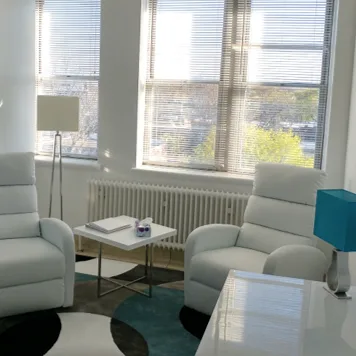
Wherever you are in the world, video consultation lends itself to this rhythm of one session every one to three weeks: no journey to fit in, and the session itself is the same as in the consulting room. We see people this way from France, Quebec, Morocco and well beyond. Here is how it works. Describe your situation to us: ask us your question, and we will give you an honest idea of the range, including if the answer is that hypnosis is not the right path.
Where would you like to consult?
All areas
 Annie Mayrand
Gatineau - Cumberland (ON)
👤
🧑🎓
🚭
❤️
💻
Annie Mayrand
Gatineau - Cumberland (ON)
👤
🧑🎓
🚭
❤️
💻
 Christian Rocher
Beloeil
👤
🧑🎓
👶
🚭
❤️
💻
Christian Rocher
Beloeil
👤
🧑🎓
👶
🚭
❤️
💻
 David Veilleux
Montréal - Anjou
👤
🧑🎓
🚭
❤️
🤰
💻
David Veilleux
Montréal - Anjou
👤
🧑🎓
🚭
❤️
🤰
💻
 Florence Aton
Sutton
👤
🚭
❤️
💻
Florence Aton
Sutton
👤
🚭
❤️
💻
 Jessica Reid
Sherbrooke
👤
🚭
💻
Jessica Reid
Sherbrooke
👤
🚭
💻
 Julie Rocque
Montréal - Jean-Talon
👤
🧑🎓
👶
🚭
❤️
🤰
💻
Julie Rocque
Montréal - Jean-Talon
👤
🧑🎓
👶
🚭
❤️
🤰
💻
 Nuria Pérez de León
Montréal - Rosemont - Saint-Lambert
👤
🧑🎓
💻
Nuria Pérez de León
Montréal - Rosemont - Saint-Lambert
👤
🧑🎓
💻
 Romain Rastoin
Bromont
👤
🧑🎓
🚭
❤️
💻
Romain Rastoin
Bromont
👤
🧑🎓
🚭
❤️
💻
 Réjeanne LeBlanc
La Prairie
👤
🧑🎓
👶
💻
Réjeanne LeBlanc
La Prairie
👤
🧑🎓
👶
💻


Frequently asked questions about the number of Hypnosis Sessions
No, there is no commitment: you book one session at a time. A format announced for a specific goal, such as a quit-smoking session with its reinforcement, is common practice and perfectly clear as long as the content and the price are stated in advance. What to be wary of is committing to a number of sessions paid for before the very first meeting.
Sometimes, on a very targeted subject and with someone who has already made up their mind. It is not the rule, and it is not what to count on.
Nothing serious. Say so when you arrive, and we pick up from where you are.
Between an hour and an hour and a half for the first, 45 minutes to an hour after that. The details are on our page about what to expect in a session.
Less than people think. We explain it on our page "Am I hypnotizable?".
Fees vary by practitioner and country. They are listed on each team member's page.
Hypnosis as practised by the members of Solutions Hypnose is a complementary support approach. It is neither a medical act, nor a diagnosis, nor psychotherapy in the regulatory sense, and it in no way replaces a consultation, follow-up or treatment prescribed by a health professional.
Our practitioners do not assess and do not treat mental disorders or illnesses. They never ask for an ongoing treatment to be stopped or changed: that decision rests exclusively with your doctor.
No result can be guaranteed. The testimonials and examples presented on this page describe individual experiences and do not predict what you will experience.
In case of significant distress, unexplained physical symptoms or suicidal thoughts, contact a doctor, emergency services or a helpline without delay.
Page written by Nuria Pérez de León
hypnotherapist and NLP coach
partner at Solutions Hypnose.
English version reviewed by David Veilleux
Updated .