
Hypnosis and Sleep: Insomnia, waking in the night
The paradox of insomnia fits in one sentence: sleep is the only thing that runs away when you chase it.
The more you want to sleep, the more you tense up; the more you tense up, the less you sleep; and the more sleepless nights pile up, the more the fear of not sleeping settles in, until it becomes the main cause of the insomnia itself.
It is precisely on that vicious circle that hypnotherapy acts: not by "forcing" sleep, but by disarming what prevents it. This page explains how, for which difficulties, in how many sessions, and in which cases the first step is a doctor.


Understanding Sleep difficulties
The three faces of insomnia
- Insomnia at the start of the night:
You go to bed tired, and as soon as the light goes out the brain switches on. The day replays on a loop, tomorrow's list writes itself, and an hour later you are more awake than you were at midday. - Waking in the night:
Falling asleep is fine, but at 3 or 4 in the morning your eyes open, and it is time for rumination, worries magnified by the dark, and the anxious calculation of how many hours of sleep are left. - Early waking:
The night ends at 5am, well before the alarm, with no chance of getting back to sleep and tiredness already booked for the day ahead.
These three forms, often mixed, most often share the same engine: a nervous system still on alert (accumulated stress, anxiety, hypervigilance…) that does not come down when the body lies down. That is why "trying to sleep" does not work: you cannot force yourself to let go.
A few figures
In France, 45% of people say they face at least one sleep disorder, and daytime sleepiness concerns one person in four, most often those aged 18 to 24. Read more
When poor sleep settles in
The vicious circle of the fear of not sleeping
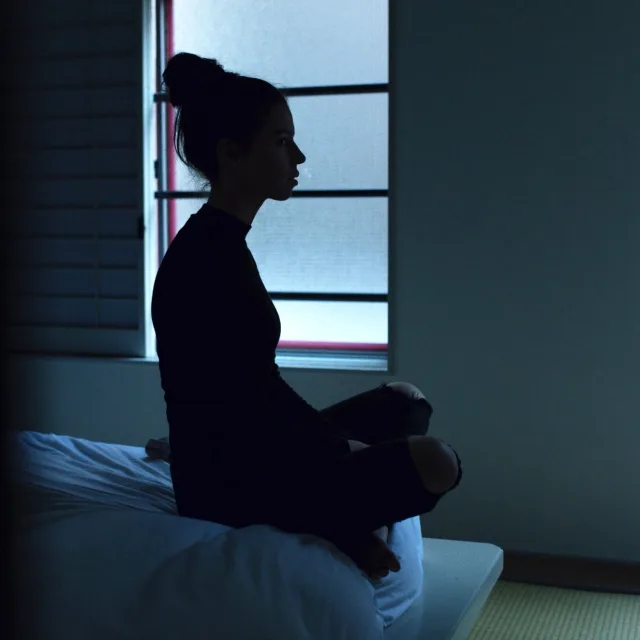
Here is the mechanism that turns a few bad nights into lasting insomnia. After several difficult nights, going to bed changes in nature: it becomes an issue. You get into bed wondering whether "it is going to work", you monitor your own falling asleep, you count the hours left, and that monitoring is exactly the opposite of the state required for sleeping. The bed itself ends up associated with the struggle rather than with rest: the brain has learned "bed = fight", and it faithfully honours that learning every evening.
This is what is called psychophysiological insomnia: the difficulty maintains itself, independently of the original cause (which has sometimes long since gone). The good news: what has been learned can be unlearned, and that is exactly the work of hypnosis.
The aggravating factors
- Sleep difficulties are largely tied to stress, to anxiety or even to depression.
- Intense physical activity in the evening or consuming stimulants (coffee, tea, energy drinks…), drugs or alcohol also complicate sleep (with alcohol, it can make falling asleep easier but the second half of the night harder).
- Screen use in the evening often pushes bedtime later and makes falling asleep harder, through mental stimulation and the negative impact of blue light on the hormones that support sleep.
- Shift work patterns or children waking in the middle of the night complicate sleep habits.
- And of course the environment has a strong impact: noise, a bedroom that is too warm or too cold…
Video transcript
Sleep disorders are one of the most frequent reasons for consultation with a hypnotherapist. There are different forms: problems going to bed, falling asleep, frequent nocturnal awakenings, difficulty going back to sleep afterwards, ultra morning awakenings... Sleep disorders can be related to hormonal imbalances, unbalanced lifestyles, for example with working the nightshift- or jet lag. But most often they are a symptom of mental or emotional stress, anxiety, or thoughts that are run in loop in your head. If the sleep disorder is caused by a post-traumatic stress, in this case you should consult a psychologist or psychotherapist. The problem - and if you're prone to insomnia you know - is that the more you think about it, the worse it gets.
I have to sleep, I'm going to be tired tomorrow... and so you roll in your bed or you get up to get a glass of water, or to go to the toilet. So why use hypnosis? Contrary to the shows and movies of the 30s, we are not going to look you straight in the eyes and say "and from now on you will sleep like a baby"! That would be the best way to get upset! The goal of hypnosis is to allow you of course to relax deeply which already feels good. But above all to let your imaginative and creative mind take over your rational mind that has already turned the problem 12000 times worst in your head. To understand the ramifications of the problem, possibly the benefits of these sleep disorders even if it seems paradoxical, or to work with symbols, and metaphors.
Let me take an example: a recently retired lady can't fall asleep at night, she always has something to do. Futile things, as she says it herself. While in session with a hypnotherapist, she realizes that she has very boring new life, and when it is time to go to bed, she wants to avoid thinking that she had done nothing with her day. We also have young and very active clients, each case is different... So if you are prone to sleep difficulties, if you wake up in the early morning already tired before you even start the day, try therapeutic hypnosis. The team of hypnotherapists of Solutions Hypnose is here to accompany you. In person or by video, it also works very well. Make an appointment now to create the life you want through hypnosis! See you soon.
Hypnotherapy is a complementary form of support and does not replace medical advice, diagnosis, or treatment. If you have any concerns about your health, please consult a physician first.
What Hypnosis offers for Sleep
How hypnosis acts on sleep
The hypnotic state is a close cousin of falling asleep: a natural state of altered consciousness, between waking and sleep, that you pass through every evening anyway. In session it becomes a training ground: your nervous system relearns the way down.
In practice, the support works on four levels:
- Settling the alert system.
Deep hypnotic relaxation is not just a pleasant moment. It physiologically retrains the body to move from alert mode to rest mode: heart rate, breathing, muscular tension... That state is then anchored, which means made available at will, particularly at bedtime and during night waking. - Switching off the mental hamster wheel.
Bedtime rumination is not fought head on (trying not to think about something is thinking about it). Hypnotic work teaches the brain to let thoughts pass without grabbing them, and to give the day a "place to close" before bed. So that the bedroom stops being the midnight meeting room. - Disarming the fear of not sleeping.
This is the heart of the work for settled insomnia: separating the bed from the struggle, taking away bedtime's status as a pass-or-fail exam, and restoring the body's confidence in its own ability to sleep. An ability that never disappeared, only got interfered with. - Making you self-sufficient through self-hypnosis.
You learn a simple protocol to use on your own: settling the body comfortably, slowing and gently lengthening the out-breath, letting attention move down into the sensations of the body rather than into thoughts, then drifting towards an imagined place of calm in more and more detail. Used at bedtime or at 3am, it does not "force" sleep: it recreates the conditions in which sleep comes on its own.
What do the studies say?
Research on hypnosis and sleep is encouraging. Experimental work has notably observed that a suitable hypnotic suggestion could increase the proportion of deep slow-wave sleep, the most restorative phase, in receptive people, and hypnotherapy is among the non-drug approaches studied for insomnia, alongside cognitive behavioural therapy for insomnia (CBT-I).
The studies are promising but still limited in volume, results vary from person to person, and hypnosis is meant to come alongside validated approaches and medical follow-up, never to replace them.
Hypnosis and sleeping pills: alongside, never a sudden stop
What hypnosis can do, and often does very well: support a gradual reduction decided and steered by your doctor, while rebuilding in parallel the natural sleep mechanisms that the treatment had put on hold. Many people reduce their dependency on sleeping pills that way, at their own pace and in the right order: the doctor decides the timetable, hypnosis helps along the way.
When to see a doctor first
Some sleep disorders have an organic cause that hypnosis does not treat. See a doctor as a priority in particular if:
- You snore heavily with pauses in your breathing or marked daytime sleepiness (suspected sleep apnoea, a serious health matter that is diagnosed and treated medically);
- Your legs are seized by irrepressible restlessness at bedtime (restless legs syndrome);
- Your insomnia comes with a collapsed mood, a loss of interest or dark thoughts. Insomnia is sometimes the first visible sign of depression, which calls for medical care;
- The difficulty appeared with a treatment or an illness.
Hypnosis can then help, alongside that follow-up, with the stress that goes with it.
And children's sleep?
Trouble falling asleep, evening fears, nightmares, frequent waking: sleep difficulties in children are common and respond very well to hypnosis, which with them takes the form of stories and imagination games. See a doctor if the difficulty is marked (particularly for night terrors and sleepwalking).
At Solutions Hypnose, our specialised practitioners support parents and children from the age of 4 or 5. See Hypnosis for Children.
What our clients say

« I was skeptical at first about doing the sessions over Zoom, but I was pleasantly surprised by the results. I came in for my chocolate addiction, and surprisingly, it's my sleep that improved, or rather came back — I used to have at least three sleepless nights a week, and since starting my hypnosis sessions, I've only had one bad night... I fall asleep quickly now, whereas it used to take me hours, even on my better nights. I have more energy, and as a result, I need sugar less to find it. I no longer struggle with chocolate; I still have to stay mindful, but my relationship with it keeps getting more balanced. I'll continue on my own now, with a few tools developed during our sessions, keeping your contact information in mind if I ever need it. Thank you! »
Josée, client of Sandra Djina Ravalia
« Florence put me at ease and made me feel comfortable right from the first session. My insomnia problems improved significantly in just 2-3 sessions. I highly recommend her! »
Sarah, client of Florence Aton
« Nuria is exceptional. She taught me a lot of strategies to fight my insomnia. The hypnosis sessions are different every time, and effective. »
Éliane, client of Nuria Perez de Leon
« Sandra is a professional who really listens to her clients. I love her approach. In a short time, she understood my situation and worked to fix my sleep, which had been bad for far too long. I highly recommend her. Video or in-person sessions available »
Sébastien, client of Sandra Djina Ravalia
« I found Florence Aton to be a very gifted hypnotist. I sought her assistance with insomnia and have seen significant improvement in my ability to get an adequate night's sleep. I think her compassionate interview skills have as much to do with effectiveness as her technical skills at induction and suggestive reframing. »
Geneviève, client of Florence Aton
« Nuria is amazing. I've been taking some sessions with her and had amazing results in everything we've worked on, and finally I can sleep, and most importantly, I have a restful, deep sleep. Before, I couldn't sleep, and when I did, I didn't sleep well. Now I sleep like a baby. 100% recommended »
Mariana, client of Nuria Perez de Leon
« Anne-Marie worked a miracle for me with hypnosis. I'd been having nightmares for over 40 years, always with rats, and she worked a miracle with me... It's now been 4 years and I've never had a nightmare again.. Thank you Anne-Marie xx »
André, client of Anne-Marie Quesnel
« I had serious sleep problems. Thanks to hypnosis, things are much better now. Thank you Patricia »
Bernadette, client of Patricia Jouannet
« I took Zopiclone for 10 years just to be able to sleep 5 hours a night. After two sessions, I now sleep over 7 hours without medication. »
Jonathan, client of Annie Mayrand
« I went to see Jean-Marie for a sleep problem. I immediately liked his approach — asking questions to really get to know me, his attentive listening, and the advice and steps to improve my situation. I highly recommend him; I told him he had a gift, and my sleep is so much better for it. »
Lise, client of Jean-Marie Balestrat
Find a Hypnotherapist for Sleep difficulties near you
All areas
 Annie Mayrand
Gatineau - Cumberland (ON)
👤
🧑🎓
🚭
❤️
💻
Annie Mayrand
Gatineau - Cumberland (ON)
👤
🧑🎓
🚭
❤️
💻
 Christian Rocher
Beloeil
👤
🧑🎓
👶
🚭
❤️
💻
Christian Rocher
Beloeil
👤
🧑🎓
👶
🚭
❤️
💻
 David Veilleux
Montréal - Anjou
👤
🧑🎓
🚭
❤️
🤰
💻
David Veilleux
Montréal - Anjou
👤
🧑🎓
🚭
❤️
🤰
💻
 Florence Aton
Sutton
👤
🚭
❤️
💻
Florence Aton
Sutton
👤
🚭
❤️
💻
 Jessica Reid
Sherbrooke
👤
🚭
💻
Jessica Reid
Sherbrooke
👤
🚭
💻
 Julie Rocque
Montréal - Jean-Talon
👤
🧑🎓
👶
🚭
❤️
🤰
💻
Julie Rocque
Montréal - Jean-Talon
👤
🧑🎓
👶
🚭
❤️
🤰
💻
 Nuria Pérez de León
Montréal - Rosemont - Saint-Lambert
👤
🧑🎓
💻
Nuria Pérez de León
Montréal - Rosemont - Saint-Lambert
👤
🧑🎓
💻
 Romain Rastoin
Bromont
👤
🧑🎓
🚭
❤️
💻
Romain Rastoin
Bromont
👤
🧑🎓
🚭
❤️
💻
 Réjeanne LeBlanc
La Prairie
👤
🧑🎓
👶
💻
Réjeanne LeBlanc
La Prairie
👤
🧑🎓
👶
💻


Frequently asked questions about Hypnosis for Sleep and Insomnia
Yes, particularly when the insomnia is maintained by stress, rumination or the fear of not sleeping, which is the great majority of chronic insomnia.
It retrains the nervous system to come down into rest mode and disarms the vicious circle of monitoring your own sleep.
Results vary from person to person, and organic causes (apnoea, restless legs) are first a matter for a doctor.
Often fewer than people imagine: two to five sessions in most cases, with the self-hypnosis learned from the start gradually taking over.
Long-standing, deeply settled insomnia can need slightly longer work, particularly when it comes with background anxiety (see Stress & Anxiety).
No, not directly, and never without medical advice: stopping some sleeping pills abruptly can be dangerous.
Hypnotherapy does, however, support a gradual reduction decided with your doctor very well, rebuilding in parallel what lets natural sleep come back: physiological relaxation, settling of rumination, confidence recovered in your ability to sleep.
Two things.
In the moment: a self-hypnosis protocol to cross the waking without panicking or ruminating. It is the panic of "I will never get back to sleep" that turns an ordinary micro-waking into two hours of insomnia.
Underneath: retraining the nervous system so that those wakings become what they are for every sleeper: brief and forgotten by morning.
Because in front of the television you are not monitoring your falling asleep, and in your bed you are.
Your brain has associated the bed with the stakes and the struggle: that is psychophysiological insomnia, and it is almost good news, because it proves your ability to sleep is intact.
The work then mainly consists in giving the bed back its status as a place of rest.
No.
Sleep apnoea is a mechanical breathing disorder that is diagnosed (with a sleep study) and treated medically; it is a serious health matter.
If you snore heavily, have pauses in your breathing or suffer from daytime sleepiness, see a doctor as a priority. Hypnosis can then help with the associated aspects (stress, adapting to the treatment).
It is a respectable way in to relaxation. Many people fall asleep to them, and that is already something.
But a generic recording knows neither your triggers, nor your sleep history, nor your form of insomnia: it relaxes, it does not treat the vicious circle that maintains the difficulty. That is the whole difference between listening to a lullaby and retraining your sleep.
Yes.
How long insomnia has lasted does not mean your sleep is "broken". The ability to sleep is a fundamental biological mechanism that does not disappear; it gets interfered with by learned patterns (monitoring, fear, bed as battlefield) which can be unlearned.
It is often with long-standing insomniacs that the relief is most spectacular.
From both, because it is the same alert system expressing itself as anxiety by day and as insomnia by night.
The support works both sides together: daytime tools to bring down the background pressure, night-time tools for bedtime and for waking.
Treating one without the other is bailing out the boat without turning off the tap (see Stress & Anxiety).
Yes, and it is even a case where video has a natural advantage: you are at home, sometimes in the very room where sleep happens, and the deep relaxation at the end of the session is not interrupted by a journey home.
The hypnotic state depends on voice and attention, not on physical presence.
Going further
- Stress Management: when the pressure is strong and constant.
- Symptoms of anxiety: when the alarm runs with no present danger.
- Performance anxiety: when the pressure concentrates on one moment to get right.
Hypnotherapy is complementary well-being support: it replaces neither advice, nor treatment, nor medical or psychological follow-up, and guarantees no result. Any significant distress or persistent symptom is first a matter for a health professional.
Page written by Réjeanne LeBlanc
hypnotherapist and NLP coach
partner at Solutions Hypnose.
English version reviewed by David Veilleux
Updated .