
Hypnosis and Bedwetting in Children (Nocturnal Enuresis)
Waking up to it again. The sheets to change before school, the washing machine running every morning, and a child who says nothing.
There is also what you see without them saying it: the sleepover invitation turned down for a made-up reason. The camp they no longer want to go to. The bag they refuse to pack.
And there is your own tiredness, and perhaps an irritation that slips out sometimes and that you then regret.
One thing to state from the outset: your child is not doing it on purpose, they cannot help it, and it is not a matter of willpower. Nor is it the result of anything you did wrong as a parent.

What is Nocturnal Enuresis?
Nocturnal enuresis means involuntary wetting during sleep, in a child aged 5 or older — below that age we do not speak of enuresis.
It is primary when the child has never had lasting dry nights, and secondary when it comes back after at least six months without an accident.
It is common: around 10 to 15% of five-year-olds, with a clear male predominance. And it resolves on its own in a large share of them, at a rate of roughly 15% for each year that passes. Which does not mean waiting and doing nothing, especially if the child is suffering.
What is really happening, and it is worth explaining it to your child
Enuresis is now understood as the meeting of three factors, which can combine:
1. The kidneys produce too much urine at night. Normally a hormone slows overnight production. In some children this rhythm falls into place later. 2. The bladder contracts too early, or holds less than is needed to last the night. 3. The arousal threshold is very high. The child does not wake when the bladder is full. It is not "sleeping too deeply" in the usual sense: it is a signal that fails to trigger waking.
Put differently: it is a question of maturation, not of character. Explained simply, this often comes as an enormous relief to a child who believed it was their fault.
The doctor comes first, and here is why that is not a formality. Several causes can be treated and must be ruled out. Constipation: the most frequently overlooked cause — a loaded rectum presses on the bladder and reduces its capacity, and treating it is sometimes enough to settle the bedwetting; see our page on constipation. A urinary infection, especially if the urine smells strong, if it hurts to pass or if the child goes very often. Sleep-disordered breathing: if your child snores loudly, sleeps with their mouth open, sweats a lot at night or seems tired on waking, raise it straight away. Diabetes, particularly with secondary enuresis accompanied by marked thirst, large volumes of urine, tiredness or weight loss: that picture warrants prompt medical attention. Any secondary enuresis deserves medical advice, as does any associated daytime leaking. Our hypnotherapists make no diagnosis and replace no examination.
What it costs the child
Self-esteem. That is the real issue, long before the sheets. A child who does not understand why they cannot manage when everyone else can ends up drawing a conclusion about themselves — the ground of our work on self-confidence. Nights away. Sleeping at a friend's, going to camp, the school trip. It is often that giving-up which finally brings families to consult, and it is a good reason.
The secret. Many children tell no one, not even their best friend, and live with the fear of it getting out.
In teenagers, when it persists, the impact can be considerable.
And the family. The laundry, the broken nights, the irritation that creeps in. You did nothing wrong.
What exists, and in what order
- The medical appointment, first, always.
- Information and lifting the blame, which are part of the treatment, not mere politeness.
- Simple measures: easy access to the toilet at night, drinks spread through the day rather than restricted, a trip to the toilet at bedtime, the child involved in changing the bed without it being a punishment, and a chart where dry nights are recorded.
- The bedwetting alarm. A sensor sets off a signal at the first contact with moisture and gradually teaches the brain to respond to the bladder's signal. It is the treatment with the best long-term results, with the fewest relapses. It calls for consistency over several weeks and the whole family's involvement. Talk to your doctor about it.
- Medication, if the doctor thinks it appropriate, particularly for one-off situations such as going to camp.
- Psychological support, when secondary enuresis follows a difficult event.
Hypnosis is added to this list. We have no reason to hide from you that the alarm is the best-established approach, and the two combine very well.
What Hypnosis can bring
It replaces neither the medical examination, nor the treatment of an identified cause, nor the alarm if your doctor recommends it. It guarantees no result.
What support can aim at:
- Making the explanation come alive. Understanding what is happening in their body, with images suited to their age, changes a great deal for a child. It is often the first effect, and it is immediate.
- Working on the waking signal, with metaphors of communication between the bladder and the brain.
- Easing shame and anxiety, which more often keep the problem going than cause it.
- Giving the child an active role, without making it their responsibility. The nuance matters: they become an actor, they are not at fault.
- Preparing for a specific event, such as a night at a friend's or leaving for camp, with a short-term goal that motivates children a lot.
- Supporting the family, and getting out of tense mornings.
When it fits best
When a medical cause has been ruled out, when the child is willing, and when they are old enough to understand the images offered to them. Count on about 6 years old, sometimes a little earlier depending on maturity. Our page on hypnosis for children describes what a session looks like at that age.
What research says
There are a few studies on hypnosis and nocturnal enuresis, rather encouraging, but few in number and on small samples. That is not comparable to the level of evidence behind the alarm, and we would rather tell you. We review it area by area on our page what science says about hypnosis.
An example of support
*Illustrative example, built from situations we frequently encounter.*

The parents of Noé (name changed), 8, had seen their paediatrician, who had ruled out a medical cause and treated a constipation that had gone unnoticed. The accidents had become less frequent without stopping. What worried his parents most was that he now turned down every invitation to sleep over, and had begun saying he was "useless". The work began with a simple explanation of what happens in his body, which he had never been given. Then with a story he built himself, in which a character learns to hear a signal. Part of the work involved his parents, particularly around what is said in the morning.
This example describes one possible course of support. It does not predict your child's. No result can be guaranteed.
How a session unfolds
The preliminary contact, with you. Where things stand medically, what has already been tried, how your child is living with the situation.
Your child must be willing. That is a condition. Show them the practitioner's photo or video and let them decide.
The session. We start with you, then one-to-one with the child if they wish. The hypnosis part lasts 30 to 45 minutes, through stories, drawings and characters.
What the child takes away. A short exercise, and often a story that belongs to them.
What you take away. A few pointers for the mornings, because that is where much of their self-esteem is decided.
From what age? Around 6 as a rule, sometimes a little earlier depending on maturity.
How many sessions? That is discussed at the first contact. We do not give a figure in advance.
Book an appointment
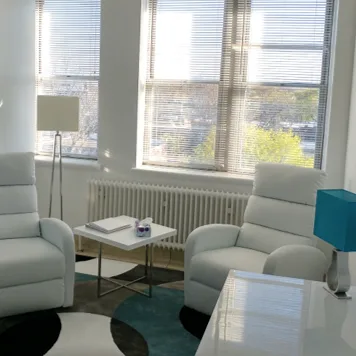
If the medical check has not been done, we will tell you to start there. Ask us your question or book an appointment. In the consulting room, our practitioners who work with children in English see families in Montreal, La Prairie and Beloeil, as well as in Paris and Lille. Wherever you are, video consultation is possible: our article on hypnosis by video with children explains how it works. Show the practitioner's introduction to your child: they are the one who decides.
Where would you like to consult?
All areas
 Annie Mayrand
Gatineau - Cumberland (ON)
👤
🧑🎓
🚭
❤️
💻
Annie Mayrand
Gatineau - Cumberland (ON)
👤
🧑🎓
🚭
❤️
💻
 Christian Rocher
Beloeil
👤
🧑🎓
👶
🚭
❤️
💻
Christian Rocher
Beloeil
👤
🧑🎓
👶
🚭
❤️
💻
 David Veilleux
Montréal - Anjou
👤
🧑🎓
🚭
❤️
🤰
💻
David Veilleux
Montréal - Anjou
👤
🧑🎓
🚭
❤️
🤰
💻
 Florence Aton
Sutton
👤
🚭
❤️
💻
Florence Aton
Sutton
👤
🚭
❤️
💻
 Jessica Reid
Sherbrooke
👤
🚭
💻
Jessica Reid
Sherbrooke
👤
🚭
💻
 Julie Rocque
Montréal - Jean-Talon
👤
🧑🎓
👶
🚭
❤️
🤰
💻
Julie Rocque
Montréal - Jean-Talon
👤
🧑🎓
👶
🚭
❤️
🤰
💻
 Nuria Pérez de León
Montréal - Rosemont - Saint-Lambert
👤
🧑🎓
💻
Nuria Pérez de León
Montréal - Rosemont - Saint-Lambert
👤
🧑🎓
💻
 Romain Rastoin
Bromont
👤
🧑🎓
🚭
❤️
💻
Romain Rastoin
Bromont
👤
🧑🎓
🚭
❤️
💻
 Réjeanne LeBlanc
La Prairie
👤
🧑🎓
👶
💻
Réjeanne LeBlanc
La Prairie
👤
🧑🎓
👶
💻


Frequently asked questions about Hypnosis and Bedwetting in Children (Nocturnal Enuresis)
We do not talk about enuresis before the age of 5. After that, what matters is less the age than how much the child is suffering and how it affects their life.
Often, yes, with time. But 'often' is not 'always', and waiting while a child turns down camps and comes to think they are useless has a cost. If it bothers them, it is worth acting.
Talk to your doctor about it. Waking a child at random teaches their bladder nothing, and it is different from the bedwetting alarm, which links a signal to a precise moment.
In the evening, perhaps, but without restricting what they drink during the day: a child needs to be well hydrated, and a bladder that never fills does not learn to fill. Here again, your doctor will guide you.
That is secondary enuresis and it warrants medical advice without delay. Several causes can be treated, and some need prompt care.
More than you would think. When breathing is obstructed at night, sleep fragments and the arousal threshold rises: the signal of a full bladder no longer wakes the child. And the effort of breathing seems to trigger a hormonal mechanism that pushes the kidneys to pass more water overnight. That is why removing the tonsils or adenoids sometimes makes the bedwetting disappear. If your child snores loudly, sleeps with their mouth open or pauses in their breathing, mention it at the first appointment.
No. The alarm is the approach with the best-established long-term results. Hypnosis works on what the alarm does not treat: shame, anxiety, understanding and motivation. The two combine well.
It is a common reason to consult and an excellent motivator for a child. Talk to your doctor too: there are solutions for one-off situations.
Do not force him, it will not work. Show him the practitioner's introduction and let a little time pass.
Sources and references
In English
- Caldwell, P. H. Y., Codarini, M., Stewart, F., Hahn, D., & Sureshkumar, P. (2020). *Alarm interventions for nocturnal enuresis in children*. Cochrane Database of Systematic Reviews. doi.org/10.1002/14651858.CD002911.pub3
- Austin, P. F. et al. (2016). *The standardization of terminology of lower urinary tract function in children and adolescents: Update report from the standardization committee of the International Children's Continence Society*. Neurourology and Urodynamics, 35(4), 471-481. doi.org/10.1002/nau.22751
In French
- Pipi au lit (énurésie) — Ameli, French national health insurance · Que faire et quand consulter ?
- L'incontinence nocturne — Soins de nos enfants, Canadian Paediatric Society
Hypnosis as practised by the members of Solutions Hypnose is a complementary support approach. It is neither a medical act, nor a diagnosis, nor psychotherapy in the regulatory sense, and it in no way replaces a consultation, follow-up or treatment prescribed by a health professional.
Our practitioners do not assess and do not treat mental disorders or illnesses. They never ask for an ongoing treatment to be stopped or changed: that decision rests exclusively with your doctor.
No result can be guaranteed. The testimonials and examples presented on this page describe individual experiences and do not predict what you will experience.
In case of significant distress, unexplained physical symptoms or suicidal thoughts, contact a doctor, emergency services or a helpline without delay.
Page written by Réjeanne LeBlanc
hypnotherapist and NLP coach
partner at Solutions Hypnose.
English version reviewed by David Veilleux
Updated .