
Hypnosis to Stop Nail Biting (Onychophagia)
You are reading a slightly tense email, and your thumb is already between your teeth. You didn't decide to do it. You notice when it stings, or when someone looks at you.
You have probably tried everything: bitter nail polish, plasters, the promise made on the first of January. It holds for a few days, then a meeting or a gripping film resets the count.
Nail biting, or onychophagia, is a body-focused repetitive behaviour: an automatic gesture that often serves to release tension, boredom or concentration, far more than a question of willpower. Hypnosis support can help you notice the moments when your hand rises to your mouth and set up other responses to what the gesture was soothing. If your fingers bleed or become infected, or if the habit comes with other behaviours that worry you, talk to your doctor first.
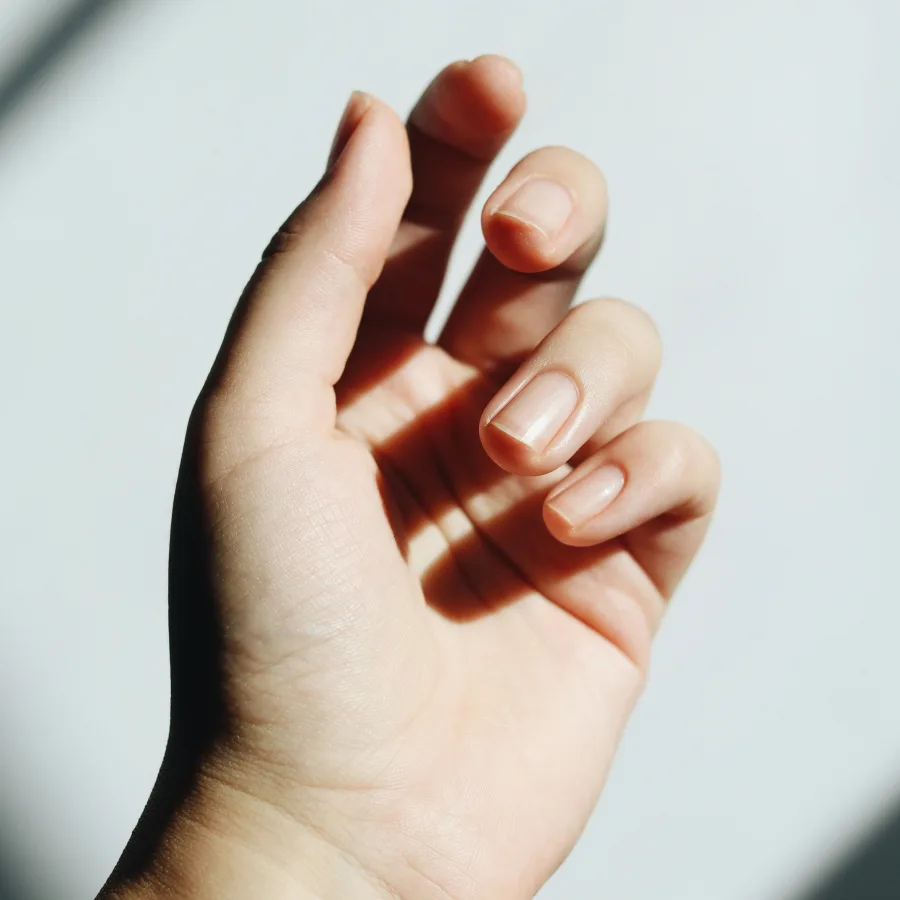

What it is like when you bite your nails
When to see a doctor first.
If the skin around your nails is red, swollen, painful or weeping: an infection needs medical care, not hypnosis.
If you regularly hurt yourself to the point of bleeding, or if a nail has changed shape.
If the gesture comes with other behaviours that worry you (pulling out hair, picking at skin), with intrusive thoughts, or with anxiety that spills over into the rest of your life.
Hypnosis comes alongside, never instead.
There are the moments when you know it is coming: traffic jams, waiting for a result, the series you watch late at night. And there are all the others, when you discover afterwards a nail bitten down to the skin without remembering lifting it to your mouth.
Then come the hidden hands. Fists closed in a photo, a slightly rushed handshake, the pen you hold so you look busy. Sometimes a small pain that lasts all day, because you went too far.
If you recognise yourself, you are not "weak-willed". You have a gesture that took hold long ago, that does a real job, and that now starts on its own. That is exactly why it resists good resolutions.
What is onychophagia?

Onychophagia means biting your nails repeatedly, and often the bits of skin and cuticle around them too. It affects children and adults alike.
It belongs to what are called body-focused repetitive behaviours, like pulling out hair or picking at skin. These are gestures that bring relief or satisfaction in the moment, and that keep coming back despite the wish to stop.
It is not OCD, in the vast majority of cases. In obsessive-compulsive disorder, the gesture answers an obsessive thought it tries to neutralise. Here there is usually no such thought: the gesture is set off by a sensation, a tension or a situation. We go into this distinction in our article on hypnosis for OCD and repetitive behaviours.
Nor is it a tic. A tic is a sudden, brief, involuntary movement, preceded by a sensation that is hard to describe. Nail biting is a longer gesture, which can happen "on autopilot" but which you can interrupt once you pay attention. Tics have their own page: hypnosis for tics.
In children
The habit is very widespread in childhood and adolescence, and it often fades with age. Repeated remarks and punishments tend to keep it going, because they add tension at the very moment the gesture is there to release it. A discreet reminder, agreed in advance with the child, works better. If the habit is part of a wider worry, our article on hypnosis for anxiety in children may help you see more clearly.
The day-to-day impact of onychophagia
Physically, the habit is often only a cosmetic concern. But it damages the cuticle, which protects the nail, and opens the way to infections around the nail. Over time, a nail that is bitten chronically can change shape, especially when the area that grows it is affected. It also wears the teeth, and brings to the mouth everything the hands have touched.
The heaviest cost is often elsewhere. It is the embarrassment of showing your hands, at work, on a date, at the nail salon you no longer dare to visit. It is the negotiation that starts again every day, and the small defeat you blame yourself for in the evening. Many people have been biting their nails for twenty or thirty years and have come to believe it is part of who they are.
The recognised approaches, apart from hypnosis
If your fingers are damaged, the first port of call is your doctor or a dermatologist. They treat an infection, check the state of the nails and can refer you on.
- Practical steps recommended by dermatologists: keep nails short and well cared for, identify the situations that trigger the gesture, and stop gradually, one finger or one hand at a time.
- Bitter-tasting nail polish, available over the counter, which turns the automatic gesture into a conscious one. It helps most when combined with something else.
- Habit reversal training, a behavioural therapy technique: you learn to spot the gesture and replace it with an incompatible response, such as clenching your fist or laying your hands flat. It is the best-studied approach for these behaviours.
- "Decoupling", a more recent variant: you redirect the hand at the very last moment, towards your ear or your knees for example, rather than blocking it.
- A psychologist or psychotherapist, when the habit is part of wider anxiety or comes with other behaviours.
Hypnosis sits alongside these approaches, on the side of the automatic pattern and what it soothes.
Hypnosis to stop nail biting: aims and benefits
Let's start with what hypnosis does not do.
It does not "program" you never to put your fingers to your mouth again, and it does not make you disgusted by your nails. It does not replace care for an infected finger, or psychological support when it is needed. It does not put you to sleep and does not make you do anything against your will. And it guarantees no result.
What support aims at:
- Making the gesture conscious. Most people only notice the gesture once it has started, or even finished. The first piece of work is to feel the hand rising earlier, and even the urge that comes before it, so that a choice becomes possible again.
- Understanding what the gesture is doing. Releasing tension before speaking up, keeping your hands busy when bored, going along with an effort of concentration, calming down before sleep: it is not the same gesture, and it is not the same response.
- Setting up a replacement response. In hypnosis, you can rehearse in your imagination another response in the situations that trigger the gesture: the hand coming to rest, the fist closing, a breath. What you have rehearsed inwardly is more available when the moment comes.
- Easing the underlying tension. When the gesture mainly answers stress, work on relaxation and on the situations that create tension provides a relay. Our page on stress management says more.
- Lightening the self-blame. The judgement that follows a bitten nail is often the tension that prepares the next one. A kinder look at your hands and at yourself is not self-indulgence: it is what lets you step out of the loop.
What the research says
The best-documented approach for these gestures is habit reversal training. A meta-analysis published in 2011 in Clinical Psychology Review brought together 18 studies and 575 participants, covering tics, stuttering and habits such as nail biting: the method's effect was large compared with control groups. A more recent randomised trial compared this method with decoupling, a self-help technique that is simpler to learn, with encouraging results for the latter. These studies involve small samples, and none promises that the habit will stop for good.
On the hypnosis side, there is currently no rigorous trial devoted to onychophagia. What we offer rests on the same principles as these recognised methods (awareness of the gesture, a replacement response, work on tension), with the hypnotic state as a way of rehearsing and anchoring them. We would rather tell you so plainly.
How a hypnosis session on this subject unfolds

The conversation. How long you have been biting your nails, at what moments, in which places, what you feel just before and just after, what you have already tried. We will also ask whether other gestures or other difficulties come with this one: that is how we know whether we are the right resource, or whether another door should open first.
The goal. Worked out together, concrete and suited to you. It might be getting through a meeting with your hands at rest, letting the nails on one hand grow back, or simply noticing the gesture before it starts.
The induction. A natural state of focused attention, which you already know without naming it. You stay aware, you hear everything, you can speak and stop whenever you wish.
The work. On this subject, it usually focuses on the sensation that comes before the gesture, on rehearsing a replacement response in your own situations, and on the tension the gesture was releasing.
Feedback and an exercise. A conversation about what you experienced, and a self-hypnosis exercise to take home, short, designed for the moments when your hands go looking for your mouth. Most of it happens between sessions, in real life.
Book an appointment
The first conversation is there precisely to work out whether hypnosis is the right resource for your situation, and a clear answer (including "this isn't for you") is part of the work. Ask us a question or book an appointment. Our practitioners who work in English see people in Montreal, Sherbrooke, Gatineau, Paris and Lille, and by video wherever you are in the world. The number of sessions is worked out at the first conversation.
Where would you like to consult?
All areas
 Annie Mayrand
Gatineau - Cumberland (ON)
👤
🧑🎓
🚭
❤️
💻
 Christian Rocher
Beloeil
👤
🧑🎓
👶
🚭
❤️
💻
 David Veilleux
Montréal - Anjou
👤
🧑🎓
🚭
❤️
🤰
💻
 Florence Aton
Sutton
👤
🚭
❤️
💻
 Jessica Reid
Sherbrooke
👤
🚭
💻
 Julie Rocque
Montréal - Jean-Talon
👤
🧑🎓
👶
🚭
❤️
🤰
💻
 Nuria Pérez de León
Montréal - Rosemont - Saint-Lambert
👤
🧑🎓
💻
 Romain Rastoin
Bromont
👤
🧑🎓
🚭
❤️
💻
 Réjeanne LeBlanc
La Prairie
👤
🧑🎓
👶
💻


Frequently asked questions about hypnosis to stop nail biting (onychophagia)
Most of the time, the gesture serves a purpose: releasing tension, keeping your hands busy when you are bored, going along with concentration. It took hold early, often in childhood, and today it starts on its own in the same situations. It is neither a character flaw nor a lack of willpower.
No, in the vast majority of cases. It is a body-focused repetitive behaviour, with no obsessive thought behind the gesture. The distinction matters, because what helps is not the same. If the gesture comes with intrusive thoughts or rituals, talk to a doctor.
The number of sessions is worked out at the first conversation, depending on how long you have had the habit, the situations that trigger it and what it soothes. The work continues between sessions with a self-hypnosis exercise, and that is where most of it happens.
It is very common in children and teenagers, and the habit often fades with age. Repeated remarks and punishments tend to keep it going. See your doctor if the fingers bleed or become infected, if your child seems anxious in other ways, or if other habits appear.
No. The hypnotic state is a state of focused attention, not sleep and not being under someone's influence. You stay aware, you hear everything, and at any moment you can refuse a suggestion, speak or stop the session.
Yes, hypnosis is a drug-free approach that is added to your care rather than replacing it. Tell us what you are taking at the first conversation. Any decision about your treatment belongs exclusively to the doctor who prescribed it.
Psychotherapy is a regulated framework, practised by professionals with a protected title, and it can address the whole of psychological functioning and established disorders. Hypnosis as we practise it is more focused support, centred on a specific goal and on the automatic patterns linked to it. The two often combine well.
Sources and references
On onychophagia and its consequences
- Traumatisme des ongles de la main et du pied, MSD Manual, consumer version (in French). The section on nail biting describes damage to the cuticles, infections and possible deformities.
- How to stop biting your nails, American Academy of Dermatology. Practical advice from American dermatologists.
On behavioural approaches
- Bate, K. S., Malouff, J. M., Thorsteinsson, E. T., & Bhullar, N. (2011). The efficacy of habit reversal therapy for tics, habit disorders, and stuttering: a meta-analytic review. Clinical Psychology Review, 31(5), 865-871. pubmed.ncbi.nlm.nih.gov
- A Head-to-Head Comparison of Three Self-Help Techniques to Reduce Body-Focused Repetitive Behaviors, a randomised trial comparing habit reversal and decoupling. pmc.ncbi.nlm.nih.gov
Hypnosis as practised by the members of Solutions Hypnose is a complementary support approach. It is neither a medical act, nor a diagnosis, nor psychotherapy in the regulatory sense, and it in no way replaces a consultation, follow-up or treatment prescribed by a health professional.
Our practitioners do not assess and do not treat mental disorders or illnesses. They never ask for an ongoing treatment to be stopped or changed: that decision rests exclusively with your doctor.
No result can be guaranteed. The testimonials and examples presented on this page describe individual experiences and do not predict what you will experience.
In case of significant distress, unexplained physical symptoms or suicidal thoughts, contact a doctor, emergency services or a helpline without delay.
Page written by Florence Aton
hypnotherapist and NLP coach
partner at Solutions Hypnose.
English version reviewed by David Veilleux
Published .